
A set-top box (STB), also known as a cable box, receiver, or simply box, and historically television decoder or a converter, is an information appliance device that generally contains a TV tuner input and displays output to a television set, turning the source signal into content in a form that can then be displayed on the television screen or other display device. It is designed to be placed alongside or "on top" of a television set.
In radio communication, a transceiver is an electronic device which is a combination of a radio transmitter and a receiver, hence the name. It can both transmit and receive radio waves using an antenna, for communication purposes. These two related functions are often combined in a single device to reduce manufacturing costs. The term is also used for other devices which can both transmit and receive through a communications channel, such as optical transceivers which transmit and receive light in optical fiber systems, and bus transceivers which transmit and receive digital data in computer data buses.

Digital Audio Broadcasting (DAB) is a digital radio standard for broadcasting digital audio radio services in many countries around the world, defined, supported, marketed and promoted by the WorldDAB organisation. The standard is dominant in Europe and is also used in Australia, and in parts of Africa and Asia; as of 2022, 55 countries are actively running DAB broadcasts.
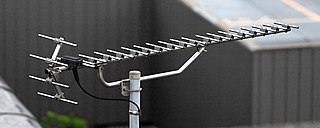
Ultra high frequency (UHF) is the ITU designation for radio frequencies in the range between 300 megahertz (MHz) and 3 gigahertz (GHz), also known as the decimetre band as the wavelengths range from one meter to one tenth of a meter. Radio waves with frequencies above the UHF band fall into the super-high frequency (SHF) or microwave frequency range. Lower frequency signals fall into the VHF or lower bands. UHF radio waves propagate mainly by line of sight; they are blocked by hills and large buildings although the transmission through building walls is strong enough for indoor reception. They are used for television broadcasting, cell phones, satellite communication including GPS, personal radio services including Wi-Fi and Bluetooth, walkie-talkies, cordless phones, satellite phones, and numerous other applications.
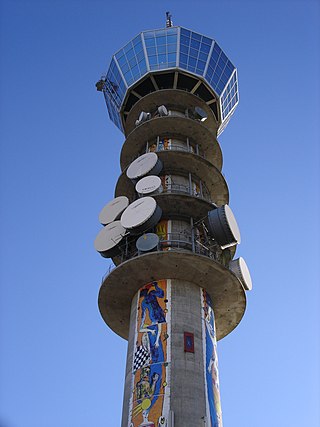
Radio broadcasting is the broadcasting of audio (sound), sometimes with related metadata, by radio waves to radio receivers belonging to a public audience. In terrestrial radio broadcasting the radio waves are broadcast by a land-based radio station, while in satellite radio the radio waves are broadcast by a satellite in Earth orbit. To receive the content the listener must have a broadcast radio receiver (radio). Stations are often affiliated with a radio network that provides content in a common radio format, either in broadcast syndication or simulcast, or both. The encoding of a radio broadcast depends on whether it uses an analog or digital signal. Analog radio broadcasts use one of two types of radio wave modulation: amplitude modulation for AM radio, or frequency modulation for FM radio. Newer, digital radio stations transmit in several different digital audio standards, such as DAB, HD radio, or DRM.
In-band on-channel (IBOC) is a hybrid method of transmitting digital radio and analog radio broadcast signals simultaneously on the same frequency. The name refers to the new digital signals being broadcast in the same AM or FM band (in-band), and associated with an existing radio channel (on-channel). By utilizing additional digital subcarriers or sidebands, digital information is multiplexed on existing signals, thus avoiding re-allocation of the broadcast bands.

Digital Radio Mondiale is a set of digital audio broadcasting technologies designed to work over the bands currently used for analogue radio broadcasting including AM broadcasting—particularly shortwave—and FM broadcasting. DRM is more spectrally efficient than AM and FM, allowing more stations, at higher quality, into a given amount of bandwidth, using xHE-AAC audio coding format. Various other MPEG-4 codecs and Opus are also compatible, but the standard now specifies xHE-AAC.
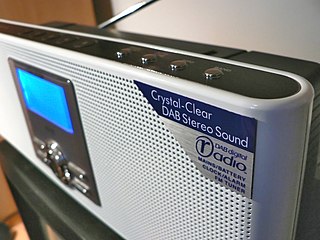
Digital radio is the use of digital technology to transmit or receive across the radio spectrum. Digital transmission by radio waves includes digital broadcasting, and especially digital audio radio services.
The Digibox is a device marketed by Sky UK in the UK and Ireland to enable home users to receive digital satellite television broadcasts from the Astra satellites at 28.2° east. An Internet service was also available through the device, similar in some ways to the American MSN TV, before being discontinued in 2015. The first Digiboxes shipped to consumers in October 1998 when Sky Digital was launched, and the hardware reference design has been relatively unchanged since then. Compared to other satellite receivers, they are severely restricted. As of 2020, Sky Digiboxes have become largely outmoded, superseded by Sky's latest-generation Sky Q boxes and Sky Glass televisions; the previous generation Sky+HD boxes are still in use, however.

HD Radio (HDR) is a trademark for an in-band on-channel (IBOC) digital radio broadcast technology. HD radio generally simulcasts an existing analog radio station in digital format with less noise and with additional text information. HD Radio is used primarily by AM and FM radio stations in the United States, U.S. Virgin Islands, Canada, Mexico and the Philippines, with a few implementations outside North America.
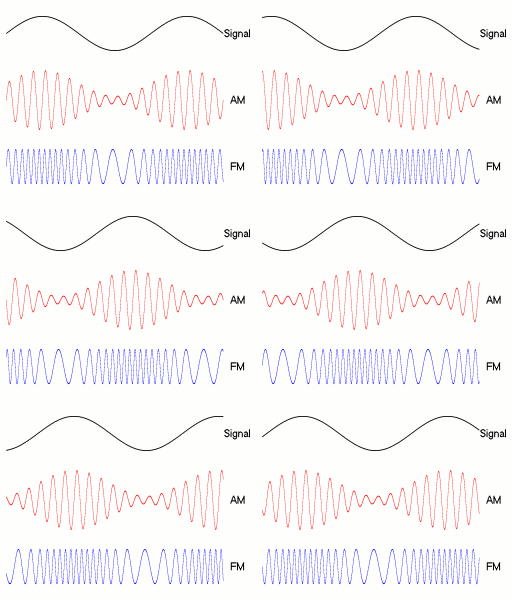
FM broadcasting is a method of radio broadcasting that uses frequency modulation (FM) of the radio broadcast carrier wave. Invented in 1933 by American engineer Edwin Armstrong, wide-band FM is used worldwide to transmit high-fidelity sound over broadcast radio. FM broadcasting offers higher fidelity—more accurate reproduction of the original program sound—than other broadcasting techniques, such as AM broadcasting. It is also less susceptible to common forms of interference, having less static and popping sounds than are often heard on AM. Therefore, FM is used for most broadcasts of music and general audio. FM radio stations use the very high frequency range of radio frequencies.

An amateur radio repeater is an electronic device that receives a weak or low-level amateur radio signal and retransmits it at a higher level or higher power, so that the signal can cover longer distances without degradation. Many repeaters are located on hilltops or on tall buildings as the higher location increases their coverage area, sometimes referred to as the radio horizon, or "footprint". Amateur radio repeaters are similar in concept to those used by public safety entities, businesses, government, military, and more. Amateur radio repeaters may even use commercially packaged repeater systems that have been adjusted to operate within amateur radio frequency bands, but more often amateur repeaters are assembled from receivers, transmitters, controllers, power supplies, antennas, and other components, from various sources.

Digital Radio in the Republic of Ireland is broadcast on a number of digital terrestrial, cable and internet platforms. Until the 31 March 2021, official broadcasts of the digital audio broadcasting standard were also available in the state by Raidió Teilifís Éireann (RTÉ) of their full compliment of radio services. From April 2021 until the summer of 2024, unlicensed, low powered DAB multiplexes operated in a small number of locations.

A wireless microphone, or cordless microphone, is a microphone without a physical cable connecting it directly to the sound recording or amplifying equipment with which it is associated. Also known as a radio microphone, it has a small, battery-powered radio transmitter in the microphone body, which transmits the audio signal from the microphone by radio waves to a nearby receiver unit, which recovers the audio. The other audio equipment is connected to the receiver unit by cable. In one type the transmitter is contained within the handheld microphone body. In another type the transmitter is contained within a separate unit called a "bodypack", usually clipped to the user's belt or concealed under their clothes. The bodypack is connected by wire to a "lavalier microphone" or "lav", a headset or earset microphone, or another wired microphone. Most bodypack designs also support a wired instrument connection. Wireless microphones are widely used in the entertainment industry, television broadcasting, and public speaking to allow public speakers, interviewers, performers, and entertainers to move about freely while using a microphone without requiring a cable attached to the microphone.

An audio/video receiver (AVR) or a stereo receiver is a consumer electronics component used in a home theater or hi-fi system. Its purpose is to receive audio and video signals from a number of sources, and to process them and provide power amplifiers to drive loudspeakers, and/or route the video to displays such as a television, monitor or video projector. Inputs may come from a TV, FM, or AM tuner, satellite receiver, DVD players, Blu-ray Disc players, VCRs or video game consoles, among others. The AVR source selection and settings such as volume, are typically set by a remote controller.
In the United Kingdom, the roll-out of digital radio has been proceeding since engineering test transmissions were started by the BBC in 1990 followed by a public launch in September 1995. The UK currently has one of the world's biggest digital radio networks, with about 500 transmitters, three national DAB ensembles, one regional DAB ensemble, 48 local DAB ensembles and an increasing number of small-scale DAB ensembles broadcasting over 250 commercial and 34 BBC radio stations across the UK. In London there are already more than 100 different digital stations available. In addition to DAB and DAB+, radio stations are also broadcast on digital television platform as well as internet radio in the UK. Digital radio ensemble operators and stations need a broadcasting licence from the UK's media regulator Ofcom to broadcast.
A communications satellite's transponder is the series of interconnected units that form a communications channel between the receiving and the transmitting antennas. It is mainly used in satellite communication to transfer the received signals.

Radio is the technology of communicating using radio waves. Radio waves are electromagnetic waves of frequency between 3 hertz (Hz) and 300 gigahertz (GHz). They are generated by an electronic device called a transmitter connected to an antenna which radiates oscillating electrical energy, often characterized as a wave. They can be received by other antennas connected to a radio receiver; this is the fundamental principle of radio communication. In addition to communication, radio is used for radar, radio navigation, remote control, remote sensing, and other applications.

Digital multimedia broadcasting (DMB) is a digital radio transmission technology developed in South Korea as part of the national IT project for sending multimedia such as TV, radio and datacasting to mobile devices such as mobile phones, laptops and GPS navigation systems. This technology, sometimes known as mobile TV, should not be confused with Digital Audio Broadcasting (DAB) which was developed as a research project for the European Union.
The 800 MHz frequency band is a portion of the electromagnetic spectrum, or frequency band, that encompasses 790–862 MHz.

