
A Geiger counter is an electronic instrument used for detecting and measuring ionizing radiation. It is widely used in applications such as radiation dosimetry, radiological protection, experimental physics and the nuclear industry.

X-ray fluorescence (XRF) is the emission of characteristic "secondary" X-rays from a material that has been excited by being bombarded with high-energy X-rays or gamma rays. The phenomenon is widely used for elemental analysis and chemical analysis, particularly in the investigation of metals, glass, ceramics and building materials, and for research in geochemistry, forensic science, archaeology and art objects such as paintings.

A scintillation counter is an instrument for detecting and measuring ionizing radiation by using the excitation effect of incident radiation on a scintillating material, and detecting the resultant light pulses.
In experimental and applied particle physics, nuclear physics, and nuclear engineering, a particle detector, also known as a radiation detector, is a device used to detect, track, and/or identify ionizing particles, such as those produced by nuclear decay, cosmic radiation, or reactions in a particle accelerator. Detectors can measure the particle energy and other attributes such as momentum, spin, charge, particle type, in addition to merely registering the presence of the particle.

Radioactive contamination, also called radiological pollution, is the deposition of, or presence of radioactive substances on surfaces or within solids, liquids, or gases, where their presence is unintended or undesirable.
The measurement of ionizing radiation is sometimes expressed as being a rate of counts per unit time as registered by a radiation monitoring instrument, for which counts per minute (cpm) and counts per second (cps) are commonly used quantities.
The ionization chamber is the simplest type of gaseous ionisation detector, and is widely used for the detection and measurement of many types of ionizing radiation, including X-rays, gamma rays, alpha particles and beta particles. Conventionally, the term "ionization chamber" refers exclusively to those detectors which collect all the charges created by direct ionization within the gas through the application of an electric field. It uses the discrete charges created by each interaction between the incident radiation and the gas to produce an output in the form of a small direct current. This means individual ionising events cannot be measured, so the energy of different types of radiation cannot be differentiated, but it gives a very good measurement of overall ionising effect.

The INTErnational Gamma-Ray Astrophysics Laboratory (INTEGRAL) is a space telescope for observing gamma rays of energies up to 8 MeV. It was launched by the European Space Agency (ESA) into Earth orbit in 2002, and is designed to provide imaging and spectroscopy of cosmic sources. In the MeV energy range, it is the most sensitive gamma ray observatory in space. It is sensitive to higher energy photons than X-ray instruments such as NuSTAR, the Neil Gehrels Swift Observatory, XMM-Newton, and lower than other gamma-ray instruments such Fermi and HESS.

Gamma-ray spectroscopy is the qualitative study of the energy spectra of gamma-ray sources, such as in the nuclear industry, geochemical investigation, and astrophysics. Gamma-ray spectrometry, on the other hand, is the method used to acquire a quantitative spectrum measurement.

Gaseous ionization detectors are radiation detection instruments used in particle physics to detect the presence of ionizing particles, and in radiation protection applications to measure ionizing radiation.

Neutron detection is the effective detection of neutrons entering a well-positioned detector. There are two key aspects to effective neutron detection: hardware and software. Detection hardware refers to the kind of neutron detector used and to the electronics used in the detection setup. Further, the hardware setup also defines key experimental parameters, such as source-detector distance, solid angle and detector shielding. Detection software consists of analysis tools that perform tasks such as graphical analysis to measure the number and energies of neutrons striking the detector.
Phoswich detectors were developed to detect low-intensity, low-energy gamma rays, X-rays, as well as alpha and beta particles efficiently in a higher-energy ambient background. Some detector designs can measure and separately identify all energies simultaneously.

SNOLAB is a Canadian underground science laboratory specializing in neutrino and dark matter physics. Located 2 km below the surface in Vale's Creighton nickel mine near Sudbury, Ontario, SNOLAB is an expansion of the existing facilities constructed for the original Sudbury Neutrino Observatory (SNO) solar neutrino experiment.

DEAP is a direct dark matter search experiment which uses liquid argon as a target material. DEAP utilizes background discrimination based on the characteristic scintillation pulse-shape of argon. A first-generation detector (DEAP-1) with a 7 kg target mass was operated at Queen's University to test the performance of pulse-shape discrimination at low recoil energies in liquid argon. DEAP-1 was then moved to SNOLAB, 2 km below Earth's surface, in October 2007 and collected data into 2011.
In health physics, whole-body counting refers to the measurement of radioactivity within the human body. The technique is primarily applicable to radioactive material that emits gamma rays. Alpha particle decays can also be detected indirectly by their coincident gamma radiation. In certain circumstances, beta emitters can be measured, but with degraded sensitivity. The instrument used is normally referred to as a whole body counter.
Nuclear MASINT is one of the six major subdisciplines generally accepted to make up Measurement and Signature Intelligence (MASINT), which covers measurement and characterization of information derived from nuclear radiation and other physical phenomena associated with nuclear weapons, reactors, processes, materials, devices, and facilities. Nuclear monitoring can be done remotely or during onsite inspections of nuclear facilities. Data exploitation results in characterization of nuclear weapons, reactors, and materials. A number of systems detect and monitor the world for nuclear explosions, as well as nuclear materials production.

Survey meters in radiation protection are hand-held ionising radiation measurement instruments used to check such as personnel, equipment and the environment for radioactive contamination and ambient radiation. The hand-held survey meter is probably the most familiar radiation measuring device owing to its wide and visible use.

Radiation Portal Monitors (RPMs) are passive radiation detection devices used for the screening of individuals, vehicles, cargo or other vectors for detection of illicit sources such as at borders or secure facilities. Fear of terrorist attacks with radiological weapons spurred RPM deployment for cargo scanning since 9/11, particularly in the United States.
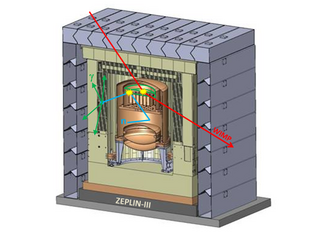
The ZEPLIN-III dark matter experiment attempted to detect galactic WIMPs using a 12 kg liquid xenon target. It operated from 2006 to 2011 at the Boulby Underground Laboratory in Loftus, North Yorkshire. This was the last in a series of xenon-based experiments in the ZEPLIN programme pursued originally by the UK Dark Matter Collaboration (UKDMC). The ZEPLIN-III project was led by Imperial College London and also included the Rutherford Appleton Laboratory and the University of Edinburgh in the UK, as well as LIP-Coimbra in Portugal and ITEP-Moscow in Russia. It ruled out cross-sections for elastic scattering of WIMPs off nucleons above 3.9 × 10⁻⁸ pb from the two science runs conducted at Boulby.
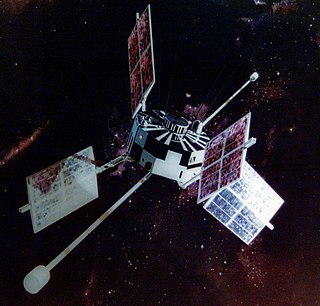
Explorer 34, was a NASA satellite launched as part of Explorer program. Explorer 34 as launched on 24 May 1967 from Vandenberg Air Force Base, California, with Thor-Delta E1 launch vehicle. Explorer 34 was the fifth satellite launched as part of the Interplanetary Monitoring Platform program, but was known as "IMP-4" because the preceding launch was more specifically part of the "Anchored IMP" sub-program. The spacecraft was put into space between the launches of Explorer 33 in 1966 and Explorer 35 in July 1967, but the next satellite to use Explorer 34's general design was Explorer 41, which flew in 1969.

