Snooker is a cue sport, that is played on a green baize-covered table with pockets in each of the four corners and in the middle of each of the long side cushions.
Contents

Snooker may also refer to:
Snooker is a cue sport, that is played on a green baize-covered table with pockets in each of the four corners and in the middle of each of the long side cushions.
Snooker may also refer to:


Cue sports are a wide variety of games of skill played with a cue, which is used to strike billiard balls and thereby cause them to move around a cloth-covered table bounded by elastic bumpers known as cushions. Cue sports are also collectively referred to as billiards, though this term has more specific connotations in some varieties of English.

Eight-ball is a discipline of pool played on a billiard table with six pockets, cue sticks, and sixteen billiard balls. The object balls include seven solid-colored balls numbered 1 through 7, seven striped balls numbered 9 through 15, and the black 8 ball. After the balls are scattered with a break shot, a player is assigned either the group of solid or striped balls once they have legally pocketed a ball from that group. The object of the game is to legally pocket the 8-ball in a "called" pocket, which can only be done after all of the balls from a player's assigned group have been cleared from the table.

Nine-ball is a discipline of the cue sport pool. The game's origins are traceable to the 1920s in the United States. It is played on a rectangular billiard table with pockets at each of the four corners and in the middle of each long side. Using a cue stick, players must strike the white cue ball to pocket nine colored billiard balls, hitting them in ascending numerical order. An individual game is won by the player pocketing the 9-ball. Matches are usually played as a race to a set number of racks, with the player who reaches the set number winning the match.

Snooker is a cue sport played on a rectangular billiards table covered with a green cloth called baize, with six pockets: one at each corner and one in the middle of each long side. First played by British Army officers stationed in India in the second half of the 19th century, the game is played with twenty-two balls, comprising a white cue ball, fifteen red balls and six other balls—a yellow, green, brown, blue, pink and black—collectively called 'the colours'. Using a snooker cue, the individual players or teams take turns to strike the cue ball to pot other balls in a predefined sequence, accumulating points for each successful pot and for each foul committed by the opposing player or team. An individual frame of snooker is won by the player who has scored the most points, and a snooker match ends when a player wins a predetermined number of frames.

English billiards, called simply billiards in the United Kingdom and in many former British colonies, is a cue sport that combines the aspects of carom billiards and pool. Two cue balls and a red object ball are used. Each player or team uses a different cue ball. It is played on a billiards table with the same dimensions as one used for snooker and points are scored for cannons and pocketing the balls.
Golf billiards is a pocket billiards game usually played for money. Unlike the majority of such games, it allows more than two people to play without compromises or rule changes. The game borrows from the outdoor game of golf, which is historically related to the cue sports. It is usually played on 10-foot or 12-foot snooker tables as their size and structure are more appropriate. In 2006 the Billiard Congress of America commented it was more popular than snooker in the United States.

Russian pyramid, also known as Russian billiards, is a form of billiards played on a large billiard table with narrow pockets. It is played across Russia and several former Soviet/Eastern Bloc countries. In the West, the game is known as pyramid billiards, or simply pyramid.

Pool is the name given to a series of cue sports played on a billiard table. The table has six pockets along the rails, into which balls are shot. Of the many different pool games, the most popular include: eight-ball, blackball, nine-ball, ten-ball, seven-ball, straight pool, one-pocket, and bank pool. Eight-ball is the most frequently played discipline of pool, and it is often thought of as synonymous with "pool".

Four-ball billiards or four-ball carom is a carom billiards game, played on a pocketless table with four billiard balls, usually two red and two white, one of the latter with a spot to distinguish it. Each player is assigned one of the white balls as a cue ball. A point is scored when a shooter's cue ball caroms on any two other balls in the same shot. Two points are scored when the shooter caroms on each of the three object balls in a single shot. A carom on only one ball results in no points, and ends the shooter's inning.
The following is a glossary of traditional English-language terms used in the three overarching cue sports disciplines: carom billiards referring to the various carom games played on a billiard table without pockets; pool, which denotes a host of games played on a table with six pockets; and snooker, played on a large pocket table, and which has a sport culture unto itself distinct from pool. There are also games such as English billiards that include aspects of multiple disciplines.

Five-pin billiards or simply five-pins or 5-pins, is today usually a carom billiards form of cue sport, though sometimes still played on a pocket table. In addition to the customary three balls of most carom games, it makes use of a set of five upright pins (skittles) arranged in a "+" pattern at the center of the table. The game is popular especially in Italy and Argentina, but also in some other parts of Latin America and Europe, with international, televised professional tournaments. It is sometimes referred to as Italian five-pins or Italian billiards, or as simply italiana. A variant of the game, goriziana or nine-pins, adds additional skittles to the formation. A related pocket game, with larger pins, is played in Scandinavia and is referred to in English as Danish pin billiards, with a Swedish variant that has some rules more similar to the Italian game.

Cue Club, or International Cue Club is a sports simulation video game developed by Bulldog Interactive and released for Microsoft Windows on 10 November 2000. It is a realistic interpretation of pool and snooker. The game was initially published by Midas Interactive, but is now distributed exclusively by Bulldog through the official Cue Club website.

Snooker is a cue sport that is played on a baize-covered snooker table with pockets in each of the four corners and in the middle of each of the long side cushions. It is played using a cue and snooker balls: one white cue ball, 15 red balls worth one point each, and six balls of different colours: yellow, green (3), brown (4), blue (5), pink (6), black (7). A player wins a frame of snooker by scoring more points than the opponent(s), using the cue ball to pot the red and coloured object balls. A player wins a match when they have achieved the best-of score from a pre-determined number of frames. The number of frames is always odd so as to prevent a tie or a draw.

The English-originating version of eight-ball pool, also known as English pool, English eight-ball, blackball, or simply reds and yellows, is a pool game played with sixteen balls on a small pool table with six pockets. It originated in the United Kingdom and is played in the Commonwealth countries such as Australia and South Africa. In the UK and Ireland it is usually called simply "pool".

Pool Revolution: Cue Sports is a sports simulation video game video game published by Hudson Soft for the Wii's WiiWare service. The game simulates a variety of cue sports.
Carom billiards and pool are two types of cue sports or billiards-family games, which as a general class are played with a stick called a cue which is used to strike billiard balls, moving them around a cloth-covered billiard table bounded by rubber cushions attached to the confining rails of the table.

Ground billiards is a modern term for a family of medieval European lawn games, the original names of which are mostly unknown, played with a long-handled mallet, wooden balls, a hoop, and an upright skittle or pin. The game, which cue-sports historians have called "the original game of billiards", developed into a variety of modern outdoor and indoor games and sports such as croquet, pool, snooker, and carom billiards. Its relationship to games played on larger fields, such as hockey, golf, and bat-and-ball games, is more speculative. As a broader classification, the term is sometimes applied to games dating back to classical antiquity that are attested via difficult-to-interpret ancient artworks and rare surviving gaming artifacts.

Cue Club 2 is a sports simulation video game developed by Bulldog Interactive. First released for Microsoft Windows on 4 July 2014, it is a realistic interpretation of pool and snooker, and is the sequel to Cue Club. The game has received continual updates since launch, including an online multiplayer mode, the addition of a first-person camera with 3-dimensional (3D) tables and bars, a wide selection of larger table sizes, and an expanded range of achievements.
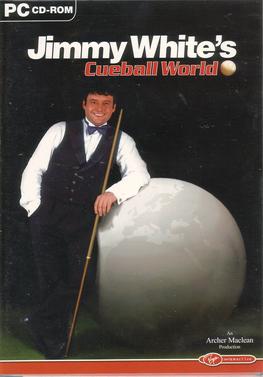
Jimmy White's Cueball World is a sports simulation video game published by Virgin Interactive as the sequel to Jimmy White's 2: Cueball, itself a sequel to Jimmy White's 'Whirlwind' Snooker. The development team once again being led by Archer Maclean, who designed the other two Jimmy White titles. The game was released in December 2001 in Europe, with a North American release was planned to be released a year later by Titus Software under a budget range using the Virgin Interactive brand name. PlayStation 2 and Xbox versions were planned, but were later cancelled.

Steve Davis World Snooker is a sports simulation video game developed by Binary Design and published by CDS Software. It simulates different types of cue sports, specifically snooker, pool and billiards. Released under licence from 6-time Snooker World Champion, Steve Davis, it is a sequel to their 1984 game Steve Davis Snooker.