
Marstal is a town in southern Denmark, located in Ærø Municipality on the island of Ærø. Marstal has a population of 2,077 and is the largest town on Ærø. It was the municipal seat of the now abolished Marstal Municipality.

Bowen Island, British Columbia, is an island municipality that is part of Metro Vancouver, and within the jurisdiction of the Islands Trust. Located in Howe Sound, it is approximately 6 kilometres (3.7 mi) wide by 12 kilometres (7.5 mi) long, and at its closest point is about 3 kilometres (1.9 mi) west of the mainland. There is regular ferry service from Horseshoe Bay provided by BC Ferries, and semi-regular water taxi services. The population of 4,256 is supplemented in the summer by about 1,500 visitors. It has a land area of 50.12 km2 (19.35 sq mi).
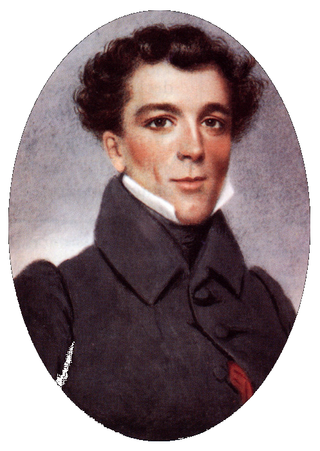
Robert Bennet Forbes, was an American sea captain, China merchant and ship owner. He was active in ship construction, maritime safety, the opium trade, and charitable activities, including food aid to Ireland, which became known as America's first major disaster relief effort.

New Brighton is a neighborhood located on the North Shore of Staten Island in New York City. The neighborhood comprises an older industrial and residential harbor front area along the Kill Van Kull west of St. George. New Brighton is bounded by Kill Van Kull on the north, Jersey Street on the east, Brighton and Castleton Avenues to the south, and Lafayette Avenue and Snug Harbor Cultural Center to the west. It is adjacent to St. George to the east, Tompkinsville to the south, and West New Brighton to the west.

The Marine Hospital Service was an organization of Marine Hospitals dedicated to the care of ill and disabled seamen in the United States Merchant Marine, the U.S. Coast Guard and other federal beneficiaries. The Marine Hospital Service evolved into the U.S. Public Health Service.

The term North Shore is frequently applied to a series of neighborhoods within the New York City borough of Staten Island.
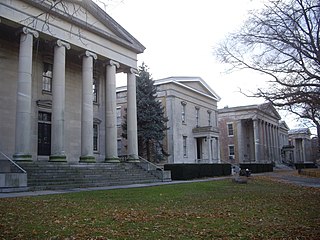
Sailors' Snug Harbor, also known as Sailors Snug Harbor and informally as Snug Harbor, is a collection of architecturally significant 19th-century buildings on Staten Island, New York City. The buildings are set in an 83-acre (34 ha) park along the Kill Van Kull in New Brighton, on the North Shore of Staten Island. Some of the buildings and the grounds are used by arts organizations under the umbrella of the Snug Harbor Cultural Center and Botanical Garden.

Livingston is a name sometimes applied to the northeastern portion of West Brighton, a neighborhood located on the North Shore of the New York City borough of Staten Island.

Washington Mews is a private gated street in Manhattan, New York City between Fifth Avenue and University Place just north of Washington Square Park. Along with MacDougal Alley and Stuyvesant Street, it was originally part of a Lenape trail which connected the Hudson and East Rivers, and was first developed as a mews that serviced horses from homes in the area. Since the 1950s the former stables have served as housing, offices and other facilities for New York University.
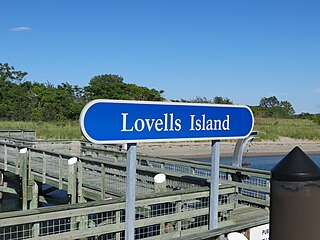
Lovells Island, or Lovell's Island, is a 62-acre (250,000 m2) island in the Boston Harbor Islands National Recreation Area, in Massachusetts. The island is across The Narrows from Georges Island and some 7 miles (11 km) offshore of downtown Boston. It is named after Captain William Lovell, who was an early settler of nearby Dorchester. The island is known as the site of several shipwrecks, including the 74-gun French warship Magnifique in 1782.

Yorke Bay is a bay on East Falkland in the Falkland Islands. It is located half a mile north of Port Stanley Airport, four miles to the northeast of the capital city of Stanley, on a peninsula connected to the mainland by the Boxer Bridge and a narrow isthmus known as "The Neck". Gypsy Cove is a smaller bay located on the west side of Yorke Bay. Most cruise ships pass Yorke Bay and Gypsy Cove on the way to dock in Stanley Harbour. It faces northwards into Port William, with Canopus Hill to the south, and is known internationally as a breeding site for the threatened Magellanic penguin.

The Staten Island Children's Museum is a children's museum on the grounds of Sailors' Snug Harbor on Staten Island, New York. The museum opened in 1976 following community and government support for the project. The museum stresses a hands-on interactive approach to its exhibits A large metal sculpture of a Praying Mantis, named Francis the Praying Mantis, is located in front of the museum.
Robert or Bob Randall may refer to:
Sailors' Snug Harbor of Boston was established in 1852 as a retirement home for sailors. It was similar to the much larger Sailors' Snug Harbor on Staten Island. Today, it is a nonprofit organization funding charitable initiatives in fishing communities and for the elderly in eastern Massachusetts.

The Sailors' Snug Harbor station is a former station on the abandoned North Shore Branch of the Staten Island Railway. It had two tracks and two side platforms. Located in the Livingston section of Staten Island north of Richmond Terrace, the station was approximately 1.2 miles (1.9 km) from Saint George Terminal. It is at the northernmost end of the Snug Harbor Cultural Center and Botanical Garden.
A seamen's haven is a social welfare organization for sailors, often operated by Christian churches or missionaries. Havens were most prominent in North American port cities in the 19th and 20th centuries. They were widely used during the Great Depression and declined in popularity afterward. Some provide comprehensive social services such as food and shelter, while others are mainly social organizations.

Robert Richard Randall was a sea captain in life, and, after his death in New York City on June 5, 1801, an important philanthropist, caring for thousands of retired seafarers.

The Boston Seaman's Friend Society or Seafarer's Friend is a charitable religious organization based in Boston, Massachusetts. It aims to improve the welfare of mariners.
Harbor or Harbour station may refer to:

The Snug Harbor Music Hall on the grounds of Sailors' Snug Harbor in the New Brighton neighborhood of Staten Island is a 686-seat Greek Revival auditorium that opened in July 1892, making it the second-oldest music hall in New York City. It was designed by the English immigrant architect Robert W. Gibson. Its inaugural performance was the cantata, "The Rose Maiden." In attendance were around 600 residents in plain wooden seats and 300 trustees with their guests in upholstered balcony seats. Entertainment in the decades that followed included the Georgia Minstrels and the Boston Ladies Schubert Quartet. It added film screenings in 1911 and sound projection in 1930. The building closed sometime in the 1970s when the campus faced a lack of funds and a decline in residents.
