
Political ecology is the study of the relationships between political, economic and social factors with environmental issues and changes. Political ecology differs from apolitical ecological studies by politicizing environmental issues and phenomena.
Green anarchism, also known as ecological anarchism or eco-anarchism, is an anarchist school of thought that focuses on ecology and environmental issues. It is an anti-capitalist and anti-authoritarian form of radical environmentalism, which emphasises social organization, freedom and self-fulfillment.

Murray Bookchin was an American social theorist, author, orator, historian, and political philosopher. Influenced by G. W. F. Hegel, Karl Marx, Peter Kropotkin, he was a pioneer in the environmental movement. Bookchin formulated and developed the theory of social ecology and urban planning within anarchist, libertarian socialist, and ecological thought. He was the author of two dozen books covering topics in politics, philosophy, history, urban affairs, and social ecology. Among the most important were Our Synthetic Environment (1962), Post-Scarcity Anarchism (1971), The Ecology of Freedom (1982), and Urbanization Without Cities (1987). In the late 1990s, he became disenchanted with what he saw as an increasingly apolitical "lifestylism" of the contemporary anarchist movement, stopped referring to himself as an anarchist, and founded his own libertarian socialist ideology called "communalism", which seeks to reconcile and expand Marxist, syndicalist, and anarchist thought.
Ecosophy or ecophilosophy is a philosophy of ecological harmony or equilibrium. The term was coined by the French post-structuralist philosopher and psychoanalyst Félix Guattari and the Norwegian father of deep ecology, Arne Næss.
The Institute for Social Ecology (ISE) is an educational institution in Plainfield, Vermont dedicated to the study of social ecology, "an interdisciplinary field drawing on philosophy, political and social theory, anthropology, history, economics, the natural sciences, and feminism." Founded in 1974, ISE offered some of the first courses in the country on urbanism and ecology, radical technology, ecology and feminism, activist art and community; it "won an international reputation" for its courses in social theory, eco-philosophy and alternative technologies.
Ecological anthropology is a sub-field of anthropology and is defined as the "study of cultural adaptations to environments". The sub-field is also defined as, "the study of relationships between a population of humans and their biophysical environment". The focus of its research concerns "how cultural beliefs and practices helped human populations adapt to their environments, and how people used elements of their culture to maintain their ecosystems". Ecological anthropology developed from the approach of cultural ecology, and it provided a conceptual framework more suitable for scientific inquiry than the cultural ecology approach. Research pursued under this approach aims to study a wide range of human responses to environmental problems.
Ecocentrism is a term used by environmental philosophers and ecologists to denote a nature-centered, as opposed to human-centered, system of values. The justification for ecocentrism usually consists in an ontological belief and subsequent ethical claim. The ontological belief denies that there are any existential divisions between human and non-human nature sufficient to claim that humans are either (a) the sole bearers of intrinsic value or (b) possess greater intrinsic value than non-human nature. Thus the subsequent ethical claim is for an equality of intrinsic value across human and non-human nature, or biospherical egalitarianism.

Janet Biehl is an American author, copyeditor, translator, and artist. She authored several books and articles associated with social ecology, the body of ideas developed and publicized by Murray Bookchin. Formerly an advocate of his antistatist political program, she broke with it publicly in 2011 and now identifies as a progressive Democrat.

Environmental philosophy is the branch of philosophy that is concerned with the natural environment and humans' place within it. It asks crucial questions about human environmental relations such as "What do we mean when we talk about nature?" "What is the value of the natural, that is non-human environment to us, or in itself?" "How should we respond to environmental challenges such as environmental degradation, pollution and climate change?" "How can we best understand the relationship between the natural world and human technology and development?" and "What is our place in the natural world?" Environmental philosophy includes environmental ethics, environmental aesthetics, ecofeminism, environmental hermeneutics, and environmental theology. Some of the main areas of interest for environmental philosophers are:
Ethnoecology is the scientific study of how different groups of people living in different locations understand the ecosystems around them, and their relationships with surrounding environments.
The following outline is provided as an overview of and topical guide to ecology:
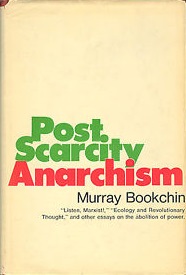
Post-Scarcity Anarchism is a collection of essays by Murray Bookchin, first published in 1971 by Ramparts Press. In it, Bookchin outlines the possible form anarchism might take under conditions of post-scarcity. One of Bookchin's major works, its author's radical thesis provoked controversy for being utopian in its faith in the liberatory potential of technology.
Deep ecology is an environmental philosophy that promotes the inherent worth of all living beings regardless of their instrumental utility to human needs, and the restructuring of modern human societies in accordance with such ideas.
A social-ecological system consists of 'a bio-geo-physical' unit and its associated social actors and institutions. Social-ecological systems are complex and adaptive and delimited by spatial or functional boundaries surrounding particular ecosystems and their context problems.
Eco-socialism is an ideology merging aspects of socialism with that of green politics, ecology and alter-globalization or anti-globalization. Eco-socialists generally believe that the expansion of the capitalist system is the cause of social exclusion, poverty, war and environmental degradation through globalization and imperialism, under the supervision of repressive states and transnational structures.

The Ecology of Freedom: The Emergence and Dissolution of Hierarchy is a 1982 book by the American libertarian socialist and ecologist Murray Bookchin, in which the author describes his concept of social ecology, the idea that human social problems cause ecological problems and can be solved only by reorganizing society along ecological and ethical lines. The book is considered Bookchin's magnum opus, but it has also been criticized as utopian.
Social ecology studies relationships between people and their environment, often the interdependence of people, collectives and institutions. Evolving out of biological ecology, human ecology, systems theory and ecological psychology, social ecology takes a “broad, interdisciplinary perspective that gives greater attention to the social, psychological, institutional, and cultural contexts of people-environment relations than did earlier versions of human ecology.” The concept has been employed to study a diverse array of social problems and policies within the behavioural and social sciences.
Queer ecology is the endeavor to understand nature, biology, and sexuality in the light of queer theory, thus rejecting the presumption that heterosexuality and cisgenderedness constitute any objective standard. It draws from science studies, ecofeminism, environmental justice, and queer geography. These perspectives break apart various "dualisms" that exist within human understandings of nature and culture.
This is a list of works by Murray Bookchin (1921–2006). For a more complete list, please see the Bookchin bibliography compiled by Janet Biehl.
Social ecology is the concept of how people interact with their surroundings, how they respond to it, and how these interactions impact society and the environment at large. Think about conventional ecological studies, where students investigate how various natural processes must interact to form the world's ecosystems.
