Related Research Articles

A militia is generally an army or some other fighting organization of non-professional or part-time soldiers; citizens of a country, or subjects of a state, who may perform military service during a time of need, as opposed to a professional force of regular, full-time military personnel; or, historically, to members of a warrior-nobility class. When acting independently, militias are generally unable to hold ground against regular forces; militias commonly support regular troops by skirmishing, holding fortifications, or conducting irregular warfare, instead of undertaking offensive campaigns by themselves. Local civilian laws often limit militias to serve only in their home region, and to serve only for a limited time; this further reduces their use in long military campaigns. Militias may also, however, serve as a pool of available manpower for regular forces to draw from, particularly in emergencies.

The Schutzstaffel was a major paramilitary organisation under Adolf Hitler and the Nazi Party in Nazi Germany, and later throughout German-occupied Europe during World War II.

Vidkun Abraham Lauritz Jonssøn Quisling was a Norwegian military officer, politician and Nazi collaborator who nominally headed the government of Norway during the country's occupation by Nazi Germany during World War II.

The Norwegian resistance to the occupation of Norway by Nazi Germany began after Operation Weserübung in 1940 and ended in 1945. It took several forms:

The Centre Party, formerly the Farmer's Party, is an agrarian political party in Norway.
Auxiliaries are support personnel that assist the military or police but are organised differently from regular forces. Auxiliary may be military volunteers undertaking support functions or performing certain duties such as garrison troops, usually on a part-time basis. Unlike a military reserve force, an auxiliary force does not necessarily have the same degree of training or ranking structure as regular soldiers, and it may or may not be integrated into a fighting force. Some auxiliaries, however, are militias composed of former active duty military personnel and actually have better training and combat experience than their regular counterparts.
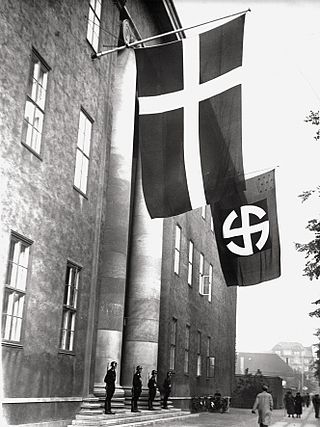
The Germanic SS was the collective name given to paramilitary and political organisations established in parts of German-occupied Europe between 1939 and 1945 under the auspices of the Schutzstaffel (SS). The units were modeled on the Allgemeine SS in Nazi Germany and established in Belgium, Denmark, the Netherlands, and Norway—population groups who were considered to be especially "racially suitable" by the Nazis. They typically served as local security police augmenting German units of the Gestapo, Sicherheitsdienst (SD), and other departments of the German Reich Security Main Office (RSHA), rendering them culpable for their participation in Nazi atrocities.
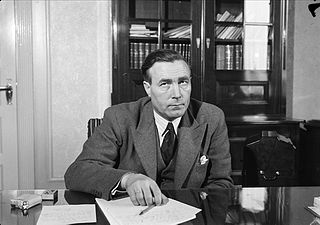
Olav Meisdalshagen was a Norwegian politician for the Labour Party best known for serving as the Norwegian Minister of Finance from December 1947 to November 1951 and as the Norwegian Minister of Agriculture from January 1955 to May 1956. He was also a Member of Parliament for a long time, being elected for the first time in parliamentary election of 1936 and serving until his death, except for the period between 1940 and 1945 when the Parliament of Norway was de facto defunct due to the occupation of Norway by Nazi Germany. His death in 1959 came halfway through his fifth term in Parliament, and shortly after a parliamentary speech.

Bengal Volunteers Corps was an underground revolutionary group against the British rule of India. The group was functional from its inception in 1928 to the Indian independence.

The Slovene Home Guard was a Slovene anti-Partisan collaborationist militia that operated during the 1943–1945 German occupation of the formerly Italian-annexed Slovene Province of Ljubljana. The Guard consisted of former Village Sentries, part of Italian-sponsored Anti-Communist Volunteer Militia, re-organized under Nazi command after the Italian Armistice of September 1943.
The Free-minded Liberal Party was a political party in Norway founded in 1909 by the conservative-liberal faction of the Liberal Party. The party cooperated closely with the Conservative Party and participated in several short-lived governments, including two headed by Free-minded Prime Ministers. In the 1930s the party changed its name to the Free-minded People's Party and initiated cooperation with nationalist groups. The party contested its last election in 1936, and was not reorganised in 1945.
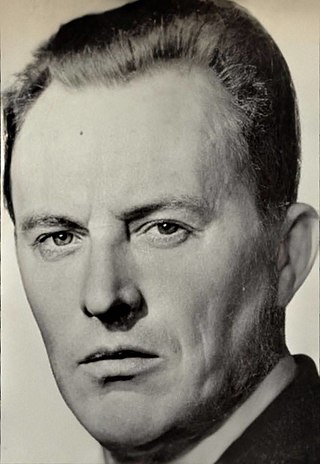
Asbjørn Edvin Sunde was a Norwegian politician for the Communist Party of Norway, communist partisan during the Spanish Civil War, saboteur against the Nazi occupation of Norway during the Second World War, and a convicted Soviet spy. During the Second World War, from 1941 to 1944, Sunde's group, the Osvald Group, carried out approximately 39 acts of sabotage and assassination against the German occupation forces and Norwegian collaborators. In 1954 he was convicted by Eidsivating Court of Appeal of treason and espionage in favour of the Soviet Union, and sentenced to eight years in prison. He was released from prison in 1959 after serving two thirds of his sentence. He was expelled from the Communist Party of Norway in 1970.
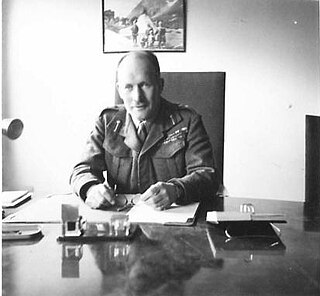
General Sir Augustus Francis Andrew Nicol Thorne, was a senior British Army officer who served in the First and Second World Wars, where he commanded the 48th Infantry Division during the Battle of France in mid-1940.

The Quisling regime, or Quisling government are common names used to refer to the fascist collaboration government led by Vidkun Quisling in German-occupied Norway during the Second World War. The official name of the regime from 1 February 1942 until its dissolution in May 1945 was Den nasjonale regjering. Actual executive power was retained by the Reichskommissariat Norwegen, headed by Josef Terboven.
Aake Anker Ording was a Norwegian civil servant and politician for Mot Dag and the Labour Party.
Roald Rachlew Dysthe was a Norwegian businessperson and acquitted Nazi collaborator.

Hirden was a uniformed paramilitary organisation during the occupation of Norway by Nazi Germany, modelled the same way as the German Sturmabteilungen.
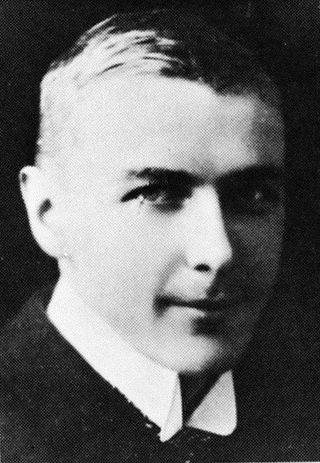
Sverre Krogh was a Norwegian actuary, newspaper editor and politician for the Labour and Communist Labour parties. He later became a Nazi, working for Norwegian and German Nazis during the Second World War.
The Menstad conflict or "The Menstad battle" was a Norwegian policing and political débâcle on 8 June 1931 at Norsk Hydro's Menstad plant, near Skien in the Norwegian province of Telemark.
Vanguardism, in Leninist struggle, is a strategy where the most class-conscious members of the working-class, known as the revolutionary vanguard, lead institutions to advance communist goals.
References
- 1 2 3 4 Joenniemi, Pertti (2006). The changing face of European conscription. Ashgate. p. 103. ISBN 978-0-7546-4410-1.
- 1 2 3 4 5 6 "Samfundsvernet". Store norske leksikon (in Norwegian). 8 May 2011.
- 1 2 3 Dahl, Hans Fredrik (1999). Quisling: a study in treachery. Cambridge University. p. 70. ISBN 978-0-521-49697-1.
- ↑ Thompson, David G. (2004). The Norwegian armed forces and defense policy, 1905-1955. Edwin Mellen. p. 7. ISBN 978-0-7734-6422-3.
- 1 2 3 Hansen, Svein Olav; Bakkerud, Audun; Hagen, Hans-Jørgen (2008). Mennesker i tid 2 : verden og Norge etter 1750. Cappelen Damm. p. 360. ISBN 978-82-02-27686-7.
- ↑ Kunkeler, Nathaniël (2023). "Counter-Revolutionary Strikebreaking in Interwar Europe, 1918–1929: The Role of Norway, Christopher Fougner, and Samfundshjelpen". Scandinavian Journal of History. 49: 69–91. doi: 10.1080/03468755.2023.2221245 . hdl: 10852/109256 . ISSN 0346-8755.
- ↑ McBride, William M.; Reed, Eric P. (1998). New interpretations in naval history. Naval Institute. p. 148. ISBN 978-1-55750-648-1.
- ↑ "Samfundsvernet". Caplex (in Norwegian). 8 May 2011.