
Korçë is the eighth most populous city of the Republic of Albania and the seat of Korçë County and Korçë Municipality. The total population is 75,994, in a total area of 806 km2 (311 sq mi). It stands on a plateau some 850 m (2,789 ft) above sea level, surrounded by the Morava Mountains.

Alice Neel was an American visual artist, who was known for her portraits depicting friends, family, lovers, poets, artists, and strangers. Her career spanned from the 1920s to 1980s. Her paintings have an expressionistic use of line and color, psychological acumen, and emotional intensity. She pursued a career as a figurative painter during a period when abstraction was favored, and she did not begin to gain critical praise for her work until the 1960s.

Nikoll Idromeno, better known as Kolë Idromeno, was an Albanian painter, sculptor, architect, photographer, cinematographer, composer and engineer during the Albanian Renaissance in the nineteenth century. He is widely regarded as a precursor of both realism and landscape art in Albania.

Vangjush Mio was an Albanian impressionist painter. He was the brother of the Albanian film director and actor Sokrat Mio.

The Athens School of Fine Arts, is Greece's premier Art school whose main objective is to develop the artistic talents of its students.
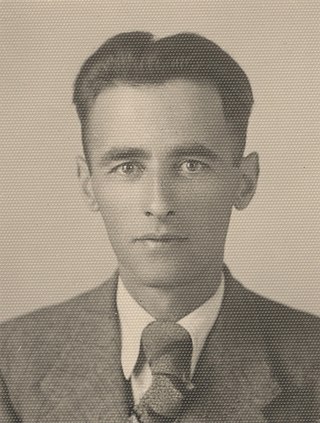
Abdurrahim Buza was an Albanian painter.
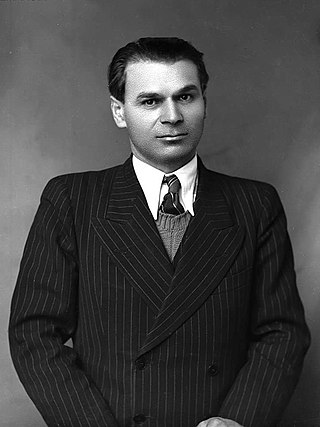
Llazar Sotir Gusho, commonly known by the pen name Lasgush Poradeci, was an Albanian philologist, poet, translator, writer and pioneer of modern Albanian literature. He is regarded as one of the most influential Albanian writers of the 20th century whose works are directly connected with Romanticism and Realism.

David Selenica, also commonly known as Selenicasi, was an Albanian Orthodox icon and fresco painter of the Post-Byzantine period in the seventeenth century. He is regarded as one of the most prominent figures of medieval Albanian art besides Onufri and Kostandin Shpataraku.

Gjergj Qiriazi was an Albanian patriot, author, educator, translator, Protestant Bible distributor, organizer of the First Congress of Monastir (1908), and activist of the Albanian National Awakening.
Laprakë is a neighbourhood of Tirana, Albania, located west of the main centre. It is mainly a residential district, but also contains the Tirana Military Hospital, the Albanian Mobile Communications building, the ProCredit Bank building and several other high-rise buildings, a football pitch, and a petrol station.
Andrea Kushi (1884–1959) was an Albanian painter. He was one of the most important representatives of the elder generation of Albanian painters.
Nexhmedin Zajmi was an Albanian painter and sculptor.
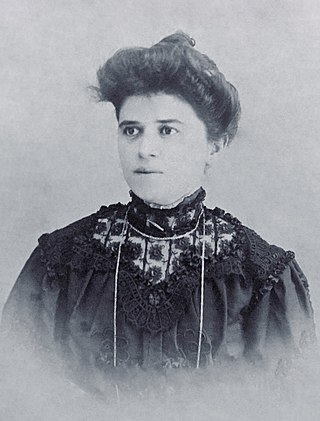
Sevasti Qiriazi-Dako was an Albanian patriot, educator, Protestant missionary, author, pioneer of Albanian female education, and activist of the Albanian National Awakening.

The Queen Mother Pedagogical Institute, was a women's pedagogical high school, created in 1933 in Tirana, Albania.

Marigo Posio was one of the most distinguished Albanian women, an activist of the Albanian National Awakening and Independence Movement, and consolidating the social status of Albanian women. She is mostly remembered for sewing the flag raised by Ismail Qemali during the Albanian Declaration of Independence in Vlorë on 28 November 1912.

Lola GjokaAleksi was an Albanian pianist during the period of the Communist regime.

Laura Coombs Hills (1859–1952) was an American artist and illustrator who specialized in watercolor and pastel still life paintings, especially of flowers, and miniature portrait paintings on ivory. She became the first miniature painter elected to the Society of American Artists, and she was a founder of the American Society of Miniature Painters. She also worked as a designer and illustrated children's books for authors such as Kate Douglas Wiggin and Anna M. Pratt.
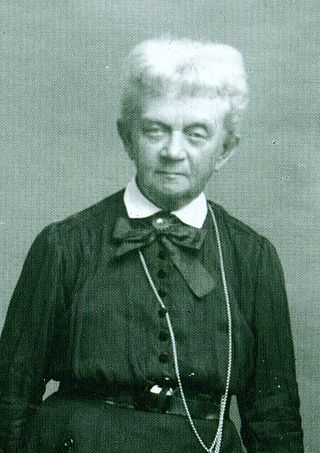
Caroline Emilie Mundt was a Danish painter, known for her portraits of children.

Androniqi Zengo Antoniu was an Albanian painter. She is considered to the first professional woman painter from Albania, along with her sister Sofia Zengo Papadhimitri, and with Vangjush Mijo is credited with the introduction of impressionism to the country.

Zhaneta Andrea was an Albanian archeologist and prehistorian. She has been described as an "emblem of Albanian archaeology".
