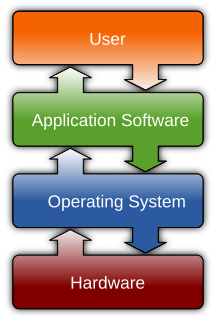
Computer software, or simply software, is a collection of data or computer instructions that tell the computer how to work. This is in contrast to physical hardware, from which the system is built and actually performs the work. In computer science and software engineering, computer software is all information processed by computer systems, programs and data. Computer software includes computer programs, libraries and related non-executable data, such as online documentation or digital media. Computer hardware and software require each other and neither can be realistically used on its own.

A computer program is a collection of instructions that can be executed by a computer to perform a specific task.

An operating system (OS) is system software that manages computer hardware, software resources, and provides common services for computer programs.

A computer programmer, sometimes called a software developer, a programmer or more recently a coder, is a person who creates computer software. The term computer programmer can refer to a specialist in one area of computers, or to a generalist who writes code for many kinds of software.
Software engineering is the systematic application of engineering approaches to the development of software. Software engineering is a computing discipline.
Shareware is a type of proprietary software which is initially provided free of charge to users, who are allowed and encouraged to make and share copies of the program. Shareware is often offered as a download from a website or on a compact disc included with a magazine. Shareware differs from freeware, which is software distributed at no cost to the user but without source code being made available; and open-source software, in which the source code is freely available for anyone to inspect and alter.
In computing, source code is any collection of code, with or without comments, written using a human-readable programming language, usually as plain text. The source code of a program is specially designed to facilitate the work of computer programmers, who specify the actions to be performed by a computer mostly by writing source code. The source code is often transformed by an assembler or compiler into binary machine code that can be executed by the computer. The machine code might then be stored for execution at a later time. Alternatively, source code may be interpreted and thus immediately executed.
Software testing is an investigation conducted to provide stakeholders with information about the quality of the software product or service under test. Software testing can also provide an objective, independent view of the software to allow the business to appreciate and understand the risks of software implementation. Test techniques include the process of executing a program or application with the intent of finding software bugs, and verifying that the software product is fit for use.

An embedded system is a computer system—a combination of a computer processor, computer memory, and input/output peripheral devices—that has a dedicated function within a larger mechanical or electrical system. It is embedded as part of a complete device often including electrical or electronic hardware and mechanical parts. Because an embedded system typically controls physical operations of the machine that it is embedded within, it often has real-time computing constraints. Embedded systems control many devices in common use today. Ninety-eight percent of all microprocessors manufactured are used in embedded systems.

A software release life cycle is the sum of the stages of development and maturity for a piece of computer software. Cycles range from its initial development to its eventual release, and include updated versions of the released version to help improve software or fix software bugs still present in the software.
Software development is the process of conceiving, specifying, designing, programming, documenting, testing, and bug fixing involved in creating and maintaining applications, frameworks, or other software components. Software development is a process of writing and maintaining the source code, but in a broader sense, it includes all that is involved between the conception of the desired software through to the final manifestation of the software, sometimes in a planned and structured process. Therefore, software development may include research, new development, prototyping, modification, reuse, re-engineering, maintenance, or any other activities that result in software products.

Open-source software (OSS) is a type of computer software in which source code is released under a license in which the copyright holder grants users the rights to use, study, change, and distribute the software to anyone and for any purpose. Open-source software may be developed in a collaborative public manner. Open-source software is a prominent example of open collaboration.

Application software is a program or group of programs designed for end users. Examples of an application include a word processor, a spreadsheet, an accounting application, a web browser, an email client, a media player, a file viewer, simulators, a console game or a photo editor. The collective noun application software refers to all applications collectively. This contrasts with system software, which is mainly involved with running the computer.
In software development, agile practices approach discovering requirements and developing solutions through the collaborative effort of self-organizing and cross-functional teams and their customer(s)/end user(s). It advocates adaptive planning, evolutionary development, early delivery, and continual improvement, and it encourages flexible responses to change.
A software license is a legal instrument governing the use or redistribution of software. Under United States copyright law, all software is copyright protected, in both source code and object code forms, unless that software was developed by the United States Government, in which case it cannot be copyrighted. Authors of copyrighted software can donate their software to the public domain, in which case it is also not covered by copyright and, as a result, cannot be licensed.
Free and open-source software (FOSS) is software that can be classified as both free software and open-source software. That is, anyone is freely licensed to use, copy, study, and change the software in any way, and the source code is openly shared so that people are encouraged to voluntarily improve the design of the software. This is in contrast to proprietary software, where the software is under restrictive copyright licensing and the source code is usually hidden from the users.
Software as a service is a software licensing and delivery model in which software is licensed on a subscription basis and is centrally hosted. It is sometimes referred to as "on-demand software", and was formerly referred to as "software plus services" by Microsoft.
Proprietary software, also known as non-free software, or closed-source software, is computer software for which the software's publisher or another person retains intellectual property rights—usually copyright of the source code, but sometimes patent rights.

The GNU General Public License is a series of widely used free software licenses that guarantee end users the freedom to run, study, share, and modify the software. The licenses were originally written by Richard Stallman, former head of the Free Software Foundation (FSF), for the GNU Project, and grant the recipients of a computer program the rights of the Free Software Definition. The GPL series are all copyleft licenses, which means that any derivative work must be distributed under the same or equivalent license terms. This is in distinction to permissive software licenses, of which the BSD licenses and the MIT License are widely used, less restrictive examples. GPL was the first copyleft license for general use.
Productivity software is application software used for producing information. Its names arose from the fact that it increases productivity, especially of individual office workers, from typists to knowledge workers, although its scope is now wider than that. Office suites, which brought word processing, spreadsheet, and relational database programs to the desktop in the 1980s, are the core example of productivity software. They revolutionized the office with the magnitude of the productivity increase they brought as compared with the pre-1980s office environments of typewriters, paper filing, and handwritten lists and ledgers. In the United States, some 78% of "middle-skill" occupations now require the use of productivity software. In the 2010s, productivity software has become even more consumerized than it already was, as computing becomes ever more integrated into daily personal life.


