Related Research Articles

The Songhay, Songhai or Ayneha languages are a group of closely related languages/dialects centred on the middle stretches of the Niger River in the West African countries of Mali, Niger, Benin, Burkina Faso and Nigeria. In particular, they are spoken in the cities of Timbuktu, Djenné, Niamey and Gao. They have been widely used as a lingua franca in that region ever since the era of the Songhai Empire. In Mali, the government has officially adopted the dialect of Gao as the dialect to be used as a medium of primary education.

The Zaghai Empire was a state located in the western part of the Sahel during the 15th and 16th centuries. At its peak, it was one of the largest African empires in history. The state is known by its historiographical name, derived from its largest ethnic group and ruling elite, the Songhai people. Sonni Ali established Gao as the empire's capital, although a Songhai state had existed in and around Gao since the 11th century. Other important cities in the kingdom were Timbuktu and Djenné, where urban-centred trade flourished; they were conquered in 1468 and 1475, respectively. Initially, the Songhai Empire was ruled by the Sonni dynasty, but it was later replaced by the Askia dynasty (1493–1901).

The Songhai people are an ethnolinguistic group in West Africa who speak the various Songhai languages. Their history and lingua franca is linked to the Songhai Empire which dominated the western Sahel in the 15th and 16th century. Predominantly adherents of Islam, the Songhai are primarily located in Niger and Mali within the Western Sudanic region. Historically, the term "Songhai" did not denote an ethnic or linguistic identity but referred to the ruling caste of the Songhay Empire known as the Songhaiborai. However, the correct term used to refer to this group of people collectively by the natives is "Ayneha". Although some Speakers in Mali have also adopted the name Songhay as an ethnic designation, other Songhay-speaking groups identify themselves by other ethnic terms such as Zarma or Isawaghen. The dialect of Koyraboro Senni spoken in Gao is unintelligible to speakers of the Zarma dialect of Niger, according to at least one report. The Songhay languages are commonly taken to be Nilo-Saharan but this classification remains controversial: Dimmendaal (2008) believes that for now it is best considered an independent language family.

Askia Muhammad I (1443–1538), born Muhammad ibn Abi Bakr al-Turi or Muhammad Ture, was the first ruler of the Askia dynasty of the Songhai Empire, reigning from 1493 to 1528. He is also known as Askia the Great, and his name in modern Songhai is Mamar Kassey. Askia Muhammad strengthened his empire and made it the largest empire in West Africa's history. At its peak under his reign, the Songhai Empire encompassed the Hausa states as far as Kano and much of the territory that had belonged to the Songhai empire in the east. His policies resulted in a rapid expansion of trade with Europe and Asia, the creation of many schools, and the establishment of Islam as an integral part of the empire.
Sunni Ali, also known as Si Ali, Sunni Ali Ber, born Ali Kolon, reigned from about 1464 to 1492 as the first king of the Songhai Empire and the 15th ruler of the Sunni dynasty.
Taghaza is an abandoned salt-mining centre located in a salt pan in the desert region of northern Mali. It was an important source of rock salt for West Africa up to the end of the 16th century when it was abandoned and replaced by the salt-pan at Taoudenni which lies 150 km (93 mi) to the southeast. Salt from the Taghaza mines formed an important part of the long distance trans-Saharan trade. The salt pan is located 857 km (533 mi) south of Sijilmasa, 787 km (489 mi) north-northwest of Timbuktu and 731 km (454 mi) north-northeast of Oualata.
Maïga is a name or title that is extensively found among the Songhai nobility, denoting descent from Askia Muhammad I and Sonni Ali Ber. The name Maiga is a commonly used surname among the Songhai people in Mali, Niger, and other West African countries with a significant Songhai population. Additionally, the name is occasionally used as a given name.
The Zā dynasty were rulers of the Gao Empire and Songhai Empire based in the towns of Kukiya and Gao on the Niger River in what is today modern Mali. The Songhai people at large all descended from this kingdom. The most notable of them being the Zarma people of Niger who derive their name "Zarma " from this dynasty, which means "the descendants of Za".
The Sonni dynasty, Sunni dynasty or Si dynasty was a dynasty of rulers of the Songhai Empire of medieval West Africa. The first ruler of the dynasty, Sunni Ali Kulun probably reigned at the end of the fourteenth century. The last ruler, Sonni Baru, ruled until 1493 when the throne was usurped by the Askiya Muhammad I, the founder of the Askiya dynasty.
The Askiya dynasty, also known as the Askia dynasty, ruled the Songhai Empire at the height of that state's power. It was founded in 1493 by Askia Mohammad I, a general of the Songhai Empire who usurped the Sonni dynasty. The Askiya ruled from Gao over the vast Songhai Empire until its defeat by a Moroccan invasion force in 1591. After the defeat, the dynasty moved south back to its homeland and created several smaller kingdoms in what is today Songhai in south-western Niger and further south in the Dendi.
Askia Ishaq I was the ruler of the Songhai Empire from 1539 to 1549, elected Askia following the death of Askia Isma'il. He was the fifth ruler of the Askiya dynasty which had the town of Gao as its capital.
The Gao Empire preceded the Songhai Empire in the region of the Middle Niger. It owes its name to the town of Gao located at the eastern Niger bend, and was ruled by the Za dynasty.
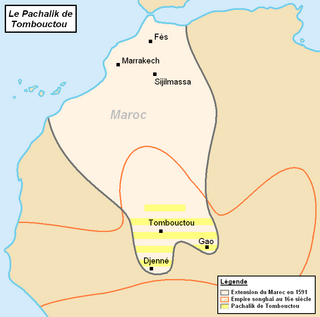
The Pashalik of Timbuktu, also known as the Pashalik of Sudan, was a West African political entity that existed between the 16th and the 19th century. It was formed after the Battle of Tondibi, when a military expedition sent by Saadian sultan Ahmad al-Mansur of Morocco defeated the Songhai Empire and established control over a territory centered on Timbuktu. Following the decline of the Saadi Sultanate in the early 17th century, Morocco retained only nominal control of the Pashalik.
The battle of Anfao was fought between the troops of rebel General Muhammad Askia and Sonni Baru, the legitimate ruler of the Songhai Empire on April 12, 1493 at Anfao, outside the capital of Gao, on the upper Niger. Despite being outnumbered, Askia's troops won the day. The victory of Muhammad Askia ended the Sonni dynasty.

Askia Daoud was the ruler of the Songhai Empire from 1549 to 1582. Daoud came to power unopposed following the death of his brother Askia Ishaq I in 1549. The Empire continued to expand under Daoud's peaceful rule, and saw little internal strife, until the invasion and interference of the Moroccan forces, which led to the empire's downfall in 1591.

The Songhai, ) is an area in the northwestern corner of Niger's Tillabéri Region populated mainly by the Songhaiborai. It is considered the heartland of the Songhai people and the sanctuary of their ancient pantheon and priestly class and the place in which the original lineage of the Sonni dynasty retreated after the coup d'etat of 1493 creating a secret society of magicians, the Sohance.

The Songhaiborai are a distinct subgroup within the larger Songhai ethnolinguistic family. Residing predominantly in Niger's Songhai region, Northern Mali, and a minority presence in Burkina Faso. Notably, they trace their lineage to the ruling dynasties of the ancient Songhai Empire.
The Moroccan invasion of the Songhai Empire began with an expedition sent in 1590 by Sultan Ahmad al-Mansur of the Saadian dynasty, which ruled over Morocco at the time. The Saadian army, led by Judar Pasha, arrived in the Niger valley region in 1591 and won its first and most decisive victory against the forces of Askia Ishaq II at the Battle of Tondibi and occupied the capital of Gao shortly after.
Sikié is a Songhai town near Namaro in Niger. Sikié was the place where the defeated Songhai Empire army led by Askia Muhammed Gao installed their base hoping for a possible passage of the Moroccan army.

Songhai architecture or Zarma architecture refers to the traditional Sahelian architectural style of the Songhai people in West Africa. The architecture typically encompasses mud-brick buildings, flat roofs, and distinctive designs reflecting the cultural and historical aspects of the Songhai civilization.
References
- ↑ Shoup, John A. (2011), Ethnic Groups of Africa and the Middle East: An Encyclopedia, Santa Barbara, California, p. 266, ISBN 9781598843620 , retrieved 2023-03-05
{{citation}}: CS1 maint: location missing publisher (link) - ↑ Hunwick, John (2003), Timbuktu and the Songhay Empire: Al-Sa'dī's Ta'rīkh Al-sūdān down to 1613, Leiden, p. 103, ISBN 9789004491137 , retrieved 2023-03-05
{{citation}}: CS1 maint: location missing publisher (link) - ↑ Lange, Dierk (2004), Ancient Kingdoms of West Africa: African-centred and Canaanite-Israelite Cultural Contacts, Abingdon-on-Thames, p. 530, ISBN 9783897541153 , retrieved 2023-03-05
{{citation}}: CS1 maint: location missing publisher (link) - ↑ Sardan, Jean-Pierre Olivier de (2008), Les sociétés Songhay-Zarma (Niger-Mali): chefs, guerriers, esclaves, paysans, Paris, p. 75, ISBN 9782865371068 , retrieved 2023-03-05
{{citation}}: CS1 maint: location missing publisher (link) - ↑ Stoller, Paul (1992), The Cinematic Griot: The Ethnography of Jean Rouch, University of Chicago Press, p. 59 "In this way the true Songhay, after the seventeenth century,is no longer the one of Timbuktu or Gao, but the one farther south near the Anzourou, the Gorouol, on the islands of the river surrounded by rapids" (Rouch 1953, 224), ISBN 9780226775487 , retrieved 2021-06-04