
The Staatliches Bauhaus, commonly known as the Bauhaus, was a German art school operational from 1919 to 1933 that combined crafts and the fine arts. The school became famous for its approach to design, which attempted to unify individual artistic vision with the principles of mass production and emphasis on function. Along with the doctrine of functionalism, the Bauhaus initiated the conceptual understanding of architecture and design.

Walter Adolph Georg Gropius was a German-American architect and founder of the Bauhaus School, who, along with Alvar Aalto, Ludwig Mies van der Rohe, Le Corbusier and Frank Lloyd Wright, is widely regarded as one of the pioneering masters of modernist architecture. He was a founder of Bauhaus in Weimar (1919). Gropius was a leading architect of the International Style. Gropius emigrated from Germany to England in 1934 and from England to the United States in 1937, where he spent the rest of his life.

Modern architecture, also called modernist architecture, was an architectural movement and style that was prominent in the 20th century, between the earlier Art Deco and later postmodern movements. Modern architecture was based upon new and innovative technologies of construction ; the principle functionalism ; an embrace of minimalism; and a rejection of ornament.
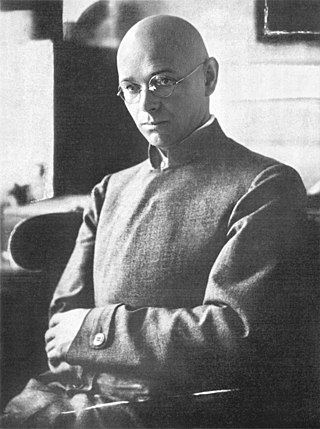
Johannes Itten was a Swiss expressionist painter, designer, teacher, writer and theorist associated with the Bauhaus school. Together with German-American painter Lyonel Feininger and German sculptor Gerhard Marcks, under the direction of German architect Walter Gropius, Itten was part of the core of the Weimar Bauhaus.

Marcel Lajos Breuer was a Hungarian-German modernist architect and furniture designer. He moved to the United States in 1937 and became a naturalized American citizen in 1944.

Gerhard Marcks was a German artist, known primarily as a sculptor, but who is also known for his drawings, woodcuts, lithographs and ceramics.

Hans Emil "Hannes" Meyer was a Swiss architect and second director of the Bauhaus Dessau from 1928 to 1930.

Adolf Meyer was a German architect.

The Haus am Horn is a domestic house in Weimar, Germany, designed by Georg Muche. It was built for the Bauhaus Werkschau exhibition which ran from July to September 1923. It was the first building based on Bauhaus design principles, which revolutionized 20th century architectural and aesthetic thinking and practice.
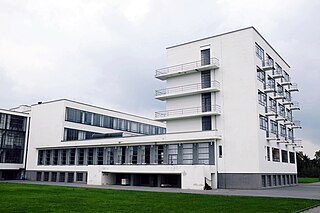
The New Objectivity is a name often given to the Modern architecture that emerged in Europe, primarily German-speaking Europe, in the 1920s and 30s. It is also frequently called Neues Bauen. The New Objectivity remodeled many German cities in this period.
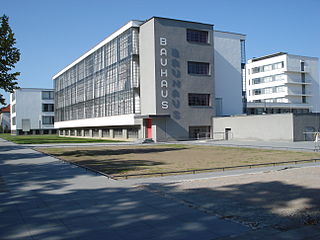
Bauhaus Dessau, also Bauhaus-Building Dessau, is a building-complex in Dessau-Roßlau. It is considered the pinnacle of pre-war modern design in Europe and originated out of the dissolution of the Weimar School and the move by local politicians to reconcile the city's industrial character with its cultural past.
Juergen Nogai is a German architecture, art and documentary photographer.
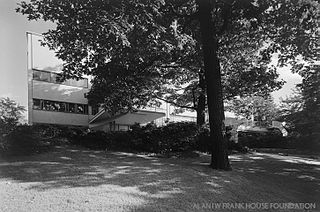
The Alan I W Frank House is a private residence in Pittsburgh, Pennsylvania, designed by Bauhaus founder Walter Gropius and partner Marcel Breuer, two of the pioneering masters of 20th-century architecture and design. This spacious, multi-level residence, its furnishings and landscaping were all created by Gropius and Breuer as a 'Total Work of Art.' In size and completeness, it is unrivaled. It was their most important residential commission, and it is virtually the same today as when it was built in 1939–40, original and authentic.
Set within the Bauhaus design school, the Bauhaus dances were created by Oskar Schlemmer, along with Paul Klee and Wassily Kandinsky, for series of lecture dances between 1927 and 1929. They took as inspiration the architectonic cubical stage space designed by Walter Gropius for the Dessau Bauhaus, which opened in 1926. The dances draw on simple gestures—walking, sitting, jumping—the dancers are to be perceived as figures symbolizing the potential of new technology while remaining primarily an exploration of the human element.
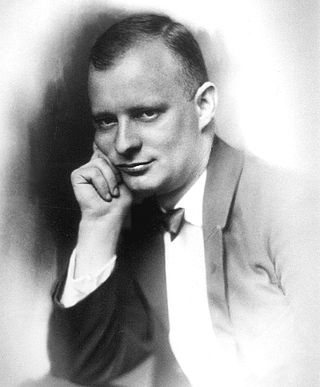
Das Marienleben is a song cycle by German composer Paul Hindemith. The cycle, written for piano and soprano, sets to music a collection of 15 poems by Rainer Maria Rilke that tells the story of the life of Mary. The cycle was featured in the 1923 Bauhaus exhibition in Weimar. Thirteen years after its 1923 premiere in Frankfurt, Hindemith began extensively revising and reworking the piece, eventually producing a second version which premiered in Hanover in 1948.
Gertrud Grunow was a German musician and educationalist who formulated theories on the relationships between sound, colour and movement and was a specialist in vocal pedagogy. She taught courses in the "theory of harmonisation" at the Bauhaus in Weimar, where she was the school's first woman teacher and the only woman teacher during the school's Weimar years.

Nazi architecture is the architecture promoted by Adolf Hitler and the Nazi regime from 1933 until its fall in 1945, connected with urban planning in Nazi Germany. It is characterized by three forms: a stripped neoclassicism, typified by the designs of Albert Speer; a vernacular style that drew inspiration from traditional rural architecture, especially alpine; and a utilitarian style followed for major infrastructure projects and industrial or military complexes. Nazi ideology took a pluralist attitude to architecture; however, Hitler himself believed that form follows function and wrote against "stupid imitations of the past".

The Bauhaus was seen as a progressive academic institution, as it declared equality between the sexes and accepted both male and female students into its programs. During a time when women were denied admittance to formal art academies, the Bauhaus provided them with an unprecedented level of opportunity for both education and artistic development, though generally only in weaving and other fields considered at the time to be appropriate for women.
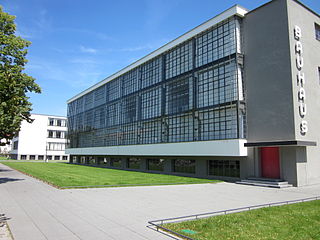
Bauhaus and its Sites in Weimar, Dessau and Bernau are World Heritage Sites in Germany, comprising six separate sites which are associated with the Bauhaus art school. It was designated in 1996 with four initial sites, and in 2017 two further sites were added.
Adolf Sommerfeld, also Andrew Sommerfield was a German-British architect and builder of Jewish origins.

