Related Research Articles
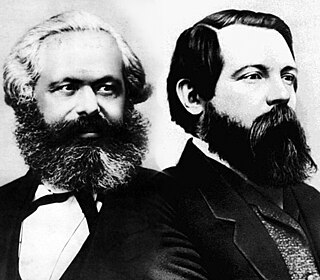
The Communist Manifesto, originally the Manifesto of the Communist Party, is a political pamphlet written by German philosophers Karl Marx and Friedrich Engels. Commissioned by the Communist League and originally published in London in 1848, the Manifesto remains one of the world's most influential political documents. It presents an analytical approach to class struggle and criticizes capitalism and the capitalist mode of production, without attempting to predict communism's potential future forms.

Primo Michele Levi was an Italian chemist, partisan, writer, and Jewish Holocaust survivor. He was the author of several books, collections of short stories, essays, poems and one novel. His best-known works include If This Is a Man, his account of the year he spent as a prisoner in the Auschwitz concentration camp in Nazi-occupied Poland; and The Periodic Table (1975), linked to qualities of the elements, which the Royal Institution named the best science book ever written.
The Communist Party of Germany was a major political party in the Weimar Republic between 1918 and 1933, an underground resistance movement in Nazi Germany, and a minor party in West Germany in the postwar period until it was banned by the Federal Constitutional Court in 1956.

Council communism is a current of communist thought that emerged in the 1920s. Inspired by the November Revolution, council communism was opposed to state socialism and advocated workers' councils and council democracy. Strong in Germany and the Netherlands during the 1920s, council communism continues to exist as a small minority in the left.

Carlo Levi was an Italian painter, writer, activist, communist, and doctor.

Leon "Leo" Jogiches, also commonly known by the party name Jan Tyszka, was a Polish Marxist revolutionary and politician, active in Poland, Lithuania, and Germany.

The Communist Workers' Party of Germany was an anti-parliamentarian and left communist party that was active in Germany during the time of the Weimar Republic. It was founded in April 1920 in Heidelberg as a split from the Communist Party of Germany (KPD). Originally the party remained a "sympathising member of Communist International." In 1922 the KAPD split into two factions, both of whom kept the name but are referred to as the KAPD Essen Faction and the KAPD Berlin Faction.

Natalia Ginzburg was an Italian author whose work explored family relationships, politics during and after the Fascist years and World War II, and philosophy. She wrote novels, short stories and essays, for which she received the Strega Prize and Bagutta Prize. Most of her works were also translated into English and published in the United Kingdom and United States.

Paul Levi was a German communist and social democratic political leader. He was the head of the Communist Party of Germany following the assassination of Rosa Luxemburg and Karl Liebknecht in 1919. After being expelled for publicly criticising Communist Party tactics during the March Action, he formed the Communist Working Organisation which in 1922 merged with the Independent Social Democratic Party. This party, in turn, merged with the Social Democratic Party a few months later and Levi became one of the leaders of its left wing.

Combat was a French newspaper created during the Second World War. It was founded in 1941 as a clandestine newspaper of the French Resistance.

Giustizia e Libertà was an Italian anti-fascist resistance movement, active from 1929 to 1945. The movement was cofounded by Carlo Rosselli, Ferruccio Parri, who later became Prime Minister of Italy, and Sandro Pertini, who became President of Italy, were among the movement's leaders.
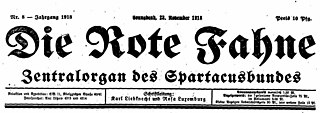
Die Rote Fahne was a German newspaper originally founded in 1876 by Socialist Worker's Party leader Wilhelm Hasselmann, and which has been since published on and off, at times underground, by German Socialists and Communists. Karl Liebknecht and Rosa Luxemburg famously published it in 1918 as organ of the Spartacus League.
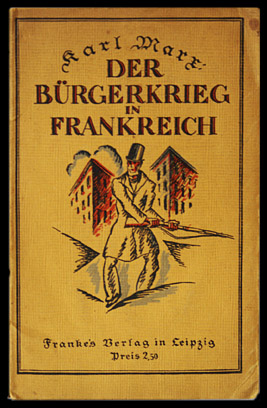
"The Civil War in France" was a pamphlet written by Karl Marx, as an official statement of the General Council of the International on the character and significance of the struggle of the Communards in the Paris Commune.

Claude Lévi-Strauss was a French anthropologist and ethnologist whose work was key in the development of the theories of structuralism and structural anthropology. He held the chair of Social Anthropology at the Collège de France between 1959 and 1982, was elected a member of the Académie française in 1973 and was a member of the School for Advanced Studies in the Social Sciences in Paris. He received numerous honors from universities and institutions throughout the world.

Karl Bernhard Fritz Schröder was a communist politician and writer.
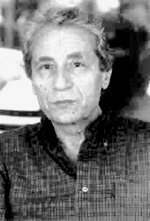
Dr. Hassan Kobeissi was a prominent Lebanese writer, thinker and translator. He was born in Zebdine زبدين Lebanon, and is considered an important figure in the Lebanese intellectual circle. He is noted for writing publications such as "Rodinson and the Son of Islam", and for his award-winning translations of many prominent philosophical, sociological and anthropological writings.
During the nine decades since its establishment in 1919, the Communist Party USA produced or inspired a vast array of newspapers and magazines in at least 25 different languages. This list of the Non-English press of the Communist Party USA provides basic information on each title, along with links to pages dealing with specific publications in greater depth.
Left communism, or the communist left, is a position held by the left wing of communism, which criticises the political ideas and practices espoused by Marxist–Leninists and social democrats. Left communists assert positions which they regard as more authentically Marxist than the views of Marxism–Leninism espoused by the Communist International after its Bolshevization by Joseph Stalin and during its second congress.
Anna Geyer was a German politician and journalist.

Mathilde Jacob was a German typist and translator who during the First World War became politically involved, working with the anti-war Spartacus League and as a founder member of the German Communist Party. She came to politics through her work for Rosa Luxemburg, whose friend and close confidant she became. Although Mathilde Jacob continued to be politically engaged in the 1920s, her greater contribution to history comes from her having smuggled Luxemburg's letters and documents out of Luxemburg's prison cell during her friend's various incarcerations during the 1914–1918 war. She then preserved much of Luxemburg's written legacy after the latter's murder.
References
 | This article about mass media in Germany is a stub. You can help Wikipedia by expanding it. |
 | This European political magazine or journal-related article is a stub. You can help Wikipedia by expanding it. See tips for writing articles about magazines. Further suggestions might be found on the article's talk page. |