Tohil was a deity of the K'iche' Maya in the Late Postclassic period of Mesoamerica.

Tecun Uman was one of the last rulers of the K'iche' Maya people, in the Highlands of what is now Guatemala. According to the Kaqchikel annals, he was slain by Spanish conquistador Pedro de Alvarado while waging battle against the Spanish and their allies on the approach to Quetzaltenango on 12 February 1524. Tecun Uman was declared Guatemala's official national hero on March 22, 1960 and is commemorated on February 20, the popular anniversary of his death. Tecun Uman has inspired a wide variety of activities ranging from the production of statues and poetry to the retelling of the legend in the form of folkloric dances to prayers. Despite this, Tecun Uman's existence is not well documented, and it has proven to be difficult to separate the man from the legend.

Q'umarkaj, is an archaeological site in the southwest of the El Quiché department of Guatemala. Q'umarkaj is also known as Utatlán, the Nahuatl translation of the city's name. The name comes from K'iche' Q'umarkah "Place of old reeds".

Quetzaltenango is a department in the western highlands of Guatemala. The capital is the city of Quetzaltenango, the second largest city in Guatemala. The department is divided up into 24 municipalities. The inhabitants include Spanish-speaking Ladinos and the K'iche' and Mam Maya groups, both with their own Maya language. The department consists of mountainous terrain, with its principal river being the Samalá River. the department is seismically active, suffering from both earthquakes and volcanic activity.

The Spanish conquest of Guatemala was a protracted conflict during the Spanish colonization of the Americas, in which Spanish colonisers gradually incorporated the territory that became the modern country of Guatemala into the colonial Viceroyalty of New Spain. Before the conquest, this territory contained a number of competing Mesoamerican kingdoms, the majority of which were Maya. Many conquistadors viewed the Maya as "infidels" who needed to be forcefully converted and pacified, disregarding the achievements of their civilization. The first contact between the Maya and European explorers came in the early 16th century when a Spanish ship sailing from Panama to Santo Domingo was wrecked on the east coast of the Yucatán Peninsula in 1511. Several Spanish expeditions followed in 1517 and 1519, making landfall on various parts of the Yucatán coast. The Spanish conquest of the Maya was a prolonged affair; the Maya kingdoms resisted integration into the Spanish Empire with such tenacity that their defeat took almost two centuries.

Uspantán is a municipality in the Guatemalan department of El Quiché. It is one of the largest municipalities of El Quiché and stretches from the mountainous highlands in the South to the tropical lowlands in the North. The municipal seat is in Villa de San Miguel Uspantán with a population of 2,800. The birthplace of Nobel Peace Prize winner Rigoberta Menchú, a community named Laj Chimel, is located Uspantán not far from the municipal seat. Completion of paving on the road in from Chichicastenango has brought a small tourist boom to the town.

The K'iche' kingdom of Q'umarkaj was a state in the highlands of modern-day Guatemala which was founded by the K'iche' (Quiché) Maya in the thirteenth century, and which expanded through the fifteenth century until it was conquered by Spanish and Nahua forces led by Pedro de Alvarado in 1524.

Yax Nuun Ahiin II also known as Ruler C and Chitam,, was an ajaw of the Maya city of Tikal. He took the throne on December 25, 768 and reigning probably until his death. He was son of Yik'in Chan K'awiil and brother of 28th Ruler. The monuments associated with Yax Nuun Ahiin II are: Stelae 19, 21 and Altars 6 and 10.
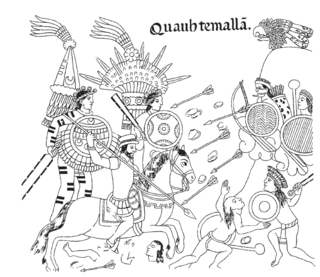
Indian auxiliaries or indios auxiliares is the term used in old Spanish chronicles and historical texts for the indigenous peoples who were integrated into the armies of the Spanish conquistadors with the purpose of supporting their advance and combat operations during the Conquest of America. They acted as guides, translators, or porters and in this role were also called yanakuna, particularly within the old Inca Empire and Chile. The term was also used for formations composed of indigenous warriors or Indios amigos, which they used for reconnaissance, combat, and as reserve in battle. The auxiliary Indians remained in use after the conquest, during some revolts, in border zones and permanent military areas, as in Chile in the Arauco War.
The Spanish conquest of the Maya was a protracted conflict during the Spanish colonisation of the Americas, in which the Spanish conquistadores and their allies gradually incorporated the territory of the Late Postclassic Maya states and polities into the colonial Viceroyalty of New Spain. The Maya occupied a territory that is now incorporated into the modern countries of Mexico, Guatemala, Belize, Honduras and El Salvador; the conquest began in the early 16th century and is generally considered to have ended in 1697.
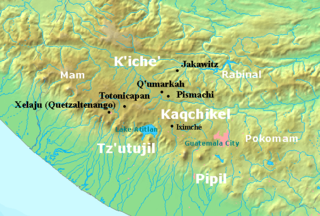
Chitinamit is an archeological site of the Maya civilization in the highlands of Guatemala. It has been identified as Jakawitz, the first capital of the K'iche' Maya. The site is located in the El Quiché department, in the municipality of Uspantán. Chitinamit dates from the Early Classic through to the Late Postclassic periods and covers approximately 2 hectares (220,000 sq ft), making it the largest site in its region.

Maya cities were the centres of population of the pre-Columbian Maya civilization of Mesoamerica. They served the specialised roles of administration, commerce, manufacturing and religion that characterised ancient cities worldwide. Maya cities tended to be more dispersed than cities in other societies, even within Mesoamerica, as a result of adaptation to a lowland tropical environment that allowed food production amidst areas dedicated to other activities. They lacked the grid plans of the highland cities of central Mexico, such as Teotihuacán and Tenochtitlan. Maya kings ruled their kingdoms from palaces that were situated within the centre of their cities. Cities tended to be located in places that controlled trade routes or that could supply essential products. This allowed the elites that controlled trade to increase their wealth and status. Such cities were able to construct temples for public ceremonies, thus attracting further inhabitants to the city. Those cities that had favourable conditions for food production, combined with access to trade routes, were likely to develop into the capital cities of early Maya states.

During the pre-Columbian era, human sacrifice in Maya culture was the ritual offering of nourishment to the gods. Blood was viewed as a potent source of nourishment for the Maya deities, and the sacrifice of a living creature was a powerful blood offering. By extension, the sacrifice of a human life was the ultimate offering of blood to the gods, and the most important Maya rituals culminated in human sacrifice. Generally only high status prisoners of war were sacrificed, with lower status captives being used for labour.
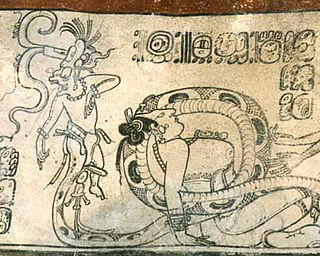
Manikin Scepters are objects that were held by Maya rulers to signify their power and authority. The term scepter is deceiving, because the object is too short to be held in the hand and touch the ground. Manikin scepters are normally clay or stone with intricate carvings and the face of a god. K'awiil was the most common god to be shown on them. All the manikin scepters held by the Halach Uiniks of the Kuchkabals of Yucatán show K'awiil.
Wil Ohl K'inich was the eighth ruler of the Maya city state Copan. He was nicknamed Head on Earth by archaeologists.
The history of Maya civilization is divided into three principal periods: the Preclassic, Classic and Postclassic periods; these were preceded by the Archaic Period, which saw the first settled villages and early developments in agriculture. Modern scholars regard these periods as arbitrary divisions of chronology of the Maya civilization, rather than indicative of cultural evolution or decadence. Definitions of the start and end dates of period spans can vary by as much as a century, depending on the author. The Preclassic lasted from approximately 2000 BC to approximately 250 AD; this was followed by the Classic, from 250 AD to roughly 950 AD, then by the Postclassic, from 950 AD to the middle of the 16th century. Each period is further subdivided:
The Título C'oyoi is an important early colonial K'iche document documenting the mythical origins of the K'iche' people and their history up to the Spanish conquest. It describes K'iche' preparations for battle against the Spanish, and the death of the K'iche' hero Tecun Uman. The document was written in Q'umarkaj, the K'iche' capital city, by the C'oyoi Sakcorowach lineage, which belonged to the Quejnay branch of the K'iche', and who held territory just to the east of Quetzaltenango, now in Guatemala. The document was largely written by Juan de Penonias de Putanza, who claimed to be the relative of a C'oyoi nobleman who was killed during the Spanish conquest. It was composed with the assistance of the K'iche' officialdom at Q'umarkaj, and portions of the text reflect the official version of K'iche' history as produced in the capital. An illustration in the document shows that the Maya nobility of Quetzaltenango adopted the double-headed Hapsburg Eagle as their family crest.