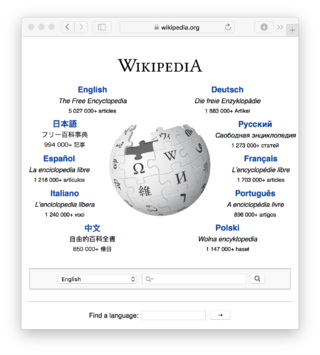
Wiki software is collaborative software that runs a wiki, which allows the users to create and collaboratively edit pages or entries via a web browser. A wiki system is usually a web application that runs on one or more web servers. The content, including previous revisions, is usually stored in either a file system or a database. Wikis are a type of web content management system, and the most commonly supported off-the-shelf software that web hosting facilities offer.

An intranet is a computer network for sharing information, easier communication, collaboration tools, operational systems, and other computing services within an organization, usually to the exclusion of access by outsiders. The term is used in contrast to public networks, such as the Internet, but uses the same technology based on the Internet protocol suite.

Ziff Davis, Inc. is an American digital media and internet company. Founded in 1927 by William Bernard Ziff Sr. and Bernard George Davis, the company primarily owns technology- and health-oriented media websites, online shopping-related services, internet connectivity services, gaming and entertainment brands, and cybersecurity and martech tools. Previously, the company was predominantly a publisher of hobbyist magazines.

ZDNET is a business technology news website owned and operated by Red Ventures. The brand was founded on April 1, 1991, as a general interest technology portal from Ziff Davis and evolved into an enterprise IT-focused online publication.

GameSpy was an American provider of online multiplayer and matchmaking middleware for video games founded in 1999 by Mark Surfas. After the release of a multiplayer server browser for the game, QSpy, Surfas licensed the software under the GameSpy brand to other video game publishers through a newly established company, GameSpy Industries, which also incorporated his Planet Network of video game news and information websites, and GameSpy.com.
Social computing is an area of computer science that is concerned with the intersection of social behavior and computational systems. It is based on creating or recreating social conventions and social contexts through the use of software and technology. Thus, blogs, email, instant messaging, social network services, wikis, social bookmarking and other instances of what is often called social software illustrate ideas from social computing.

Image sharing, or photo sharing, is the publishing or transfer of digital photos online. Image sharing websites offer services such as uploading, hosting, managing and sharing of photos. This function is provided through both websites and applications that facilitate the upload and display of images. The term can also be loosely applied to the use of online photo galleries that are set up and managed by individual users, including photoblogs. Sharing means that other users can view but not necessarily download images, and users can select different copyright options for their images.
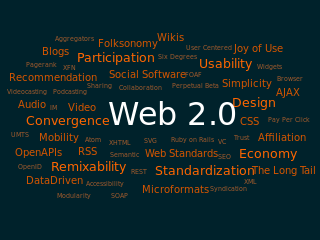
Web 2.0 refers to websites that emphasize user-generated content, ease of use, participatory culture and interoperability for end users.

Citizen media is content produced by private citizens who are not professional journalists. Citizen journalism, participatory media and democratic media are related principles.
Personal knowledge networks are methods for organizations to identify, capture, evaluate, retrieve, and share information. This method was primarily conceived by researchers to facilitate the sharing of personal, informal knowledge between organizations. Instead of focusing on the organizational context, some researchers investigate the intra-firm aspects at the personal level of organizational knowledge networks, where knowledge management (KM) processes both begin and end. Various technologies and behaviors support personal knowledge networking, including wikis, Really Simple Syndication (RSS), and relationship networks. Researchers propose that knowledge management can occur with little explicit governance. This trend is referred to as "grassroots KM" as opposed to traditional, top-down enterprise KM.

User-generated content (UGC), alternatively known as user-created content (UCC), is generally any form of content, such as images, videos, text, testimonials, and audio, that has been posted by users on online content aggregation platforms such as social media, discussion forums and wikis. It is a product consumers create to disseminate information about online products or the firms that market them.
Naver is a South Korean online platform operated by the Naver Corporation. It was launched in 1999 as the first web portal in South Korea to develop and use its own search engine. It was also the world's first operator to introduce the comprehensive search feature, which compiles search results from various categories and presents them in a single page. Naver has since added a multitude of new services ranging from basic features such as e-mail and news to the world's first online Q&A platform Knowledge iN.

Intellipedia is an online system for collaborative data sharing used by the United States Intelligence Community (IC). It was established as a pilot project in late 2005 and formally announced in April 2006. Intellipedia consists of three wikis running on the separate JWICS (Intellipedia-TS), SIPRNet (Intellipedia-S), and DNI-U (Intellipedia-U) networks. The levels of classification allowed for information on the three wikis are Top Secret Sensitive Compartmented Information, Secret (S), and Sensitive But Unclassified information, respectively. Each of the wikis is used by individuals with appropriate clearances from the 18 agencies of the US intelligence community and other national-security related organizations, including Combatant Commands and other federal departments. The wikis are not open to the public.

The Cult of the Amateur: How Today's Internet Is Killing Our Culture is a 2007 book written by entrepreneur and Internet critic Andrew Keen. Published by Currency, Keen's first book is a critique of the enthusiasm surrounding user-generated content, peer production, and other Web 2.0–related phenomena.
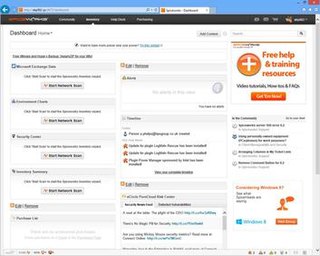
Spiceworks is a professional network for the information technology (IT) industry that is headquartered in Austin, Texas. The company was founded in January 2006 by Scott Abel, Jay Hallberg, Greg Kattawar, and Francis Sullivan to build IT management software.

Aberdeen is an international marketing intelligence company. Aberdeen's headquarters is based in Waltham, Massachusetts, United States, with an additional US office location in Wilton, CT, as well as three European offices in Versailles (France), Madrid (Spain), and Chertsey.
Content creation is the act of producing and sharing information or media content for specific audiences, particularly in digital contexts. According to Dictionary.com, content refers to "something that is to be expressed through some medium, as speech, writing or any of various arts" for self-expression, distribution, marketing and/or publication. Content creation encompasses various activities including maintaining and updating web sites, blogging, article writing, photography, videography, online commentary, social media accounts, and editing and distribution of digital media. In a survey conducted by Pew, content creation was defined as "the material people contribute to the online world."
The Independent Oracle Users Group (IOUG) represents the voice of Oracle technology and database professionals and empowers them to be more productive in their business and careers by:

SmartPlanet was an online magazine that covered clean technology and information technology as it related to healthcare, science, transportation, corporate sustainability, architecture, and design. It was part of the business portfolio of CBS Interactive that included BNET and ZDNet and was known for its daily coverage of the technology and energy industries. It stopped publishing on June 30, 2014.

Toolbox.com is a network of online business-to-business communities geared at professionals working in the information technology, human resources, and finance fields, allowing online collaboration between professionals utilizing discussion groups, blogs, and wikis.
