
The iPod is a discontinued series of portable media players and multi-purpose mobile devices designed and marketed by Apple Inc. The first version was released on October 23, 2001, about 8+1⁄2 months after the Macintosh version of iTunes was released. Apple sold an estimated 450 million iPod products as of 2022. Apple discontinued the iPod product line on May 10, 2022. At over 20 years, the iPod brand is the oldest to be discontinued by Apple.

To counterfeit means to imitate something authentic, with the intent to steal, destroy, or replace the original, for use in illegal transactions, or otherwise to deceive individuals into believing that the fake is of equal or greater value than the real thing. Counterfeit products are fakes or unauthorized replicas of the real product. Counterfeit products are often produced with the intent to take advantage of the superior value of the imitated product. The word counterfeit frequently describes both the forgeries of currency and documents as well as the imitations of items such as clothing, handbags, shoes, pharmaceuticals, automobile parts, unapproved aircraft parts, watches, electronics and electronic parts, software, works of art, toys, and movies.
The automotive aftermarket is the secondary market of the automotive industry, concerned with the manufacturing, remanufacturing, distribution, retailing, and installation of all vehicle parts, chemicals, equipment, and accessories, after the sale of the automobile by the original equipment manufacturer (OEM) to the consumer. The parts, accessories, etc. for sale may or may not be manufactured by the OEM. According to a report by the International Trade Administration in the US Department of Commerce, "Aftermarket parts are divided into two categories: replacement parts and accessories. Replacement parts are automotive parts built or remanufactured to replace OE parts as they become worn or damaged. Accessories are parts made for comfort, convenience, performance, safety, or customization, and are designed for add-on after the original sale of the motor vehicle."

The Tetris Company, Inc. (TTC) is based in Nevada and is owned by Henk Rogers, Alexey Pajitnov and Blue Planet Software. The company is the exclusive licensee of Tetris Holding LLC, the company that owns Tetris rights worldwide. It licenses the Tetris brand to third parties.
The multinational technology corporation Apple Inc. has been a participant in various legal proceedings and claims since it began operation and, like its competitors and peers, engages in litigation in its normal course of business for a variety of reasons. In particular, Apple is known for and promotes itself as actively and aggressively enforcing its intellectual property interests. From the 1980s to the present, Apple has been plaintiff or defendant in civil actions in the United States and other countries. Some of these actions have determined significant case law for the information technology industry and many have captured the attention of the public and media. Apple's litigation generally involves intellectual property disputes, but the company has also been a party in lawsuits that include antitrust claims, consumer actions, commercial unfair trade practice suits, defamation claims, and corporate espionage, among other matters.

Monster Inc. is an American company that manufactures and markets about 6,000 products, but is best known for audio and video cables. It also produces speakers, headphones, power strips, mobile accessories and audio devices for automobiles. The company was founded by an audiophile and engineer, Noel Lee, in 1979 by experimenting with different ways to build audio cables. It grew by doing demonstrations to convince the industry that audio cables made a difference in audio quality and by establishing relationships with retailers that were attracted to the cable's profit margins.
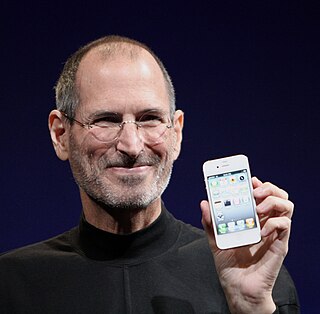
The history of the iPhone development by Apple Inc. spans from the early 2000s to about 2010. The first iPhone was released in 2007. By the end of 2009, iPhone models had been released in all major markets.
Skullcandy Inc. is an American company based in Park City, Utah, that markets headphones, earphones, hands-free devices, audio backpacks, MP3 players, and other products.

AirPods are wireless Bluetooth earbuds designed by Apple Inc. They were first announced on September 7, 2016, alongside the iPhone 7. Within two years, they became Apple's most popular accessory. The most recent model, AirPods, are a replacement to the 1st and 2nd generation models, although the 2nd generation is still sold on Apple's website. These models are Apple's entry-level wireless headphones, sold alongside the AirPods Pro and AirPods Max.

A dock connector is a connector used to attach a mobile electronic device simultaneously to multiple external resources. The dock connector will typically carry a variety of signals and power, through a single connector, to simplify the process of docking the mobile device. A dock connector may be embedded in a mechanical fixture used to support or align the mobile device or may be at the end of a cable.

Apple Inc. has produced and sold headphones since 2001, available for standalone purchase and bundled with iPhone and iPod products. Apple's current product line consists of EarPods, AirPods and AirPods Pro, and AirPods Max.

OtterBox is a privately-owned consumer electronics accessory company based in Fort Collins, Colorado that produces water-resistant, shock-resistant, and drop-resistant cases for mobile devices. The company was founded in 1998 as a manufacturer of water-resistant boxes meant to house electronic devices, mostly catering to outdoor enthusiasts. Since then, OtterBox has produced both water-resistant and non-water-resistant protective cases for smartphones.
The smartphone wars or smartphone patents licensing and litigation refers to commercial struggles among smartphone manufacturers including Sony Mobile, Google, Apple Inc., Samsung, Microsoft, Nokia, Motorola, Huawei, LG Electronics, ZTE and HTC, by patent litigation and other means. The conflict is part of the wider "patent wars" between technology and software corporations. The patent wars occurred because a finished smartphone might involve hundreds of thousands of patents.
Apple Inc. v. Samsung Electronic Co., Ltd. was the first of a series of ongoing lawsuits between Apple Inc. and Samsung Electronics regarding the design of smartphones and tablet computers; between them, the companies made more than half of smartphones sold worldwide as of July 2012. In the spring of 2011, Apple began litigating against Samsung in patent infringement suits, while Apple and Motorola Mobility were already engaged in a patent war on several fronts. Apple's multinational litigation over technology patents became known as part of the mobile device "smartphone patent wars": extensive litigation in fierce competition in the global market for consumer mobile communications. By August 2011, Apple and Samsung were litigating 19 ongoing cases in nine countries; by October, the legal disputes expanded to ten countries. By July 2012, the two companies were still embroiled in more than 50 lawsuits around the globe, with billions of dollars in damages claimed between them. While Apple won a ruling in its favor in the U.S., Samsung won rulings in South Korea, Japan, and the UK. On June 4, 2013, Samsung won a limited ban from the U.S. International Trade Commission on sales of certain Apple products after the commission found Apple had violated a Samsung patent, but this was vetoed by U.S. Trade Representative Michael Froman.

Lightning is a proprietary computer bus and power connector created and designed by Apple Inc. and introduced on September 12, 2012, to replace its predecessor, the 30-pin dock connector. The Lightning connector is used to connect Apple mobile devices like iPhones, iPads, and iPods to host computers, external monitors, cameras, USB battery chargers, and other peripherals. Using 8 pins instead of 30, Lightning is much smaller than its predecessor, which was integrated with devices like the iPhone 4 and the iPad 2. The Lightning plug is symmetrical, so it can be inserted into a Lightning receptacle in either orientation. The plug is indented on each side to match up with corresponding points inside the receptacle to retain the connection.
The MyPhone is a Philippine mobile phone and multimedia brand designed and marketed by MySolid Technologies & Devices Corp. that use Google's Android mobile operating system. The first-generation MyPhone was announced in January 2007. Since then MyPhone has annually released new MyPhone models and updates.

An eSIM (embedded-SIM) is a form of programmable SIM card that is embedded directly into a device. Instead of an integrated circuit located on a removable universal integrated circuit card (UICC), typically made of PVC, an eSIM consists of software installed onto an eUICC chip permanently attached to a device.

AirPower is an unreleased wireless charging mat developed by Apple Inc. It was designed to charge up to three devices simultaneously, supporting two Qi devices, such as an iPhone and AirPods, and an Apple Watch. It was announced on September 12, 2017. Formerly scheduled to be released in early 2018, AirPower failed to materialize, leading to wide speculation over the product's future, until Apple announced on March 29, 2019 it had canceled the release.

PopSockets LLC is a privately owned consumer-electronics accessory company that produces removable grips for smartphones. The company was founded in 2012 by David Barnett, who was at the time a philosophy professor.

MagSafe is a proprietary, magnetically attached wireless power transfer and accessory-attachment standard developed by Apple Inc. for its iPhone and AirPods product lines. It was announced on 13 October 2020, in conjunction with the iPhone 12 and 12 Pro series. It provides up to 15 W of power and is backwards-compatible with the open Qi standard for up to 7.5 W of power. The connector also enables connecting non-charger accessories such as card holders and cases with communication through an integrated NFC loop.


