
The Brittoniclanguages form one of the two branches of the Insular Celtic language family; the other is Goidelic. It comprises the extant languages Breton, Cornish, and Welsh. The name Brythonic was derived by Welsh Celticist John Rhys from the Welsh word Brython, meaning Ancient Britons as opposed to an Anglo-Saxon or Gael.

Breton is a Southwestern Brittonic language of the Celtic language group spoken in Brittany, part of modern-day France. It is the only Celtic language still widely in use on the European mainland, albeit as a member of the insular branch instead of the continental grouping.

Cape Breton Island is a rugged and irregularly shaped island on the Atlantic coast of North America and part of the province of Nova Scotia, Canada.
Cornish is a Southwestern Brittonic language of the Celtic language family. Along with Welsh and Breton, Cornish is descended from the Common Brittonic language spoken throughout much of Great Britain before the English language came to dominate. For centuries, until it was pushed westwards by English, it was the main language of Cornwall, maintaining close links with its sister language Breton, with which it was mutually intelligible, perhaps even as long as Cornish continued to be spoken as a vernacular. Cornish continued to function as a common community language in parts of Cornwall until the mid 18th century, and there is some evidence for traditional speakers of the language persisting into the 19th century.

Brittany is a peninsula, historical country and cultural area in the north-west of modern France, covering the western part of what was known as Armorica during the period of Roman occupation. It became an independent kingdom and then a duchy before being united with the Kingdom of France in 1532 as a province governed as a separate nation under the crown.
Alsatian is the group of Alemannic German dialects spoken in most of Alsace, a formerly disputed region in eastern France that has passed between French and German control five times since 1681.

Ille-et-Vilaine is a department of France, located in the region of Brittany in the northwest of the country. It is named after the two rivers of the Ille and the Vilaine. It had a population of 1,079,498 in 2019.

Loire-Atlantique is a department in Pays de la Loire on the west coast of France, named after the river Loire and the Atlantic Ocean. It had a population of 1,429,272 in 2019.
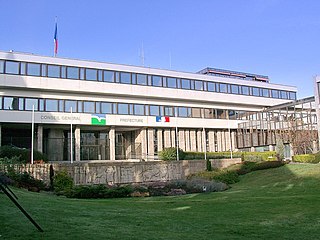
The Côtes-d'Armor, formerly known as Côtes-du-Nord until 1990, is a department in the north of Brittany, in northwestern France. In 2019, it had a population of 600,582.
Jèrriais is a Romance language and the traditional language of the Jersey people. It is a form of the Norman language spoken in Jersey, an island in the Channel Islands archipelago off the coast of France. Its closest relatives are the other Norman languages, such as Guernésiais, spoken in neighbouring Guernsey, and the other langues d'oïl.
A phonemic orthography is an orthography in which the graphemes correspond to the language's phonemes. Natural languages rarely have perfectly phonemic orthographies; a high degree of grapheme–phoneme correspondence can be expected in orthographies based on alphabetic writing systems, but they differ in how complete this correspondence is. English orthography, for example, is alphabetic but highly nonphonemic; it was once mostly phonemic during the Middle English stage, when the modern spellings originated, but spoken English changed rapidly while the orthography was much more stable, resulting in the modern nonphonemic situation. On the contrary the Albanian, Serbian/Croatian/Bosnian/Montenegrin, Romanian, Italian, Turkish, Spanish, Finnish, Czech, Latvian, Esperanto, Korean and Swahili orthographic systems come much closer to being consistent phonemic representations.

Of the languages of France, French is the sole official language according to the second article of the French Constitution. French, a Gallo-Romance language, is spoken by nearly the entire population of France.

The Celtic Revival is a variety of movements and trends in the 19th, 20th and 21st centuries that see a renewed interest in aspects of Celtic culture. Artists and writers drew on the traditions of Gaelic literature, Welsh-language literature, and Celtic art—what historians call insular art. Although the revival was complex and multifaceted, occurring across many fields and in various countries in Northwest Europe, its best known incarnation is probably the Irish Literary Revival. Irish writers including William Butler Yeats, Lady Gregory, "Æ" Russell, Edward Martyn, Alice Milligan and Edward Plunkett stimulated a new appreciation of traditional Irish literature and Irish poetry in the late 19th and early 20th century.
A nasal vowel is a vowel that is produced with a lowering of the soft palate so that the air flow escapes through the nose and the mouth simultaneously, as in the French vowel /ɑ̃/ or Amoy []. By contrast, oral vowels are produced without nasalization.

Gallo is a regional language of eastern Brittany. It is one of the langues d'oïl, a Romance sub-family that includes French. Today it is spoken only by a minority of the population, as the standard form of French now predominates in this area.

Cornouaille is a historical region on the west coast of Brittany in West France. The name is cognate with Cornwall in neighbouring Great Britain. This can be explained by the settlement of Cornouaille by migrant princes from Cornwall who created an independent principality founded by Rivelen Mor Marthou, and the founding of the Bishopric of Cornouaille by ancient saints from Cornwall. Celtic Britons and the settlers in Brittany spoke a common language, which later evolved into Breton, Welsh and Cornish.
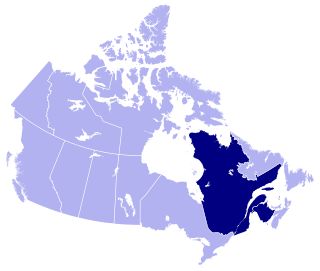
French is the mother tongue of approximately 7.2 million Canadians according to the 2016 Canadian Census. Most Canadian native speakers of French live in Quebec, the only province where French is the majority and the sole official language. Of Quebec's people, 71.2 percent are native francophones and 95 percent speak French as their first or second language.

The Bretons are an ethnic group native to Brittany, north-western France. They trace their heritage to groups of Brittonic speakers who emigrated from southwestern Great Britain, particularly Cornwall and Devon, mostly during the Anglo-Saxon settlement of Britain. They migrated in waves from the 3rd to 9th century into Armorica, which was subsequently named Brittany after them.

Louis-Paul Némo, better known by the pseudonym Roparz Hemon, was a Breton author and scholar of Breton expression. He was the author of numerous dictionaries, grammars, poems and short stories. He also founded Gwalarn, a literary journal in Breton where many young authors published their first writings during the 1920s and 1930s.
In Occitan, vergonha refers to the effects of various language discriminatory policies of the government of France on its minorities whose native language was deemed a patois, where a Romance language spoken in the country other than Standard French, such as Occitan or the langues d'oïl, as well as other non-Romance languages such as Alsatian and Basque, were suppressed. Vergonha is imagined as a process of "being made to reject and feel ashamed of one's mother tongue through official exclusion, humiliation at school and rejection from the media", as organized and sanctioned by French political leaders from Henri Grégoire onward.
