
Yokuts Valley is a census-designated place located in Fresno County, California at the foothills of the Sierra Nevada on State Route 180 just below Kings Canyon National Park.

The 1960 Winter Olympics were a winter multi-sport event held from February 18 to 28, 1960, at the Squaw Valley Resort in Squaw Valley, California, United States. The resort was chosen to host the Games at the 1956 meeting of the International Olympic Committee (IOC). Squaw Valley was an undeveloped resort in 1955, so the infrastructure and all of the venues were built between 1956 and 1960 at a cost of US$80,000,000. The layout was designed to be intimate, allowing spectators and competitors to reach most of the venues on foot.
Squaw Creek may refer to:
Clear Creek may refer to:
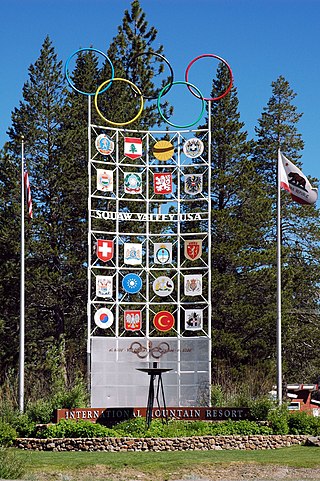
Olympic Valley is an unincorporated community located in Placer County, California northwest of Tahoe City along California State Highway 89 on the banks of the Truckee River near Lake Tahoe. It is home to Palisades Tahoe, the site of the 1960 Winter Olympics. Olympic Valley is the smallest resort area to host the Olympic Winter Games.

Palisades Tahoe is a ski resort in the western United States, located in Olympic Valley, California, northwest of Tahoe City in the Sierra Nevada range. From its founding in 1949, the resort was known as Squaw Valley, but it changed its name in 2021 due to the derogatory connotations of the word "squaw". It was the host site for the 1960 Winter Olympics.
The English word squaw is an ethnic and sexual slur, historically used for Indigenous North American women. Contemporary use of the term, especially by non-Natives, is considered derogatory, misogynist, and racist.

Hell Hole reservoir is an artificial, crescent-shaped lake in the Sierra Nevada mountain range 10 miles (16 km) west of Lake Tahoe in California, United States. The lake is about 3.5 miles (5.6 km) long when at full capacity.

The Greater Sacramento area refers to a metropolitan region in Northern California comprising either the U.S. Census Bureau defined Sacramento–Roseville–Arden-Arcade metropolitan statistical area or the larger Sacramento–Roseville combined statistical area, the latter of which consists of seven counties, namely Sacramento, Yolo, Placer, El Dorado, Sutter, Yuba, and Nevada counties.
Tahoma is a census-designated place in Placer and El Dorado counties, California, United States. Tahoma is located along Lake Tahoe 2 miles (3.2 km) southeast of Homewood. Tahoma has a population of 1,191.
For the 1960 Winter Olympics in Squaw Valley, California, in the United States, a total of five sports venues were used. Except for the Palisades Tahoe, all of the venues had to be constructed. For the first time in Winter Olympic history, a temporary venue was constructed at McKinney Creek for biathlon, cross-country skiing, and Nordic combined. A bobsleigh track was not constructed over the guarantees from the FIBT not being able to field the minimum twelve teams needed to compete, making it the only time bobsleigh has not been included in the Winter Olympics.
Alpine Meadows is a ski resort in the western United States, located in Alpine Meadows, California. Near the northwest shore of Lake Tahoe, it offers 2,400 acres (9.7 km2) of skiable terrain, 13 different lifts, and a vertical drop of 1,802 feet (549 m).

Andrew "Andy" Wirth is an American businessman and philanthropist who works in the mountain resort and hotel industry. He was most recently the president and CEO of Squaw Valley Ski Holdings, the parent company of Palisades Tahoe and Alpine Meadows ski resorts in Olympic Valley, CA until 2018. He is also the grandson of former US National Park Service Director Conrad Wirth and the great grandson of Theodore Wirth.
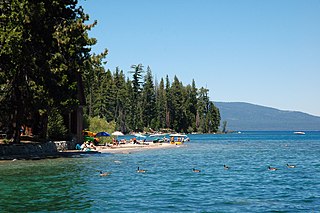
Ed Z'berg Sugar Pine Point State Park is a state park in California in the United States. It occupies nearly two miles of the western shore of Lake Tahoe and a total of about 1,000 hectares of forested mountains in El Dorado County. Originally called Sugar Pine Point State Park, its name was changed in 2003 to honor Edwin L. Z'berg, a California state assemblyman who specialized in environmental legislation and worked to develop state parks and other natural areas.
Salt Spring or Salt Springs may refer to:

The 1962 NCAA Skiing Championships were contested at the Squaw Valley Ski Resort in Olympic Valley, California at the ninth annual NCAA-sanctioned ski tournament to determine the individual and team national champions of men's collegiate alpine skiing, cross-country skiing, and ski jumping in the United States.


