Mathias Peter Møller, commonly known as M.P. Möller or Moeller, was a prolific pipe-organ builder and businessman. A native of the Danish island of Bornholm, he emigrated to the United States in 1872 and founded the M.P. Moller Pipe Organ Company in Greencastle, Pennsylvania, in 1875. The city of Hagerstown, Maryland, took notice of Möller's early successes and induced him to move his business there in 1881 to help make it a viable business center in Western Maryland. The company remained in business in Hagerstown. until 1992, with hundreds of employees at its peak and a lifetime production of over 12,000 instruments.

Lutheran Congregations in Mission for Christ (LCMC) is an association of Lutheran congregations located primarily in the United States. It describes itself as an affiliation of autonomous Lutheran churches and not a denomination. It began in 2001 in response to some liberal views of the Evangelical Lutheran Church in America (ELCA). LCMC is characterized by the stances it takes on Lutheran polity, biblical authority, and human sexuality. The group describes itself as "centrist" or "mainstream", noting that it stands between the more liberal ELCA and the more conservative Lutheran Church–Missouri Synod (LCMS) and other Lutheran church bodies in North America.

St. John's Lutheran Church is a congregation of the Lutheran Church–Missouri Synod located in Conover, North Carolina, and a member of the LCMS' Southeastern District. Officially formed in 1798, the church has a rich German history.

Trinity Evangelical Lutheran Church is a Victorian Gothic-style Lutheran church built in Milwaukee, Wisconsin in 1878 - then claimed to be "the finest church edifice within the Missouri Synod." Today it is listed on the National Register of Historic Places and is a designated State Historic Site. The building was also declared a Milwaukee Landmark in 1967, and today is the oldest church associated with the Lutheran Church–Missouri Synod in the city.
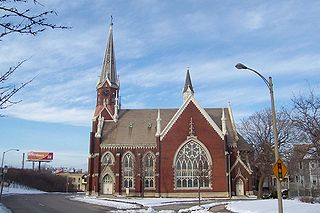
St. Stephen Lutheran Church, or Iglesia Luterana San Esteban, is a designated Milwaukee Landmark. It is in the historic Walker's Point district of Milwaukee, Wisconsin.

Lutheranism is present on all inhabited continents with an estimated 81 million adherents, out of which 74.2 million are affiliated with the Lutheran World Federation. A major movement that first began the Reformation, it constitutes one of the largest Protestant branches, claiming about 80 million of 920 million Protestants, The Lutheran World Federation brings together the vast majority of Lutherans, the second largest grouping being the International Lutheran Council with 7.15 million in 46 countries. Apart from it, there are also other organisations such as the Confessional Evangelical Lutheran Conference, as well as multiple independent Lutheran denominations.

Christ Church Lutheran is a congregation of the Evangelical Lutheran Church in America (ELCA) in Minneapolis. Its buildings—a sanctuary with chapel (1949) and an education wing (1962) designed by Finnish-American architects Eliel Saarinen and Eero Saarinen—have been internationally recognized, most recently in 2009 as a National Historic Landmark by the U.S Department of the Interior.
The Eielsen Synod was a Lutheran church body. It was founded in 1846 at Jefferson Prairie Settlement, Wisconsin, by a group of Haugean Lutherans led by Elling Eielsen, the first Norwegian Lutheran minister in the United States.
herchurch is another name used for the Ebenezer Lutheran Church in San Francisco, a congregation within the Evangelical Lutheran Church in America (ELCA). The church is a member of the San Francisco Council of Lutheran Churches. The church was founded on August 10, 1882, by Augustana Lutheran minister Johannes Telleen, who served as its pastor until 1890. The construction of the first church building was completed in 1895. For many years, the church primarily served the Swedish population; the original church building was designed by Swedish American architect August Nordin.
Redeemer Lutheran Church is a congregation of the Lutheran Church–Missouri Synod (LCMS) in Elmhurst, Illinois, a western suburb of Chicago. Founded in 1928, there were 495 baptized members. Three of Redeemer's pastors held rather long tenures; Rev. Worth Setzer served for nearly 31 years, Rev. George Bornemann for 17 years, Rev. Richard Drews for 26 years. Rev. Robert Fitzpatrick served for 7 years. Moreso recently, Rev. Scott Stiegemeyer served at Redeemer for five years; the current pastor is Rev. Anthony Oliphant, who was installed in the autumn of 2015.
The 2009 ELCA Churchwide Assembly was the eleventh biennial Churchwide Assembly of the Evangelical Lutheran Church in America. It convened in the city of Minneapolis, Minnesota, from August 17–23, 2009. The Churchwide Assembly is the 'highest legislative authority' of the ELCA.

St. Paul Lutheran Church is located in central, Davenport, Iowa, United States. It is affiliated with the Evangelical Lutheran Church in America (ELCA). The church's original property, which subsequently housed other Protestant congregations, was listed on the National Register of Historic Places in 1983, but has since been torn down. The present complex was built in 1952 and contains two buildings that are contributing properties in the Vander Veer Park Historic District. The present church building was completed in 2007.

The German Evangelical Lutheran Church of Charleston, South Carolina, was incorporated on December 3, 1840. Through usage and custom the Church is now known as St. Matthew's German Evangelical Lutheran Church or St. Matthew's Lutheran Church and is a member of the South Carolina Synod of the Evangelical Lutheran Church in America.
St. John's Lutheran Church is a Lutheran church in Atlanta, Georgia. First organized in 1869, the church moved to its current location in 1959.

First Congregational Church of Los Angeles is located at 540 South Commonwealth Avenue, Los Angeles, California, United States. It is a member of the United Church of Christ. Founded in 1867, the church is the city's oldest continuous Protestant congregation. The congregation moved around using a variety of buildings until it moved to its current location in 1932, with the first service being held on March 13, 1932.

St. John's Lutheran Church is a member congregation of the American Association of Lutheran Churches (AALC) in Pocahontas, Missouri.

The Sierra Pacific Synod is one of the 65 synods of the Evangelical Lutheran Church in America (ELCA). It covers central and northern California and northern Nevada and supports ELCA congregations throughout that region. It is headed by a bishop, most recently by Megan Rohrer who resigned on June 6, 2022.

The Lutheran Church of the Redeemer is a Lutheran church in midtown Atlanta, Georgia. The congregation was founded in the city in 1903, with the current building constructed in 1952.

