Related Research Articles

A subwoofer is a loudspeaker designed to reproduce low-pitched audio frequencies, known as bass and sub-bass, that are lower in frequency than those which can be (optimally) generated by a woofer. The typical frequency range that is covered by a subwoofer is about 20–200 Hz for consumer products, below 100 Hz for professional live sound, and below 80 Hz in THX-certified systems. Thus, one or more subwoofers are important for high-quality sound reproduction as they are responsible for the lowest two to three octaves of the ten octaves that are audible. This very low-frequency (VLF) range reproduces the natural fundamental tones of the bass drum, electric bass, double bass, grand piano, contrabassoon, tuba, in addition to thunder, gunshots, explosions, etc.

A microphone, colloquially called a mic, or mike, is a transducer that converts sound into an electrical signal. Microphones are used in many applications such as telephones, hearing aids, public address systems for concert halls and public events, motion picture production, live and recorded audio engineering, sound recording, two-way radios, megaphones, and radio and television broadcasting. They are also used in computers and other electronic devices, such as mobile phones, for recording sounds, speech recognition, VoIP, and other purposes, such as ultrasonic sensors or knock sensors.

Audio feedback is a positive feedback situation that may occur when an acoustic path exists between an audio input and an audio output. In this example, a signal received by the microphone is amplified and passed out of the loudspeaker. The sound from the loudspeaker can then be received by the microphone again, amplified further, and then passed out through the loudspeaker again. The frequency of the resulting howl is determined by resonance frequencies in the microphone, amplifier, and loudspeaker, the acoustics of the room, the directional pick-up and emission patterns of the microphone and loudspeaker, and the distance between them. The principles of audio feedback were first discovered by Danish scientist Søren Absalon Larsen, hence it is also known as the Larsen effect.

A mixing console or mixing desk is an electronic device for mixing audio signals, used in sound recording and reproduction and sound reinforcement systems. Inputs to the console include microphones, signals from electric or electronic instruments, or recorded sounds. Mixers may control analog or digital signals. The modified signals are summed to produce the combined output signals, which can then be broadcast, amplified through a sound reinforcement system or recorded.

Surround sound is a technique for enriching the fidelity and depth of sound reproduction by using multiple audio channels from speakers that surround the listener. Its first application was in movie theaters. Prior to surround sound, theater sound systems commonly had three screen channels of sound that played from three loudspeakers located in front of the audience. Surround sound adds one or more channels from loudspeakers to the side or behind the listener that are able to create the sensation of sound coming from any horizontal direction around the listener.

An instrument amplifier is an electronic device that converts the often barely audible or purely electronic signal of a musical instrument into a larger electronic signal to feed to a loudspeaker. An instrument amplifier is used with musical instruments such as an electric guitar, an electric bass, electric organ, electric piano, synthesizers and drum machine to convert the signal from the pickup or other sound source into an electronic signal that has enough power, due to being routed through a power amplifier, capable of driving one or more loudspeaker that can be heard by the performers and audience.
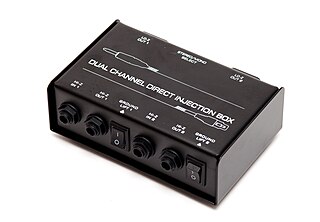
A DI unit is an electronic device typically used in recording studios and in sound reinforcement systems to connect a high output impedance unbalanced output signal to a low-impedance, microphone level, balanced input, usually via an XLR connector and XLR cable. DIs are frequently used to connect an electric guitar or electric bass to a mixing console's microphone input jack. The DI performs level matching, balancing, and either active buffering or passive impedance matching/impedance bridging. DI units are typically metal boxes with input and output jacks and, for more expensive units, “ground lift” and attenuator switches.
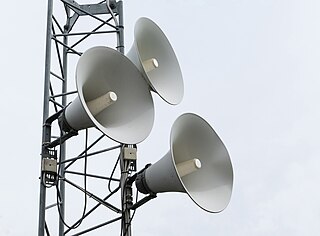
A public address system is an electronic system comprising microphones, amplifiers, loudspeakers, and related equipment. It increases the apparent volume (loudness) of a human voice, musical instrument, or other acoustic sound source or recorded sound or music. PA systems are used in any public venue that requires that an announcer, performer, etc. be sufficiently audible at a distance or over a large area. Typical applications include sports stadiums, public transportation vehicles and facilities, and live or recorded music venues and events. A PA system may include multiple microphones or other sound sources, a mixing console to combine and modify multiple sources, and multiple amplifiers and loudspeakers for louder volume or wider distribution.
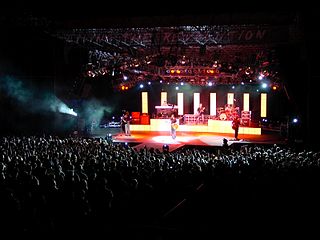
A sound reinforcement system is the combination of microphones, signal processors, amplifiers, and loudspeakers in enclosures all controlled by a mixing console that makes live or pre-recorded sounds louder and may also distribute those sounds to a larger or more distant audience. In many situations, a sound reinforcement system is also used to enhance or alter the sound of the sources on the stage, typically by using electronic effects, such as reverb, as opposed to simply amplifying the sources unaltered.

There are a number of well-developed microphone techniques used for recording musical, film, or voice sources or picking up sounds as part of sound reinforcement systems. The choice of technique depends on a number of factors, including:

Live sound mixing is the blending of multiple sound sources by an audio engineer using a mixing console or software. Sounds that are mixed include those from instruments and voices which are picked up by microphones and pre-recorded material, such as songs on CD or a digital audio player. Individual sources are typically equalised to adjust the bass and treble response and routed to effect processors to ultimately be amplified and reproduced via a loudspeaker system. The live sound engineer listens and balances the various audio sources in a way that best suits the needs of the event.

In-ear monitors, or simply IEMs or in-ears, are devices used by musicians, audio engineers and audiophiles to listen to music or to hear a personal mix of vocals and stage instrumentation for live performance or recording studio mixing. They are also used by television presenters to receive vocal instructions, information and breaking news announcements from a producer that only the presenter hears. They are often custom-fitted to an individual's ears to provide comfort and a high level of noise reduction from ambient surroundings. Their origins as a tool in live music performance can be traced back to the mid-1980s.

Lipinski Sound is a professional market and audiophile oriented manufacturer of loudspeakers, subwoofers, powered speaker stands, surround sound systems, power amplifiers, microphones, and microphone preamplifiers.
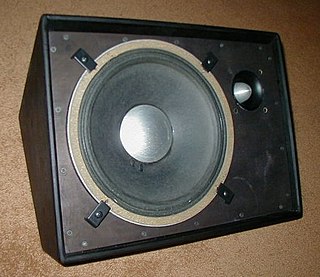
A stage monitor system is a set of performer-facing loudspeakers called monitor speakers, stage monitors, floor monitors, wedges, or foldbacks on stage during live music performances in which a sound reinforcement system is used to amplify a performance for the audience. The monitor system allows musicians to hear themselves and fellow band members clearly.
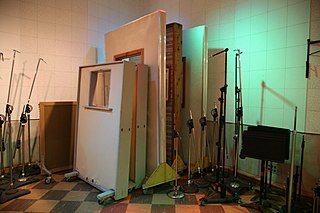
Spill is the occurrence in sound recording and live sound mixing whereby sound is picked up by a microphone from a source other than that which is intended. Spill is usually seen as a problem, and various steps are taken to avoid it or reduce it. In some styles of music, such as orchestral music, jazz, and blues, it is more likely to be accepted or even seen as desirable.

Equalization, or simply EQ, in sound recording and reproduction is the process of adjusting the volume of different frequency bands within an audio signal. The circuit or equipment used to achieve this is called an equalizer.
In live sound mixing, gain before feedback (GBF) is a practical measure of how much a microphone can be amplified in a sound reinforcement system before causing audio feedback. In audiology, GBF is a measure of hearing aid performance. In both fields the amount of gain is measured in decibels at or just below the point at which the sound from the speaker driver re-enters the microphone and the system begins to ring or feed back. Potential acoustic gain (PAG) is a calculated figure representing gain that a system can support without feeding back.

A matrix mixer is an audio electronics device that routes multiple input audio signals to multiple outputs. It usually employs level controls such as potentiometers to determine how much of each input is going to each output, and it can incorporate simple on/off assignment buttons. The number of individual controls is at least the number of inputs multiplied by the number of outputs.
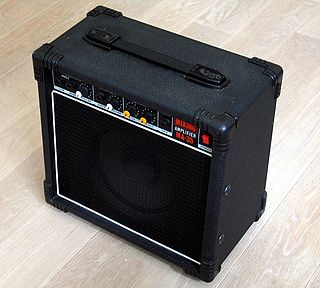
A keyboard amplifier is a powered electronic amplifier and loudspeaker in a wooden speaker cabinet used for the amplification of electronic keyboard instruments. Keyboard amplifiers are distinct from other types of amplification systems such as guitar amplifiers due to the particular challenges associated with making keyboards sound louder on stage; namely, to provide solid low-frequency sound reproduction for the deep basslines that keyboards can play and crisp high-frequency sound for the high-register notes. Another difference between keyboard amplifiers and guitar/bass amplifiers is that keyboard amps are usually designed with a relatively flat frequency response and low distortion. In contrast, many guitar and bass amp designers purposely make their amplifiers modify the frequency response, typically to "roll-off" very high frequencies, and most rock and blues guitar amps, and since the 1980s and 1990s, even many bass amps are designed to add distortion or overdrive to the instrument tone.
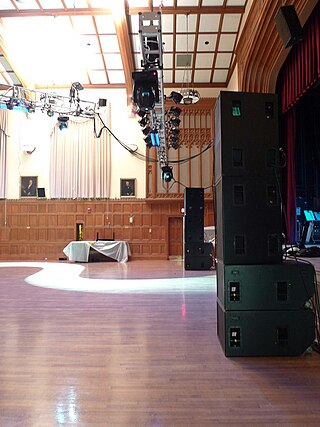
A professional audio store is a retail business that sells, and in many cases rents, sound reinforcement system equipment and PA system components used in music concerts, live shows, dance parties and speaking events. This equipment typically includes microphones, power amplifiers, electronic effects units, speaker enclosures, monitor speakers, subwoofers and audio consoles (mixers). Some professional audio stores also sell sound recording equipment, DJ equipment, lighting equipment used in nightclubs and concerts and video equipment used in events, such as video projectors and screens. Some professional audio stores rent "backline" equipment used in rock and pop shows, such as stage pianos and bass amplifiers. While professional audio stores typically focus on selling new merchandise, some stores also sell used equipment, which is often the equipment that the company has previously rented out for shows and events.
References
- 1 2 Main, Bruce (February 16, 2010). "Cut 'Em Off At The Pass: Effective Uses Of High-Pass Filtering". Live Sound International. Framingham, Massachusetts: ProSoundWeb, EH Publishing.
- ↑ "Microphone Polar Patterns -- Understanding Cardioid, Hypercardioid, and More -- All About Mics". homerecording.about.com. Archived from the original on 2007-10-18.
- ↑ "ClearSonic Panel". www.clearsonic.com. Archived from the original on 2007-03-10.
 | This sound technology article is a stub. You can help Wikipedia by expanding it. |