
The Albert Memorial, directly north of the Royal Albert Hall in Kensington Gardens, London, was commissioned by Queen Victoria in memory of her beloved husband Prince Albert, who died in 1861. Designed by Sir George Gilbert Scott in the Gothic Revival style, it takes the form of an ornate canopy or pavilion 176 feet (54 m) tall, in the style of a Gothic ciborium over the high altar of a church, sheltering a statue of the prince facing south. It took over ten years to complete, the £120,000 cost met by public subscription.

Sir William Hamo Thornycroft was an English sculptor, responsible for some of London's best-known statues, including the statue of Oliver Cromwell outside the Palace of Westminster. He was a keen student of classical sculpture and was one of the youngest artists to be elected to the Royal Academy, in 1882, the same year the bronze cast of Teucer was purchased for the British nation under the auspices of the Chantrey Bequest.
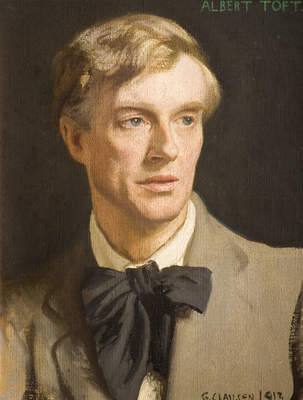
Albert Toft was a British sculptor.
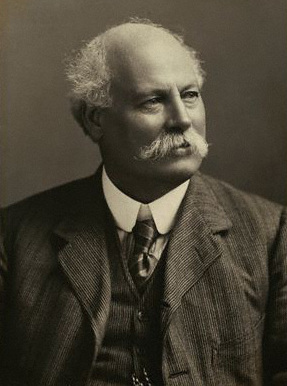
Sir Thomas Brock was an English sculptor and medallist, notable for the creation of several large public sculptures and monuments in Britain and abroad in the late nineteenth and early twentieth centuries. His most famous work is the Victoria Memorial in front of Buckingham Palace, London. Other commissions included the redesign of the effigy of Queen Victoria on British coinage, the massive bronze equestrian statue of Edward, the Black Prince, in City Square, Leeds and the completion of the statue of Prince Albert on the Albert Memorial.

Mary Thornycroft was a British sculptor who sculpted many different busts, fragments and statues. She frequently choose infants and children as her subjects and was commissioned by Queen Victoria to create a number of statues and portraits of her children and other members of the royal family. Several of these are now in the British Royal Collection.

Thomas Thornycroft was an English sculptor and engineer.
Seth Edulji Dinshaw was a Karachi-based Parsi philanthropist during the British colonial era. Dinshaw had risen from poverty, and became the largest landowner in the city.

Charles John Allen was a British sculptor, and a figure in the New Sculpture movement.

Farmer & Brindley was a firm of architectural sculptors and ornamentalists based in London, founded by William Farmer (1825–1879) and William Brindley (1832–1919).

Helen Thornycroft was an English painter and watercolourist of the Victorian era.
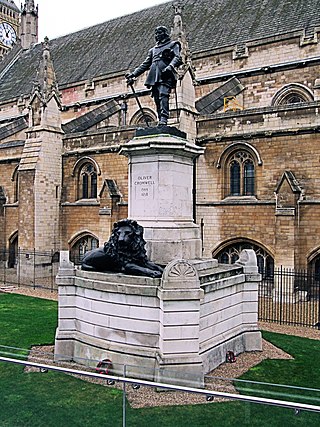
A statue of Oliver Cromwell stands outside the House of Commons of the United Kingdom in Westminster, London. Oliver Cromwell was Lord Protector of the Commonwealth of England, Scotland and Ireland between 1653 and 1658. Directly opposite the statue, in the wall of St Margaret's Church, on the other side of the road, is a bust of Charles I, which is often unnoticed.

Boadicea and Her Daughters is a bronze sculptural group in London representing Boudica, queen of the Celtic Iceni tribe, who led an uprising in Roman Britain. It is located to the north side of the western end of Westminster Bridge, near Portcullis House and Westminster Pier, facing Big Ben and the Palace of Westminster across the road. It is considered the magnum opus of its sculptor, the English artist and engineer Thomas Thornycroft. Thornycroft worked on it from 1856 until shortly before his death in 1885, sometimes assisted by his son William Hamo Thornycroft, but it was not erected in its current position until 1902.
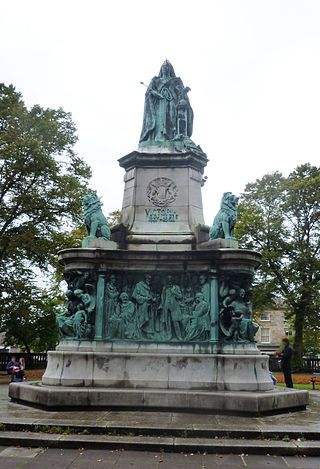
The Queen Victoria Memorial in Lancaster, Lancashire, England, is a Grade II* listed building. It stands in the centre of Dalton Square, Lancaster facing Lancaster Town Hall. It was erected in 1906, being commissioned and paid for by James Williamson, 1st Baron Ashton.

The Thames Ditton Foundry was a foundry in Thames Ditton, Surrey, which operated from 1874 to 1939 and which under various owners produced numerous major statues and monuments as one of the United Kingdom's leading firms of bronze founders.

The Poets' Fountain was a public fountain with sculptures that was installed on a traffic island in Park Lane, London, in 1875. It was removed in 1948 and it is thought to have been destroyed. One sculpture, an allegorical figure of Fame, is known to have survived and is displayed in the gardens at Renishaw Hall in Derbyshire.

A bronze statue of General Charles George Gordon by Hamo Thornycroft stands on a stone plinth in the Victoria Embankment Gardens in London. It has been Grade II listed since 1970. A similar statue stands at Gordon Reserve, near Parliament House in Melbourne, Australia, on its original tall plinth.
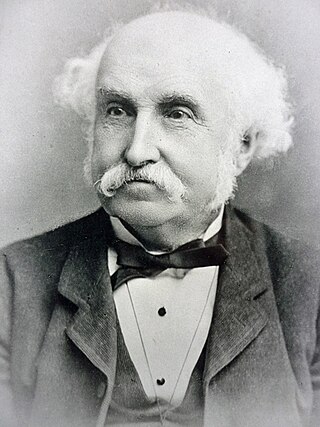
John Webb Singer was an English businessman who created a substantial art foundry in Frome, Somerset, known for its statuary and ecclesiastical products. He had assembled immense collections of antique jewellery, rings, wine glasses, snuffboxes, stamps. He took a prominent part in both local and national politics, serving on the Local Board and its successor the Urban District Council, founding the Frome Art School and helping to create the Frome Literary and Scientific Institution. He worked with the leading bronze sculptors of his day.

The Gladstone Memorial on the Strand, London is a bronze sculpture of the British statesman, created by Hamo Thornycroft between 1899-1905. The statue was erected as the national memorial to Gladstone and shows him in the robes of the Chancellor of the Exchequer. The figure stands on a plinth surrounded by allegorical figures depicting four of the Virtues, Courage, Brotherhood, Education and Aspiration. The memorial is a Grade II listed structure.

Wellington's Queen Victoria Monument is an early 20th-century statue of Queen Victoria by British sculptor Alfred Drury. Copied after Drury's earlier 1903 Portsmouth statue, Victoria is depicted standing triumphantly in her Robe of State and widow's cap, holding a royal scepter and orb. The monument's plinth additionally features a plaque and three bronze reliefs, designed in the New Sculpture style, depicting the Treaty of Waitangi and various artistic and scientific inventions of the Victorian era.

A statue of Queen Victoria was erected at Albert Park, Auckland, in 1899. The second monument to Queen Victoria in New Zealand, the bronze statue was funded by public donations encouraged by Auckland politicians and the New Zealand Herald in celebration of the Queen's Diamond Jubilee. Following applications from various British and New Zealand artists, the statue was commissioned to British portrait sculptor Francis John Williamson. It was one of nine variants of his 1887 statue erected at the Royal College of Surgeons, allegedly a favourite of the future Edward VII.

