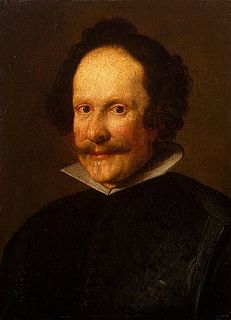
Claudio Coello was a Spanish Baroque painter. Coello is considered the last great Spanish painter of the 17th century.

Francesco Costanzo Cattaneo was an Italian painter of the Baroque period, born and mainly active in Ferrara. He is also known as Costanzo or Costanza Cattanio.

Mario Balassi (1604–1667) was an Italian painter of the Baroque period, active in Florence and Rome.
Giovanni Domenico Cappellino (1580–1651) was an Italian painter of the Renaissance period, active mainly in his natal city of Genoa. He was the pupil of the painter Giovanni Battista Paggi. At age 22, he painted a Saint Sebastian for the church of Santa Sabina. He contributed a canvas to the Oratory of San Giacomo della Marina. In Genoa, he painted a Death of St. Francis for the church of San Niccolo, and a St. Francesca Romana for the church of San Stefano.
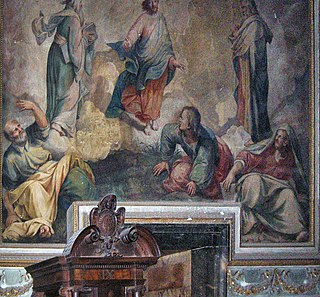
Durante Alberti was an Italian painter of the late-Renaissance period.
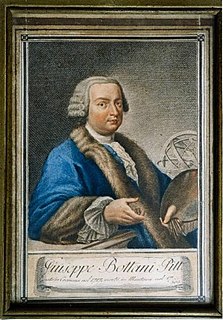
Giuseppe Bottani was an Italian painter active in the Baroque period.
Giuseppe Antonio Caccioli was an Italian painter of the Baroque period.
Padre Stefano Cassiani was an Italian painter of the Baroque.

Andrea Busati di Stefano was an Italian painter of Albanian origin during the Renaissance period. Andrea was the son of Stefano Busati who had fled to Venice from Albania. He was a follower of the Giovanni Bellini, is the author of a signed St. Mark enthroned between SS. Francis and Andrew, painted about 1510, and now in the Gallerie dell'Accademia in Venice. A figure of a Saint in the Vicenza Gallery is also ascribed to him.
Stefano Torelli (1712–1784) was an Italian painter. He was born in Bologna. He studied first under his father, Felice Torelli, and then under Francesco Solimena. The future King of Poland, Augustus III, brought him to Dresden in 1740, where he painted altar-pieces and ceiling decorations, many destroyed in the Seven Years' War. He painted figures in Canaletto's twenty-nine views of Dresden (1741). In 1762 he was summoned to the Russian court where he painted ceilings in the Royal Palace, and some portraits, among the latter one of the Empress Elizabeth in armor. He was a clever caricaturist, and etched a few plates. He died in St. Petersburg.

Vincenzo Ansaloni was a native of Bologna, and a disciple of Lodovico Carracci. Under so able an instructor he became a reputable painter of history. Malvasia speaks in very favourable terms of an altar-piece by this master, in the chapel of the family of Fioravanti, in the church of Santo Stefano of Bologna, representing the 'Martyrdom of St. Sebastian.' His main work is a picture in the church of the Celestine Monks, representing the Virgin Mary with the Infant Saviour in the clouds, and below, St Roch and St Sebastian. According to Zani, he flourished about 1615, and died young.

Victor Boucquet or Vigor Boucquet, a Flemish painter, was born at Veurne in 1619. He was the son of Marcus Boucquet, a painter little known. Descamps supposes he must have visited Italy, as his works exhibit a manner that partakes little of the taste of his country. He painted historical subjects, and was also esteemed as a portrait painter. His works are distributed in the different churches of the towns in Flanders. They are well composed, and, like those of most of the artists of his country, are well coloured. In the great church of Nieuport are two altar-pieces by this master, one of which, representing 'The Death of St. Francis,' is particularly admired; and in the town-house there is a large picture by him, considered as his principal work, representing 'The Judgment of Cambyses.' The principal altar-piece in the church at Ostend is by Boucquet: it represents the Taking down from the Cross. He died at Furnes in 1677.

Sigismondo Caula (1637–1724) was an Italian painter of the Baroque style.
Johann Dallinger von Dalling (1741–1806) was an Austrian painter born in Vienna. He distinguished himself as director of the Liechtenstein Gallery. He painted animals, historical subjects, and large altar-pieces, most of which are in Russia and Poland.
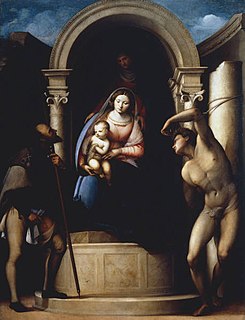
Sebastiano Florigerio was an Italian painter of the Renaissance period.

Niccolò Frangipane was an Italian artist of the late Renaissance period.
Gaetano Alemani was an Italian painter, active mainly in Bologna in the architectural and ornamental painting (quadratura) for the decoration of churches and theatres, as well as a scenic designer.
Stefano Orlandi was an Italian painter, active mainly in Bologna in the architectural perspective painting. He is known for painting fanciful architectural canvases, known as Capricci.

Santa Croce is a Roman Catholic church located on Corso Vittorio Emanuele 178 in Padua, Veneto region, Italy.
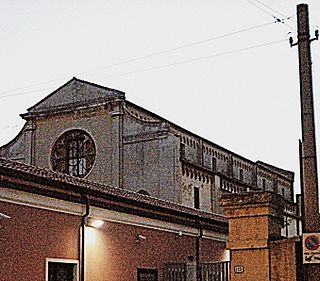
San Giovanni di Verdara or Saint John of Verdara is a former Roman Catholic monastery and church located on Via San Giovanni di Verdara # 123, in the city of Padua, region of Veneto, Italy. It was founded in 1221, but now serves as a military hospital, and is not accessible to the public.


