
Bristol Parkway, on the South Wales Main Line, is in the Stoke Gifford area in the northern suburbs of the Bristol conurbation. It is 112 miles (180 km) from London Paddington. The station was opened in 1972 by British Rail, and was the first in a new generation of park and ride/parkway stations. It is the third-most heavily used station in the West of England local authority area, after Bristol Temple Meads and Bath Spa. There are four platforms, and a well-equipped waiting area. The station is managed by Great Western Railway, who provide most of the trains at the station, with CrossCountry providing the rest.
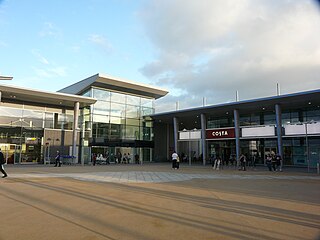
Bradley Stoke is a town in South Gloucestershire, England, situated 6 miles northeast of Bristol, It is near the Severn Estuary of the Bristol Channel, which is an extension of the North Atlantic Ocean, separating South Wales from South West England. Bradley Stoke is bordered by three motorways; the M5 to the north, the M4 to the east and the M32 to the south.

Filton is a town and civil parish in South Gloucestershire, England, 6 miles (10 km) north of Bristol. Along with nearby Patchway and Bradley Stoke, Filton forms part of the Bristol urban area and has become an overflow settlement for the city. Filton Church dates back to the 12th century and is designated a Grade II listed building.

Patchway is a town in South Gloucestershire, England, situated 10 km (6.2 mi) north-north west of central Bristol. The town has become an overflow settlement for Bristol and is contiguous with Bristol's urban area, along with the nearby towns of Filton and Bradley Stoke.
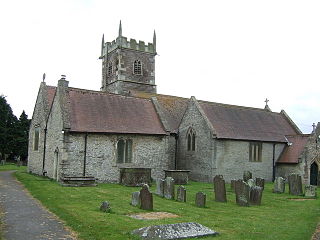
Stoke Gifford is a village and parish in South Gloucestershire, England. It had around 11,000 residents at the 2001 census, increasing to 15,494 at the 2011 census and then to 19,794 in the 2021 Census.

Little Stoke is a village in the parish of Stoke Gifford, situated in South Gloucestershire, England. It is surrounded by Patchway, Stoke Gifford and Bradley Stoke. Home to Patchway railway station, a minor stop on the railway network, the railway line separates Little Stoke from the large Rolls-Royce factories in nearby Filton. Gipsy Patch Lane Bridge provides access under the line.

Bristol North West is a constituency represented in the House of Commons of the UK Parliament since 2017 by Darren Jones of the Labour Party.

Filton and Bradley Stoke is a constituency represented in the House of Commons of the UK Parliament since 2010 by Jack Lopresti, a Conservative.

Stoke Bishop is a medium-sized outer city suburb in the north-west of Bristol, located in between Westbury-on-Trym, Sneyd Park, and Sea Mills. Although relatively low, Stoke Bishop's population has increased due to substantial infilling on the Smelting Works sports ground and The Grove which used to belong to Clifton High school. The population of Stoke Bishop varies throughout the year because of the influx of students to the large campus of Bristol University halls of residence situated on the edge of the suburb and the Downs during term time.

Sneyd Park is a suburb of Bristol, England, lying on the western fringe of Clifton Down, adjacent to the Avon Gorge and the Sea Walls observation point. It is part of the Stoke Bishop district. Home to many millionaires, Sneyd Park was originally developed in Victorian times. Many Victorian and Edwardian villas line the edge of the Downs. More modern housing has since been built down over the slope, towards Sea Mills, Bristol. Much of this development was carried out by the Stride family builders whose practice was "to purchase an estate freehold and to erect thereon their own houses, with the knowledge that none will be able to come along and dump a lot of cheap houses down in the neighbourhood, thereby spoiling the amenities of the place and detracting from the value of the houses erected by the firm." The 'Stride brothers' specialised in constructing individual style homes with the emphasis on location, finish and design. Buildings were never duplicated and no two were built to the same design. They often have solid oak interior doors, oak-panelled hallways, the hallmark Stride letterboxes and impressive staircases. Brothers Jared and Jethro Stride founded the business in the 1920s, followed by Jared's sons Arthur and Frederick, and then their sons Leslie and Raymond. In 1864 Jared and Jethro's brother Lot was killed in an accident in a sawmill in Cardiff when his hair was caught in the revolving saw. The incident made the newspapers around the world. Prior to developing Sneyd Park Edwin Stride and his sons Jared and Jethro had set up the Crown Brick Works in Shirehampton to supply bricks for the docks then under construction.

The English city of Bristol has a number of parks and public open spaces.
The city of Bristol, England, is divided into many areas, which often overlap or have non-fixed borders. These include Parliamentary constituencies, council wards and unofficial neighbourhoods. There are no civil parishes in Bristol.

Bristol Byzantine is a variety of Byzantine Revival architecture that was popular in the city of Bristol from about 1850 to 1880.
Cheswick is a new village bridging the South Gloucestershire and Bristol borders. It straddles the boundaries of Stoke Gifford, Filton and Lockleaze and lies close to the major employment sites of the University of the West of England (UWE), MoD Abbey Wood and Hewlett Packard. The development has three points of motor vehicular access: From Coldharbour Lane, just south of the UWE East Entrance, and two bus and cycle only routes from the Abbey Wood Roundabout on the A4174 Avon Ring Road and from Lockleaze.

The Dower House, Stoke Park is a dower house in Bristol, England. It is one of Bristol's more prominent landmarks, set on Purdown, a hill above the M32 motorway on the main approach into the city, and painted yellow.

Stoke Park is a public open space of 108 hectares in Bristol, England. It occupies a prominent position on the eastern flanks of Purdown, alongside the M32 motorway, together with the landmark Dower House and Purdown transmitter. Approximately 80% of the park is within the Bristol ward of Lockleaze; the remainder is within South Gloucestershire.

Stoke Park Hospital, was a large hospital for the mental handicapped, closed circa 1997, situated on the north-east edge of Bristol, England, just within South Gloucestershire. Most patients were long-term residents, both adults and children of all ages. A school was on-site. Prior to 1950, it was known as the Stoke Park Colony, which was founded in 1909.

MetroBus is a bus rapid transit system in Bristol, England, created as a joint project between Bristol, North Somerset and South Gloucestershire councils. The first route, service m3, began operations on 29 May 2018, followed by m2 on 3 September 2018, m1 on 6 January 2019 and m4 on 22 January 2023.
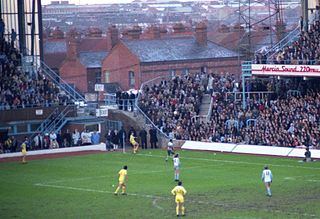
On 19 May 1977, the English association football clubs Coventry City and Bristol City contested a match in the Football League First Division at Highfield Road, Coventry. It was the final game of the 1976–77 Football League season for both clubs, and both faced potential relegation to the Second Division. A third club, Sunderland, were also in danger of relegation and were playing their final game at the same time, against Everton at Goodison Park.
