Related Research Articles
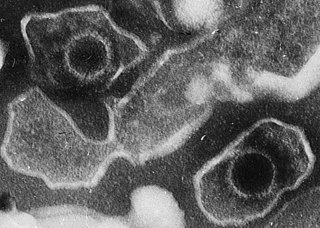
The Epstein–Barr virus (EBV), formally called Human gammaherpesvirus 4, is one of the nine known human herpesvirus types in the herpes family, and is one of the most common viruses in humans. EBV is a double-stranded DNA virus. Epstein-Barr virus (EBV) is the first identified oncogenic virus, which establishes permanent infection in humans. EBV causes infectious mononucleosis and is also tightly linked to many malignant diseases. Various vaccine formulations underwent testing in different animals or in humans. However, none of them was able to prevent EBV infection and no vaccine has been approved to date.
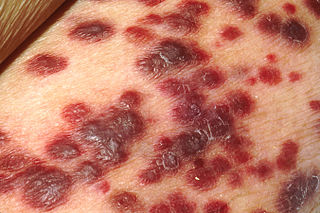
Kaposi's sarcoma-associated herpesvirus (KSHV) is the ninth known human herpesvirus; its formal name according to the International Committee on Taxonomy of Viruses (ICTV) is Human gammaherpesvirus 8, or HHV-8 in short. Like other herpesviruses, its informal names are used interchangeably with its formal ICTV name. This virus causes Kaposi's sarcoma, a cancer commonly occurring in AIDS patients, as well as primary effusion lymphoma, HHV-8-associated multicentric Castleman's disease and KSHV inflammatory cytokine syndrome. It is one of seven currently known human cancer viruses, or oncoviruses. Even after many years since the discovery of KSHV/HHV8, there is no known cure for KSHV associated tumorigenesis.
Virus latency is the ability of a pathogenic virus to lie dormant within a cell, denoted as the lysogenic part of the viral life cycle. A latent viral infection is a type of persistent viral infection which is distinguished from a chronic viral infection. Latency is the phase in certain viruses' life cycles in which, after initial infection, proliferation of virus particles ceases. However, the viral genome is not eradicated. The virus can reactivate and begin producing large amounts of viral progeny without the host becoming reinfected by new outside virus, and stays within the host indefinitely.

Herpesviridae is a large family of DNA viruses that cause infections and certain diseases in animals, including humans. The members of this family are also known as herpesviruses. The family name is derived from the Greek word ἕρπειν, referring to spreading cutaneous lesions, usually involving blisters, seen in flares of herpes simplex 1, herpes simplex 2 and herpes zoster (shingles). In 1971, the International Committee on the Taxonomy of Viruses (ICTV) established Herpesvirus as a genus with 23 viruses among four groups. As of 2020, 115 species are recognized, all but one of which are in one of the three subfamilies. Herpesviruses can cause both latent and lytic infections.
Gammaherpesvirinae is a subfamily of viruses in the order Herpesvirales and in the family Herpesviridae. Viruses in Gammaherpesvirinae are distinguished by reproducing at a more variable rate than other subfamilies of Herpesviridae. Mammals serve as natural hosts. There are 43 species in this subfamily, divided among 7 genera with three species unassigned to a genus. Diseases associated with this subfamily include: HHV-4: infectious mononucleosis. HHV-8: Kaposi's sarcoma.

The mir-BHRF1-1 microRNA precursor found in Human herpesvirus 4 and Cercopithicine herpesvirus 15. In Epstein–Barr virus, mir-BHRF1-1 is found in the 5' UTR of the BHRF1 gene, which is known to encode a distant Bcl-2 homolog. The mature sequence is excised from the 5' arm of the hairpin. Two other miRNA precursors were found in this reading frame, namely Mir-BHRF1-2 and Mir-BHRF1-3.

The mir-BHRF1-2 microRNA precursor found in human herpesvirus 4, cercopithicine herpesvirus 15 and herpesvirus papio. In Epstein-Barr virus, mir-BHRF1-2 is found in the 3' UTR of the BHRF1 gene, which is known to encode a distant Bcl-2 homolog. The mature sequence is excised from the 3' arm of the hairpin. Two other miRNA precursors were found in this reading frame, namely Mir-BHRF1-1 and Mir-BHRF1-3.

The mir-BHRF1-3 microRNA precursor found in Human herpesvirus 4. In Epstein-Barr virus, mir-BHRF1-3 is found in the 3' UTR of the BHRF1 gene, which is known to encode a distant Bcl-2 homolog. The mature sequence is excised from the 5' arm of the hairpin. Two other miRNA precursors were found in this reading frame, namely Mir-BHRF1-1 and Mir-BHRF1-2.
Strawberry crinkle cytorhabdovirus, commonly called Strawberry crinkle virus (SCV), is a negative sense single stranded RNA virus that threatens strawberry production worldwide. This virus reduces plant rigidity, runner production, fruit size, and production, while causing distortion and crinkling of the leaves. This virus was first described in 1932 in Oregon and California with commercial strawberry varieties, and later became an issue around the world, including North America, South America, Europe, South Africa, New Zealand, Australia, and Japan. Of the family Rhabdoviridae, it is a large family of viruses that affects plants, vertebrates, and invertebrates. Specifically, this virus infects strawberry plants of the genus Fragaria and is transmitted through two aphid vectors that feed on strawberries, Chaetosiphon fragaefolii and C. jacobi. When SCV is combined with other aphid-transmitted strawberry viruses, such as mottle, mild yellow-edge, vein banding, or pallidosis, the damage becomes even more deleterious. Economically, the only significant host of SCV is Fragaria ananassa.
Stralarivirus fragariae is a plant pathogenic virus in the genus Stralarivirus.
Strawberry mild yellow-edge virus (SMYEV) is a pathogenic plant virus.

Strawberry vein banding virus (SVBV) is a plant pathogenic virus and a member of the family Caulimoviridae.

Ilarvirus is a genus of positive-strand RNA viruses in the family Bromoviridae. Plants serve as natural hosts. There are 22 species in this genus.
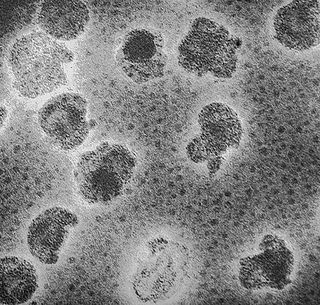
Plasmaviridae is a family of bacteria-infecting viruses. Acholeplasma species serve as natural hosts. There is one genus in the family, Plasmavirus, which contains one species: Acholeplasma virus L2. All viruses known in this family have been isolated from species in the class Mollicutes.

Carlavirus, formerly known as the "Carnation latent virus group", is a genus of viruses in the order Tymovirales, in the family Betaflexiviridae. Plants serve as natural hosts. There are 53 species in this genus. Diseases associated with this genus include: mosaic and ringspot symptoms.
Epstein–Barr virus latent membrane protein 1 (LMP1) is an Epstein–Barr virus (EBV) protein that regulates its own expression and the expression of human genes. It has a molecular weight of approximately 63 kDa, and its expression induces many of the changes associated with EBV infections and activation of primary B cells. LMP1 is the best-documented oncoprotein of the EBV latent gene products, as it is expressed in most EBV-related human cancers such as the various malignant Epstein-Barr virus-associated lymphoproliferative diseases.
Ringspot, a symptom of various plant viral infections, may refer to:

Secoviridae is a family of viruses in the order Picornavirales. Plants serve as natural hosts. There are 8 genera and 86 species in this family, one of which is unassigned to a genus. The family was created in 2009 with the grouping of families Sequiviridae, now dissolved, and Comoviridae, now subfamily Comovirinae, along with the then unassigned genera Cheravirus, Sadwavirus, and Torradovirus.

Caulimovirus is a genus of viruses, in the family Caulimoviridae order Ortervirales. Plants serve as natural hosts. There are 12 species in this genus. Diseases associated with this genus include: vein-clearing or banding mosaic.
Macacine gammaherpesvirus 4 (McHV-4), commonly known as rhesus lymphocryptovirus (RLV), is a species of virus in the genus Lymphocryptovirus, subfamily Gammaherpesvirinae, family Herpesviridae, and order Herpesvirales.
