
The Volga is the longest river in Europe. Flowing through Central Russia and into the Caspian Sea, it has a length of 3,531 km (2,194 mi) and a catchment area of 1,360,000 km2 (530,000 sq mi). It is also Europe's largest river in terms of discharge and drainage basin. It is widely regarded as the national river of Russia. Due to its geographical situation the Volga played an important role in the movement of people between east and west as well as south and north. The old Russian state, the Rus' Khaganate, arose around the Volga river. Historically, it was an important meeting place of Eurasian civilizations.

Nizhny Novgorod, colloquially shortened to Nizhny, is a city in Russia and the administrative center (capital) of Volga Federal District and Nizhny Novgorod Oblast. From 1932 to 1990, it was known as Gorky, after the writer Maxim Gorky, who was born there.

The Sea of Azov is a sea in Eastern Europe connected to the Black Sea by the narrow Strait of Kerch, and is sometimes regarded as a northern extension of the Black Sea. The sea is bounded in the northwest by Ukraine, in the southeast by Russia. The Don River and Kuban River are the major rivers that flow into it. There is a constant outflow of water from the Sea of Azov to the Black Sea.

The Don is the fifth-longest river in Europe. Flowing from Central Russia to the Sea of Azov in Southern Russia, it is one of the major rivers of Russia, and played an important role for traders from the Byzantine Empire. The Don basin is between the Dnieper basin to the west, the Volga basin to the east, and the Oka basin to the north. Native to the Don river were Slavic nomads.

A gunboat is a naval watercraft designed for the express purpose of carrying one or more guns to bombard coastal targets, as opposed to those military craft designed for naval warfare, or for ferrying troops or supplies.

The Russian Navy is the naval arm of the Russian Armed Forces. It has existed in various forms since 1696, the present iteration of which was formed in January 1992 when it succeeded the Navy of the Commonwealth of Independent States.

Lenin Volga–Don Shipping Canal is a canal that connects the Volga River and the Don River at their closest points. Opened in 1952, the length of the waterway is 101 km (63 mi), 45 km (28 mi) of which is through rivers and reservoirs.
The Imperial Russian Navy was the navy of the Russian Empire from 1696 to 1917. It was formally established in 1696 and lasted until being dissolved during the February Revolution of 1917. It developed from a smaller force that had existed prior to Tsar Peter the Great's founding of the modern Russian Navy during the Second Azov campaign. It was expanded in the second half of the 18th century and reached its peak strength by the early part of the 19th century, behind only the British and French fleets in terms of size.

A galley is a type of ship that is propelled mainly by rowing. The galley is characterized by its long, slender hull, shallow draft, and low freeboard. Virtually all types of galleys had sails that could be used in favorable winds, but human effort was always the primary method of propulsion. This allowed galleys to navigate independently of winds and currents. The galley originated among the seafaring civilizations around the Mediterranean Sea in the late second millennium BC and remained in use in various forms until the early 19th century in warfare, trade, and piracy.
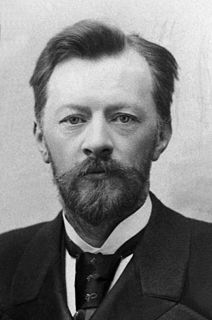
Vladimir Grigoryevich Shukhov was a Russian engineer-polymath, scientist and architect renowned for his pioneering works on new methods of analysis for structural engineering that led to breakthroughs in industrial design of the world's first hyperboloid structures, diagrid shell structures, tensile structures, gridshell structures, oil reservoirs, pipelines, boilers, ships and barges. He is also the inventor of the first cracking method.
The Siege of Taganrog is a name given in some Russian histories to Anglo-French naval operations in the northeastern part of the Sea of Azov between June and October 1855 during the Crimean War. British and French forces were implementing a strategy of destroying the supply lines for the main Russian army which ran across the Sea of Azov. Taganrog was one of the major logistical hubs of the Russian army and was attacked and its military depot destroyed on 3 June 1855 (NS) as part of a series of attacks on all major Russian supply bases in the area, except Rostov-on-Don, which could not be reached due to the large shoals not admitting any available warship.

The Ushkuyniks, also Ushkuiniks or Russian pirates were free and democratic people from early Rus' state which originated in northern regions of Russia, medieval Novgorod, composed of Slavic people like the Ilmen Slavs or Novgorod Slovenes, Finno-Ugrics and Vikings who supposedly led the Viking-like life of fighting, killing, and robbery. The Ushkuyniks were widespread in large parts of the Russian north and sailed on the arctic ocean. The origin of the term Ushkuyniks is unknown. Most likely the word "ushkuy" derives from the Oskuya River in Russia. Most likely the term is also connected to the Russian word for tight or narrow, узко (usko), узкий, plural: узкие (uzkiye). Furthermore medieval Finnic type of flat-bottom ships are called uisk. In Eastern Slavic languages word "Uzh" (уж) translates natrix, and it was common for Norsemen to sail on narrow longships called "drakkar", which roughly translates as "serpent" from Old Norse. This translation of information shows a cultural connection between Northern Europeans. These ships could be easily transported over portages between watersheds, is also considered as the namesake.

Krasnoye Sormovo Shipyard No. 112 named after Andrei Zhdanov is one of the oldest shipbuilding factories in Russia, located in the Sormovsky City District of Nizhny Novgorod.

Oryol was a frigate that served in the Russian Navy. It was commissioned by Tsar Alexis I to protect Russian trading ships on the Caspian Sea and became the first Russian-built warship. The ship was built between 1667 and 1669 by the developing shipyard in Dedinovo on the Oka River. Although Oryol was captured and burned in 1670, it has achieved lasting importance as a symbol of the birth of Russian naval power.
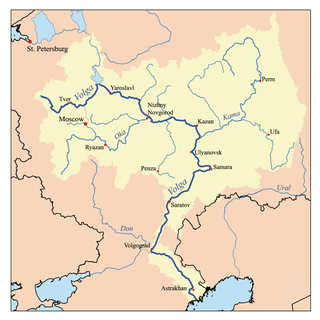
The Volga River is Europe's longest river, and a major trade artery in that continent. The technological arrival of the steam engine allowed cargoes to be more easily moved upstream. The use of steamboats on the Volga River began in the year 1821.

The steppe and forest-steppe of Ukraine and southern Russia is good agricultural land, but it was traditionally held by pastoral nomads. Any state that could drive off the nomads and fill the land with tax-paying peasants would expand its power enormously. During the period 1500–1800, this region was taken under Russian control.

An udema, also udenma, was a type of warship built for the Swedish archipelago fleet in the late 18th and early 19th centuries. It was developed for warfare in the Archipelago Sea in the Baltic and along the coasts of Svealand and Finland against the Russian navy. The udema was designed by the prolific naval architect Fredrik Henrik af Chapman for use in an area of mostly shallow waters and groups of islands and islets that extend from Stockholm all the way to the Gulf of Finland.
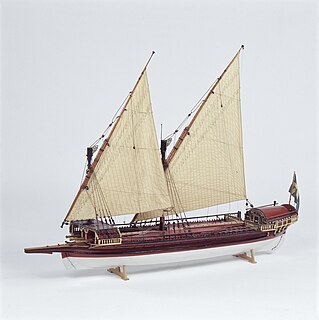
The archipelago fleet, officially the Fleet of the army, was a branch of the armed forces of Sweden which existed between 1756 and 1823. Its purpose was to protect the coasts of Sweden, which was surrounded by a natural barrier of archipelagoes. Throughout its existence, it was a largely independent arm of the army, separate from the navy, with the exception of a few years in the late 1760s. In a number of respects, it was a precursor of the Swedish Coastal Artillery and its coastal fleet.

Nizhny Novgorod was founded by Prince Yuri II of Vladimir in 4 February 1221. Citizens organized an army to liberate Moscow from the Poles in 1611, led by Kuzma Minin and Prince Dmitry Pozharsky. During the Russian Empire, in 1817 Nizhny Novgorod became the country's main trading city. In 1896, the city hosted the largest All-Russia exhibition. In the Soviet era, Nizhny Novgorod was renamed Gorky, in honor of the writer Maxim Gorky. Then it was the industrial center of the Soviet Union. During the World War II, the city sent to the front a huge amount of military equipment and ammunition. Therefore, the German air force bombed the city for 3 years. After the dissolution of the Soviet Union, the city was renamed back to Nizhny Novgorod. In Russia, the city became a political center and the capital of the Volga Federal District. Now the city is the center of information technology and develops tourism.

Already in the 9th century, the old Russian State of Kievan Rus' had the powerful naval fleet which is proved by the successful naval Siege of Constantinople of 860 However the naval fleet was irregular and was built only for the purpose of raids. Due to several major weakness of the naval fleet and in addition destructive invasion by the Mongol Empire, later the irregular naval fleet of the Russian principalities was dissolved. Except for the Principality of Novgorod which had access to the open seas and also was saved from Mongol invasions. As the first and proper Russian state of the Grand Duchy of Moscow begun and also got access to open water bodies, the Golden Age of the Russian Navy began. In 1570, in order to protect Russian navigation at the Baltic Sea, Ivan the Terrible created a flotilla which existed for about a year. In the 16th century, the Tsardom of Russia fought against the Ottoman Empire to get free access to the Black Sea.

