
The AMC Gremlin is an American subcompact automobile introduced in 1970, manufactured and marketed in a single, two-door body style in America (1970-1978) by American Motors Corporation (AMC) — as well as in Mexico (1974-1978) by AMC's Vehículos Automotores Mexicanos (VAM) subsidiary.

Eagle was a marque of the Chrysler Corporation following the purchase of American Motors Corporation (AMC) in 1987 and marketed through the end of the 1998 model year. It was aimed at the enthusiast driver and promoted as more "European" than the automaker's similar models.

American Motors Corporation (AMC) was an American automobile company formed by the 1954 merger of Nash-Kelvinator Corporation and Hudson Motor Car Company. At the time, it was the largest corporate merger in U.S. history.

The AMC Pacer is a two-door compact car produced in the United States by the American Motors Corporation from 1975 to 1979, sold out in 1980.

Four-wheel drive, also called 4×4 or 4WD, refers to a two-axled vehicle drivetrain capable of providing torque to all of its wheels simultaneously. It may be full-time or on-demand, and is typically linked via a transfer case providing an additional output drive-shaft and, in many instances, additional gear ranges.

The Renault Alliance is a front-wheel drive, front-engine subcompact automobile manufactured and marketed in North America by American Motors Corporation (AMC) for model years 1983–1987. The Alliance and its subsequent hatchback variant, the Encore, were re-engineered Renault 9 & 11 for the U.S. and Canadian markets.

Crossover, or crossover SUV, are terms predominantly used in the United States for vehicles with sport utility vehicle (SUV) styling features that are based on passenger car platforms and are only intended for light off-road use. Models which are classified as crossovers in the United States are classified as SUVs in other countries.

Subcompact car is the American classification for small cars which is broadly equivalent to the B-segment (Europe) or supermini classifications.

Full-size car— also known as large car is a vehicle size class which originated in the United States and is used for cars larger than mid-size cars. It is the largest size class for cars. The equivalent European categories are E-segment and executive car.

The Dodge Diplomat was an American mid-size car that was produced by Dodge from 1977 to 1989. It is essentially similar to the Plymouth Gran Fury in the U.S. market and the Plymouth Caravelle in Canada. It was also sold in Mexico between 1981 and 1982 as the Dodge Dart, and in Colombia as the Dodge Coronet. The Diplomat was initially offered in a coupe and a sedan. In 1978, station wagons were added as replacements for the departed full-sized C-body wagons.

The Mazda Sentia is a medium rear wheel drive luxury car that was sold by Mazda in Japan from 1991 to 1999 over two generations. It replaced the Mazda Luce nameplate on the Mazda H platform, and continued the tradition of being Mazda's largest flagship sedan, which had been in production since the late 1960s. The name "sentia" is derived from the Latin word "sentir", meaning to sense, feel or hear.

The AMC Eagle is a compact-sized four-wheel drive passenger vehicle that was produced by American Motors Corporation (AMC) from 1979 to 1987.

The AMC Concord is a compact car manufactured and marketed by the American Motors Corporation for model years 1978-1983. The Concord was essentially replacement of the AMC Hornet that was discontinued after 1977, but more luxurious, quieter, roomier, and smoother riding than the series it replaced. It was offered in four-door sedan, two-door coupé, three-door hatchback, and five-door station wagon configurations. The Concord was AMC's volume seller from the time it appeared until the introduction of the Renault Alliance.
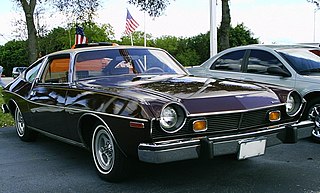
The AMC Matador is an automobile model line built and marketed by American Motors Corporation (AMC) from 1971 to 1978. The Matador came in two generations: 1971 to 1973, and a major redesign from 1974 to 1978. The second-generation four-door sedan and station wagon models were classified as full-size cars and did not share the distinctive styling of the Matador coupe that was introduced in 1974.

The Eagle Medallion, also marketed as the Renault Medallion, was a rebadged and mildly re-engineered North American version of the French Renault 21 marketed by Eagle.

The Jeep Cherokee (XJ) is a compact sport utility vehicle that was manufactured and marketed by Jeep in the USA from 1983 to 2001, as well as in other countries, and sometimes under other names, until 2014, with Jeep selling almost 3 million units between 1984 and 2001. Sharing the name of the original full-size Cherokee SJ model, the 1984 XJ Cherokee was Jeep's first all-new vehicle design since the 1963 SJ Wagoneer, from which the '74 SJ Cherokee had been derived. Instead of the traditional separate body and chassis, the XJ featured a light-weight, compact and space-efficient, integrated body and frame design, The models were originally marketed as Sportwagons and became the precursor to the modern sport utility vehicle (SUV) as that term was not yet in use.

The AMC AMX-GT is concept car developed by American Motors Corporation (AMC) for the 1968 show car circuit. The design of the grand touring-type rear-wheel drive pillarless coupe of monocoque construction with two doors and a truncated rear end treatment was influenced by AMC stylist Richard A. Teague.
The Solar Car Challenge is an annual solar-powered car race for high school students.The event attracts teams from around the world, but mostly from American high schools. The race was first held in 1995. Each event is the end product of a two-year education cycle launched by the Winston Solar Car Team. On odd-numbered years, the race is a road course that starts at the Texas Motor Speedway, Fort Worth, Texas; the end of the course varies from year to year. On even-numbered years, the race is a track race around the Texas Motor Speedway. Dell sponsored the event from 2002-2008. Hunt Oil Company sponsored the 2010 race.
Royston Charles Lunn was an engineer in the automotive industry. He had forty-one years in the design development and production of vehicles and most notably served as the head of engineering at American Motors Corporation (AMC) from 1971 to 1987. Lunn is credited as being the "father of the modern SUV" and "the godfather of the Ford GT40."


