Related Research Articles
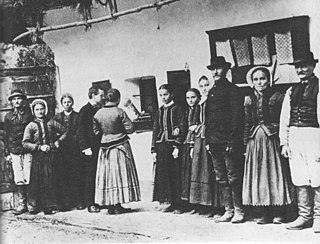
Folk music is a music genre that includes traditional folk music and the contemporary genre that evolved from the former during the 20th-century folk revival. Some types of folk music may be called world music. Traditional folk music has been defined in several ways: as music transmitted orally, music with unknown composers, music that is played on traditional instruments, music about cultural or national identity, music that changes between generations, music associated with a people's folklore, or music performed by custom over a long period of time. It has been contrasted with commercial and classical styles. The term originated in the 19th century, but folk music extends beyond that.

Swedish is a North Germanic language spoken natively by at least 10 million people, predominantly in Sweden and in parts of Finland, where it has equal legal standing with Finnish. It is largely mutually intelligible with Norwegian and Danish, although the degree of mutual intelligibility is largely dependent on the dialect and accent of the speaker. Written Norwegian and Danish are usually more easily understood by Swedish speakers than the spoken languages, due to the differences in tone, accent, and intonation. Swedish is a descendant of Old Norse, the common language of the Germanic peoples living in Scandinavia during the Viking Era. It has more speakers than any other North Germanic language.
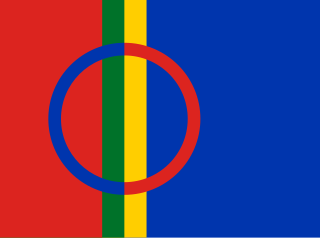
The Sámi people are an indigenous Finno-Ugric-speaking people inhabiting the region of Sápmi, which today encompasses large northern parts of Norway, Sweden, Finland, and of the Murmansk Oblast, Russia, most of the Kola Peninsula in particular. The Sámi have historically been known in English as Lapps or Laplanders, but these terms are regarded as offensive by some Sámi people, who prefer the area's name in their own languages, e.g. Northern Sami Sápmi. Their traditional languages are the Sámi languages, which are classified as a branch of the Uralic language family.
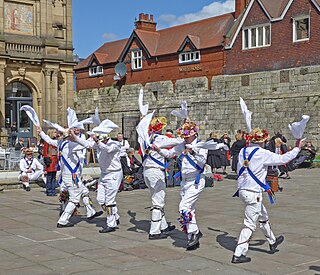
Morris dancing is a form of English folk dance usually accompanied by music. It is based on rhythmic stepping and the execution of choreographed figures by a group of dancers, usually wearing bell pads on their shins. Implements such as sticks, swords and handkerchiefs may also be wielded by the dancers. In a small number of dances for one or two people, steps are near and across a pair of clay tobacco pipes laid one across the other on the floor. They clap their sticks, swords, or handkerchiefs together to match with the dance.

Much has been learned about early music in Norway from physical artifacts found during archaeological digs. These include instruments such as the lur. Viking and medieval sagas also describe musical activity, as do the accounts of priests and pilgrims from all over Europe coming to visit St Olaf's grave in Trondheim.

The Swedish-speaking population of Finland is a linguistic minority in Finland. They maintain a strong identity and are seen either as a separate cultural or ethnic group, while still being Finns, or as a distinct nationality. They speak Finland Swedish, which encompasses both a standard language and distinct dialects that are mutually intelligible with the dialects spoken in Sweden and, to a lesser extent, other Scandinavian languages.
The native folk music of Mozambique has been highly influenced by Portuguese colonisation and local language forms. The most popular style of modern dance music is marrabenta. Mozambican music also influenced another Lusophone music in Brazil, like maxixe, and mozambique style in Cuba and New York City.

Circle dance, or chain dance, is a style of social dance done in a circle, semicircle or a curved line to musical accompaniment, such as rhythm instruments and singing, and is a type of dance where anyone can join in without the need of partners. Unlike line dancing, circle dancers are in physical contact with each other; the connection is made by hand-to-hand, finger-to-finger or hands-on-shoulders, where they follow the leader around the dance floor. Ranging from gentle to energetic, the dance can be an uplifting group experience or part of a meditation.
Cornwall is a Celtic nation with a long musical history. Strengthened by a series of 20th century revivals, traditional folk music has a popular following. It is accompanied by traditions of pipers, brass and silver bands, male voice choirs, classical, electronic and popular music.

Cecil James Sharp was an English-born folk song collector, musician and composer. He was a key leader of the folk-song revival in England as a collector, archivist, teacher and promoter. He gathered thousands of tunes both from rural England and the Southern Appalachians region of the United States, and wrote an influential volume, English Folk Song: Some Conclusions.
The music of Saint Lucia is home to many vibrant oral and folk traditions and is based on elements derived from the music of Africa, especially rhythmically, and Western Europe, dances like the quadrille, polka and waltz. The banjo and cuatro are iconic Lucian folk instruments, especially a four-stringed banjo called the bwa poye. Celebratory songs called jwé show lyricism, and rhythmic complexity. The most important of the Afro-Lucian Creole folk dances is the kwadril. Music is an integral part of Lucian folk holidays and celebrations, as well as the good-natured rivalry between the La Rose and La Marguerite societies. There is little Western classical music on Saint Lucia, and the country's popular music industry is only nascent. There are few recording opportunities, though live music and radio remain a vital part of Lucian culture. Popular music from abroad, especially Trinidadian styles like calypso and soca, is widespread.

The Royal Gustavus Adolphus Academy in Uppsala is one of 18 Swedish royal academies and dedicated to the study of Swedish folklore. The name is often expanded to Kungl. Gustav Adolfs Akademien för svensk folkkultur.

The Royal Swedish Ballet is one of the oldest ballet companies in Europe. Based in Stockholm, Sweden, King Gustav III founded the ballet in 1773 as a part of his national cultural project in response to the French and Italian dominance in this field; he also founded the Royal Swedish Opera and the Royal Dramatic Theatre. All of these were initially located in the old theatre of Bollhuset. The troupe was founded with the opening of the Royal Swedish Opera, which has served as its home since that time.

The Zorn Badge is an award that is given to prominent folk musicians in Sweden. The prize is awarded by Svenska Folkdansringen, the Swedish national organization for traditional music, dance and handicraft.

The title of riksspelman is a generally recognized badge of mastery for Swedish folk musicians. It is an honor bestowed upon bearers of the silver or gold Zorn Badge, awarded annually by the Zorn Jury, a panel of experts under the auspices of Svenska Folkdansringen. The silver Zorn Badge is the highest award attainable for musicians who play before the Zorn Jury in their annual Zorn Trials. The gold Zorn Badge cannot be sought, but is reserved for one or two master musicians pre-selected by the Jury.
Swedish folk music is a genre of music based largely on folkloric collection work that began in the early 19th century in Sweden. The primary instrument of Swedish folk music is the fiddle. Another common instrument, unique to Swedish traditions, is the nyckelharpa. Most Swedish instrumental folk music is dance music; the signature music and dance form within Swedish folk music is the polska. Vocal and instrumental traditions in Sweden have tended to share tunes historically, though they have been performed separately. Beginning with the folk music revival of the 1970s, vocalists and instrumentalists have also begun to perform together in folk music ensembles.
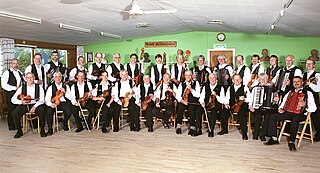
Danish traditional music is the music genre that has its roots in pre-modern Denmark. In this period it was common for towns to have one or more town musicians who played at dances, processions and certain rituals. In the 17th and 18th centuries, professional music performances were monopolized by town musicians, who also traveled into the neighboring rural areas to perform. Urban music and dance styles, often from other parts of Europe, penetrated the countryside and almost eradicated earlier styles. This period also saw the introduction of the fiddle as the most important instrument and the abandonment of earlier chain dances in favor of pair dances. Until around 1900, traditional music was the common musical culture of Denmark, but with increasing urbanization and the spread of classical music it became marginalized to rural areas.

The Chapelloise is a traditional folk dance with change of partners, belonging to the standard repertoire of a Bal Folk. Its most common name in France and the French-influenced European Bal Folk scene is Chapelloise, but the dance has many other names too.

Edda Karin Hjartardóttir Magnason is a Swedish singer-songwriter, musician and film actress of Icelandic descent. She has released three albums, Edda Magnason (2010), Goods (2011), and Woman Travels Alone (2014). She has also released a soundtrack album, Monica Z - Musiken från filmen (2013). She made her debut as an actress in the film Waltz for Monica, playing the leading role of Monica Zetterlund.
The Society of Swedish Literature in Finland is a scholarly society for the collection, archiving and dissemination of knowledge about Finland-Swedish culture. SLS publishes scholarly literature, maintains archives and libraries, funds research and awards literary and scholarly prizes and scholarships. SLS’s activity is made possible by private donations. SLS is one of the largest managers of private charitable funds in Finland.