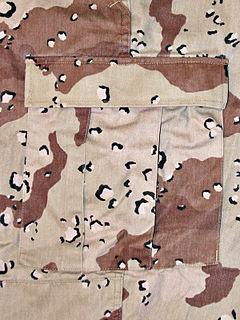
The Desert Battle Dress Uniform (DBDU) is a U.S. arid-environment camouflage battle uniform that was used by the United States Armed Forces from the early 1980s to the early to mid 1990s, most notably during the Persian Gulf War. Although the U.S. military has long since abandoned the pattern, it is still in widespread use by militaries across the world as of the early 2020s.

The Battle Dress Uniform (BDU) is a camouflaged combat uniform that was used by the United States Armed Forces as their standard combat uniform from the early 1980s to the mid-2000s. Since then, it has been replaced or supplanted in every branch of the U.S. Armed Forces.

A flight suit is a full-body garment, worn while flying aircraft such as military airplanes, gliders and helicopters. These suits are generally made to keep the wearer warm, as well as being practical, and durable. Its appearance is usually similar to a jumpsuit. A military flight suit may also show rank insignia. It is sometimes used as a combat uniform in close quarters battle or visit, board, search, and seizure situations, for its practicality.

A combat uniform, also called field uniform, battledress or military fatigues, is a casual type of uniform used by military, police, fire and other public uniformed services for everyday fieldwork and combat duty purposes, as opposed to dress uniforms worn in functions and parades. It generally consists of a jacket, trousers and shirt or T-shirt, all cut more loose and comfortable than more formal uniforms. Design may depend on regiment or service branch, e.g. army, navy, air force, marines, etc. In the army branches, fabrics tend to come in camouflage, disruptive pattern or else green, brown or khaki monochrome, in order to approximate the background and make the soldier less visible in nature. In Western dress codes, field uniform is considered equivalent to civilian casual wear. As such, field uniform is considered less formal than service dress uniform, generally aimed at office or staff use, as well as mess dress uniform, and full dress uniform.
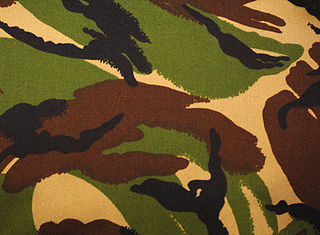
Disruptive Pattern Material (DPM) is the commonly used name of a camouflage pattern used by the British Armed Forces as well as many other armed forces worldwide, particularly in former British colonies.

The U.S. Army's M1943 uniform was a combat uniform manufactured in windproof cotton sateen cloth introduced in 1943 to replace a variety of other specialist uniforms and some inadequate garments, like the M1941 Field Jacket. It was used through the remainder of World War II and into the Korean War with modifications before being replaced by the OG-107 uniform beginning in 1952.

The Denison smock was a coverall jacket issued to Special Operations Executive (SOE) agents, the Parachute Regiment, the Glider Pilot Regiment, Air Landing Regiments, Air Observation Post Squadrons, Commando units, and other Commonwealth airborne units, to wear over their Battle Dress uniform during the Second World War. The garment was also issued as standard to the scout and sniper platoons of line infantry battalions.

Disruptive Pattern Camouflage Uniform (DPCU), also nicknamed Auscam, jelly bean camo, or hearts and bunnies is a five-colour military camouflage pattern used by the Australian Defence Force. Replacing the jungle greens used from WWII, it was developed and tested during the late 1970s and early 1980s.
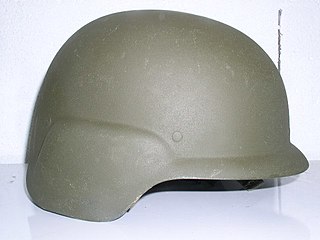
The SPECTRA helmet or CGF Gallet Combat Helmet is the PASGT-style ballistic helmet in use with the French military, and the armies of several other countries. Built by CGF Gallet, it weighs 1.4 kg (3.1 lb), is available in three sizes, and is made from ultra-high-molecular-weight polyethylene Spectra fibers, produced under license from Honeywell.
The Jacket, Field, O.D. is a field jacket that was used by US Army soldiers, most famously during the beginning of World War II. In 1941 it started to be phased in as a replacement for the wool four-pocket service coat of World War I, but around 1943 it was replaced in turn by the improved M1943 model. Owing to wide adoption, the M1941 is usually recognized as a symbol of the World War II American G.I. The jacket was made in a light shade of olive drab called O.D. number 2.

M90 camouflage is the camouflage pattern for the uniform system 90, used by the Swedish Armed Forces. The pattern consists of hard lined geometric shapes, aiming to create a camouflage pattern effective in the temperate forests and plains of Sweden. It is affectionately known among Swedish soldiers as lövhögen, or "the leaf pile." In addition to the standard pattern, which was designed with Swedish forests in mind, desert and jungle variants were later developed for international missions.

The Afghanka is a type of military uniform system developed and issued by the Soviet Army in the early 1980s, still in use today in some Post-Soviet states in many different variants. The name Afghanka is an unofficial popular slang term in Russian for the uniform, derived from its prolific use during the Soviet–Afghan War. All the non-sand coloured versions of the M88 are not called Afghanka.
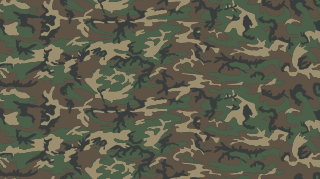
The ERDL pattern, also known as the Leaf pattern, is a camouflage pattern developed by the United States Army at its Engineer Research & Development Laboratories (ERDL) in 1948. It was not used until the Vietnam War, when it was issued to elite reconnaissance and special operations units beginning early 1967.
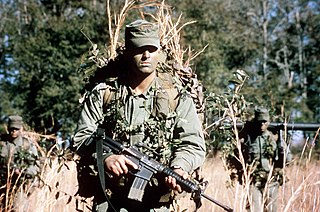
A patrol hat, also known as a field cap, is a soft kepi with a stiff, rounded visor, and flat top, somewhat similar to a baseball cap, worn by the military personnel of some countries in the field when a combat helmet is not required.

The following is a general overview of the Heer main uniforms, used by the German army prior to and during World War II.
The M05 family of military camouflage patterns are used by the Finnish Defence Forces on uniforms and other equipment. The pattern is licensed by the Finnish Defence Forces and became available to the public as of 26 September, 2016. The first M05 items were issued to troops around 2007, and have nearly universally replaced the previous M91 pattern in service use. At the same time, the even older M62 pattern is still employed in some niche uses, such as by paratroopers of the Utti Jaeger Regiment due to the cut of the M62 equipment being better suited for parachuting.

Splittertarnmuster, Splittertarn or Splittermuster (splinter-pattern) is a four-colour military camouflage pattern developed by Germany in the late 1920s, first issued to the Reichswehr in 1931.
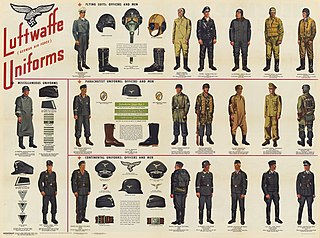
The Luftwaffe was the air force of Nazi Germany prior to and during World War II. Luftwaffe styles of uniform and rank insignia had many unique features between 1935 and 1945. By Hitler's decision on February 26, 1935, the Luftwaffe was to be officially the third branch of the Wehrmacht as of March 1, 1935. The new Luftwaffe was faced with the problem of uniforms, as they wanted a uniform distinct from those of the other two branches of the Wehrmacht and also wanted a clear differentiation in dress of military and civilian flyers.
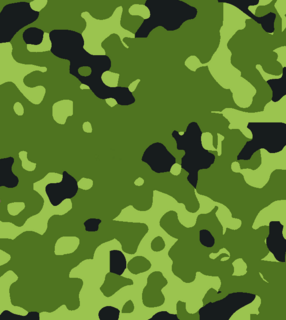
The M/84 camouflage pattern, is the former camouflage pattern of the Danish military. The M/84 is a derivative of the Flecktarn B pattern produced by the German firm Marquardt & Schulz. Using the same shapes and pattern, the number of colours was changed from 5 to 3 – choosing olive green, light green and black to better match the colouration of the Danish woodland environment.

German World War II camouflage patterns formed a family of disruptively patterned military camouflage designs for clothing, used and in the main designed during the Second World War. The first pattern, Splittertarnmuster, was designed in 1931 and was initially intended for Zeltbahn shelter halves. The clothing patterns developed from it combined a pattern of interlocking irregular green, brown, and buff polygons with vertical "rain" streaks. Later patterns, all said to have been designed for the Waffen-SS by Johann Georg Otto Schick, evolved into more leaf-like forms with rounded dots or irregular shapes. Camouflage smocks were designed to be reversible, providing camouflage for two seasons, whether summer and autumn, or summer and winter (snow). Distribution was limited to the Waffen-SS, ostensibly because of a patent, though variants were used by other units, including the Luftwaffe. Production was limited by shortage of materials, especially of high quality waterproof cotton duck.


