Middleware in the context of distributed applications is software that provides services beyond those provided by the operating system to enable the various components of a distributed system to communicate and manage data. Middleware supports and simplifies complex distributed applications. It includes web servers, application servers, messaging and similar tools that support application development and delivery. Middleware is especially integral to modern information technology based on XML, SOAP, Web services, and service-oriented architecture.
An application server is a server that hosts applications or software that delivers a business application through a communication protocol. For a typical web application, the application server sits behind the web servers.
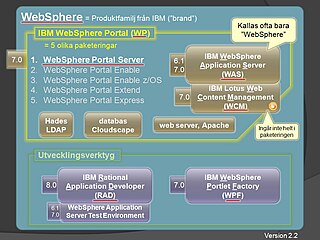
IBM WebSphere refers to a brand of proprietary computer software products in the genre of enterprise software known as "application and integration middleware". These software products are used by end-users to create and integrate applications with other applications. IBM WebSphere has been available to the general market since 1998.
In computer science, message queues and mailboxes are software-engineering components typically used for inter-process communication (IPC), or for inter-thread communication within the same process. They use a queue for messaging – the passing of control or of content. Group communication systems provide similar kinds of functionality.
Message-oriented middleware (MOM) is software or hardware infrastructure supporting sending and receiving messages between distributed systems. MOM allows application modules to be distributed over heterogeneous platforms and reduces the complexity of developing applications that span multiple operating systems and network protocols. The middleware creates a distributed communications layer that insulates the application developer from the details of the various operating systems and network interfaces. APIs that extend across diverse platforms and networks are typically provided by MOM.
Enterprise application integration (EAI) is the use of software and computer systems' architectural principles to integrate a set of enterprise computer applications.
Tuxedo is a middleware platform used to manage distributed transaction processing in distributed computing environments. Tuxedo is a transaction processing system or transaction-oriented middleware, or enterprise application server for a variety of systems and programming languages. Developed by AT&T in the 1980s, it became a software product of Oracle Corporation in 2008 when they acquired BEA Systems. Tuxedo is now part of the Oracle Fusion Middleware.
In the fields of information technology and systems management, application performance management (APM) is the monitoring and management of the performance and availability of software applications. APM strives to detect and diagnose complex application performance problems to maintain an expected level of service. APM is "the translation of IT metrics into business meaning ."
Oracle Fusion Middleware consists of several software products from Oracle Corporation. FMW spans multiple services, including Java EE and developer tools, integration services, business intelligence, collaboration, and content management. FMW depends on open standards such as BPEL, SOAP, XML and JMS.

Virtuoso Universal Server is a middleware and database engine hybrid that combines the functionality of a traditional relational database management system (RDBMS), object–relational database (ORDBMS), virtual database, RDF, XML, free-text, web application server and file server functionality in a single system. Rather than have dedicated servers for each of the aforementioned functionality realms, Virtuoso is a "universal server"; it enables a single multithreaded server process that implements multiple protocols. The free and open source edition of Virtuoso Universal Server is also known as OpenLink Virtuoso. The software has been developed by OpenLink Software with Kingsley Uyi Idehen and Orri Erling as the chief software architects.
Apache Axis2 is a web service engine. It is a redesign and re-write of the widely used Apache Axis SOAP stack. Implementations of Axis2 are available in Java and C.
SAP Business Connector is a re-branded version/restricted licence version of webMethods Integration Server provided by SAP as a middleware solution for their R/3 product. It was developed jointly by webMethods and SAP in a partnership which lasted from March 1999 to March 2002. webMethods contributed the Integration Server platform, while SAP contributed the components for RFC/tRFC, BAPI and IDoc communication and processing. These SAP components were bundled into an add-on package that can be installed on top of the core Integration Server.
TmaxSoft is a South Korea-based multinational corporation specializing in enterprise software. It was founded in 1997 by Professor Daeyeon Park, former professor at KAIST. The company is separated into 3 businesses: TmaxSoft, TmaxData and TmaxA&C. Currently, TmaxData and TmaxA&C are run as affiliated companies.
Business transaction management (BTM), also known as business transaction monitoring, application transaction profiling or user defined transaction profiling, is the practice of managing information technology (IT) from a business transaction perspective. It provides a tool for tracking the flow of transactions across IT infrastructure, in addition to detection, alerting, and correction of unexpected changes in business or technical conditions. BTM provides visibility into the flow of transactions across infrastructure tiers, including a dynamic mapping of the application topology.
Nastel Technologies is an information technology (IT) monitoring company that sells software for Artificial Intelligent IT Operations (AIOps), monitoring and managing middleware, transaction tracking and tracing, IT Operational Analytics (ITOA), Decision Support Systems (DSS) business transaction management (BTM) and application performance management (APM).
The JBoss Enterprise Application Platform is a subscription-based/open-source Java EE-based application server runtime platform used for building, deploying, and hosting highly-transactional Java applications and services developed and maintained by Red Hat. The JBoss Enterprise Application Platform is part of Red Hat's Enterprise Middleware portfolio of software. Because it is Java-based, the JBoss application server operates across platforms; it is usable on any operating system that supports Java. JBoss Enterprise Application Platform was originally called JBoss and was developed by the eponymous company JBoss, acquired by Red Hat in 2006.
Middleware is a type of computer software program that provides services to software applications beyond those available from the operating system. It can be described as "software glue".
JEUS is a Korean Web application server which is developed by TmaxSoft. JEUS provides the web application server component of TmaxSoft's middleware-tier framework solution. It has been widely adopted in Korea where it holds the largest (42.1%) share of the market.
