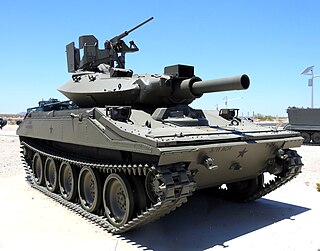
The M551 "Sheridan" AR/AAV was a light tank developed by the United States and named after General Philip Sheridan, of American Civil War fame. It was designed to be landed by parachute and to swim across rivers. It was armed with the technically advanced but troublesome M81/M81 Modified/M81E1 152 mm gun/launcher, which fired both conventional ammunition and the MGM-51 Shillelagh guided anti-tank missile.

The M24 Chaffee was an American light tank used during the later part of World War II; it was also used in post–World War II conflicts including the Korean War, and by the French in the War in Algeria and the First Indochina War. In British service it was given the service name Chaffee after the United States Army General Adna R. Chaffee Jr., who helped develop the use of tanks in the United States armed forces. Although the M41 Walker Bulldog was developed as a replacement, M24s were not mostly removed from U.S. and NATO armies until the 1960s and remained in service with some Third World countries.

The M48 Patton is an American first-generation main battle tank (MBT) introduced in February 1952, being designated as the 90mm Gun Tank: M48. It was designed as a replacement for the M26 Pershing, M4 Sherman, M46 and M47 Patton tanks, and was the main battle tank of the U.S. Army and U.S. Marine Corps in the Vietnam War. Nearly 12,000 M48s were built, mainly by Chrysler and American Locomotive Company, from 1952 to 1961. The M48 Patton was the first U.S. medium gun tank with a four-man crew, featuring a centerline driver's compartment and no bow machine gunner. As with nearly all new armored vehicles it had a wide variety of suspension systems, cupola styles, power packs, fenders and other details among individual tanks.

The M18 Hellcat is a tank destroyer that was used by the United States Army in World War II and the Korean War. Despite being equipped with the same main gun as some variants of the much larger Sherman tank, the M18 attained a much higher top speed of up to 55 mph (89 km/h) by keeping armor to a minimum, and using the innovative Torqmatic automatic transmission.

The T28 Super Heavy Tank was an American super-heavy tank/assault gun designed for the United States Army during World War II. It was originally designed to break through German defenses of the Siegfried Line and was later considered as a possible participant in the planned invasion of the Japanese mainland.

The M41 Walker Bulldog, officially 76-mm Gun Tank, M41, was an American light tank developed for armed reconnaissance purposes. It was produced by Cadillac between 1951 and 1954 and marketed successfully to the United States Army as a replacement for its aging fleet of World War II vintage M24 Chaffee tanks. Although engineered as a reconnaissance vehicle, the M41's weight and armament also made it effective in the close infantry support role and for rapid airborne deployments. Upon entering US service, all M41s received the designation Little Bulldog and subsequently, Walker Bulldog after the late General Walton Walker, who was killed in a Jeep accident in 1950. The M41 was the first postwar American light tank to see worldwide service, and was exported in considerable numbers by the United States, particularly to Asia.
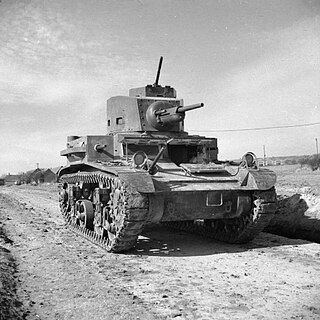
The M2 light tank, officially Light Tank, M2, was an American light tank of the interwar period which saw limited service during World War II. The most common model, the M2A4, was equipped with one 37 mm (1.5 in) M5 gun and five .30 cal M1919 Browning machine guns.
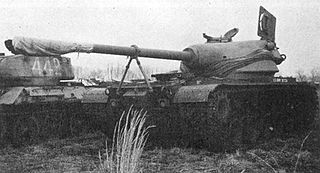
The T54 was a series of prototype American tanks of the 1950s with three different turrets, all armed with a 105 mm gun, mounted on the M48 Patton chassis. The T54 had a conventional turret with an autoloader with 3 shells, the T54E1 had an oscillating design with an autoloader, and the T54E2 had a conventional turret with a human loader.
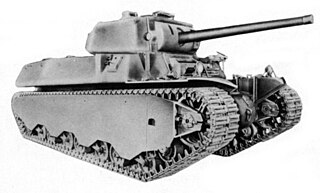
The Heavy Tank M6 was an American heavy tank designed during World War II. The tank was produced in small numbers and never saw combat.
Tank development both evolved considerably from World War II and played a key role during the Cold War (1945–1990). The period pitted the nations of the Eastern Bloc and the North Atlantic Treaty Organization (NATO against each other.

The Medium Tank T20, Medium Tank T22 and Medium Tank T23 were prototype medium tanks, developed by the United States Army during World War II. They were designed as successors to the M4 Sherman. The standard main weapon for production versions of these designs was to be the 76 mm M1.

The SK-105 Kürassier is an Austrian light tank armed with a rifled 105 mm gun in an oscillating turret. It is estimated that over 700 have been produced, with initial deliveries in 1971. It shares its CN 105-57 main gun with the French AMX-13, which was widely produced and deployed.

The T92 Light Tank, or 76-mm Gun Tank, T92, was an American light tank developed in the 1950s by Aircraft Armaments. It was designed as an airborne/airdropped replacement for the heavier M41 Walker Bulldog while retaining the mobility, protection level, and firepower of the latter. The unveiling of the Soviet PT-76 amphibious light tank pointed out that the future US light tank should be able to swim as well. Making the T92 amphibious was deemed impractical and the light gun tank program was cancelled in June 1958.

The AMX 50 or AMX-50 is a French heavy tank designed in the immediate post Second World War period. It was proposed as, in succession, the French medium, heavy, and main battle tank, incorporating many advanced features. It was cancelled in the late 1950s however, due to unfavourable economic and political circumstances after serious delays in development.

The United States has produced tanks since their inception in World War I, up until the present day. While there were several American experiments in tank design, the first American tanks to see service were copies of French light tanks and a joint heavy tank design with the United Kingdom.

This article deals with the history and development of American tanks from the end of World War II and during the Cold War.

A light tank is a tank variant initially designed for rapid movements in and out of combat, to outmaneuver heavier tanks. It is smaller in size with thinner armor and a less powerful main gun, tailored for better tactical mobility and ease of transport and logistics. They are primarily employed in the screening, armored reconnaissance, skirmishing, artillery observation, and supplementing landing operations in a fire support role of expeditionary forces where larger, heavier tanks are unavailable or have difficulties operating safely or efficiently.

An oscillating turret is a form of turret for armoured fighting vehicles, both tanks and armoured cars. The turret is unusual in being made of two hinged parts. Elevation of the gun relies on the upper part of the turret moving relative to the lower part.

The Type 64 is the designation of two distinct Cold War-era light tank projects of the Republic of China Armed Forces, in service from 1975. One being a hybrid of the M42 Duster and M18 Hellcat and the other an indigenous copy of the M41 Walker Bulldog, both Type 64s were intended as a cavalry tank to complement the existing M41 light tanks and to support the heavier and more-powerful M48 Patton medium tanks already in service with the ROCA.
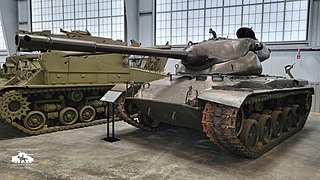
The T69 was a prototype American medium tank with an oscillating turret mounting a 90mm cannon with an eight-round drum autoloader. It held a crew of three. Developed on the basis of the T42 experimental medium tank in mid-50s, the vehicle never entered mass production.


