Related Research Articles

Chthonian planets are a hypothetical class of celestial objects resulting from the stripping away of a gas giant's hydrogen and helium atmosphere and outer layers, which is called hydrodynamic escape. Such atmospheric stripping is a likely result of proximity to a star. The remaining rocky or metallic core would resemble a terrestrial planet in many respects.

Planetary migration occurs when a planet or other body in orbit around a star interacts with a disk of gas or planetesimals, resulting in the alteration of its orbital parameters, especially its semi-major axis. Planetary migration is the most likely explanation for hot Jupiters. The generally accepted theory of planet formation from a protoplanetary disk predicts that such planets cannot form so close to their stars, as there is insufficient mass at such small radii and the temperature is too high to allow the formation of rocky or icy planetesimals.
An ultra-short period (USP) planet is a type of exoplanet with an orbital period of less than one day. At this short distance, tidal interactions lead to relatively rapid orbital and spin evolution. Therefore when there is a USP planet around a mature main-sequence star it is most likely that the planet has a circular orbit and is tidally locked. There are not many USP planets with sizes exceeding 2 Earth radii. About one out of 200 Sun-like stars has an ultra-short-period planet. There is a strong dependence of the occurrence rate on the mass of the host star. The occurrence rate falls from % for M dwarfs to % for F dwarfs. Mostly the USP planets seem consistent with an Earth-like composition of 70% rock and 30% iron, but K2-229b has a higher density suggesting a more massive iron core. WASP-47e and 55 Cnc e have a lower density and are compatible with pure rock, or a rocky-iron body surrounded by a layer of water.

A Super-Earth is a type of exoplanet with a mass higher than Earth's, but substantially below those of the Solar System's ice giants, Uranus and Neptune, which are 14.5 and 17 times Earth's, respectively. The term "super-Earth" refers only to the mass of the planet, and so does not imply anything about the surface conditions or habitability. The alternative term "gas dwarfs" may be more accurate for those at the higher end of the mass scale, although "mini-Neptunes" is a more common term.

Transiting Exoplanet Survey Satellite is a space telescope for NASA's Explorer program, designed to search for exoplanets using the transit method in an area 400 times larger than that covered by the Kepler mission. It was launched on 18 April 2018, atop a Falcon 9 launch vehicle and was placed into a highly elliptical 13.70-day orbit around the Earth. The first light image from TESS was taken on 7 August 2018, and released publicly on 17 September 2018.

An exoplanet is a planet located outside the Solar System. The first evidence of an exoplanet was noted as early as 1917, but was not recognized as such until 2016; no planet discovery has yet come from that evidence. What turned out to be the first detection of an exoplanet was published among a list of possible candidates in 1988, though not confirmed until 2003. The first confirmed detection came in 1992, with the discovery of terrestrial-mass planets orbiting the pulsar PSR B1257+12. The first confirmation of an exoplanet orbiting a main-sequence star was made in 1995, when a giant planet was found in a four-day orbit around the nearby star 51 Pegasi. Some exoplanets have been imaged directly by telescopes, but the vast majority have been detected through indirect methods, such as the transit method and the radial-velocity method. As of 1 November 2023, there are 5,521 confirmed exoplanets in 4,070 planetary systems, with 885 systems having more than one planet. This is a list of the most notable discoveries.

Planet Hunters is a citizen science project to find exoplanets using human eyes. It does this by having users analyze data from the NASA Kepler space telescope and the NASA Transiting Exoplanet Survey Satellite. It was launched by a team led by Debra Fischer at Yale University, as part of the Zooniverse project.

TOI-700 is a red dwarf 101.4 light-years away from Earth located in the Dorado constellation that hosts TOI-700 d, the first Earth-sized exoplanet in the habitable zone discovered by the Transiting Exoplanet Survey Satellite (TESS).
Planet-hosting stars are stars which host planets, therefore forming planetary systems.
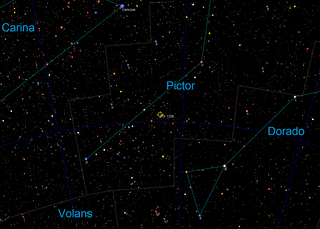
TOI-1338 is a binary star system located in the constellation Pictor, about 1,320 light-years from Earth. It is orbited by two known circumbinary planets, TOI-1338 b, discovered by the Transiting Exoplanet Survey Satellite (TESS) and BEBOP-1c, discovered by the Binaries Escorted By Orbiting Planets project.
TOI-561 is an old, metal-poor, Sun-like star, known to have multiple small planets. It is an orange dwarf, estimated to be 10.5 billion years old, and about 79% the mass and 85% the radius of Sol, Earth's sun.
L 98-59 is a bright M dwarf star, located in the constellation of Volans, at a distance of 10.608 parsecs, as measured by Gaia.
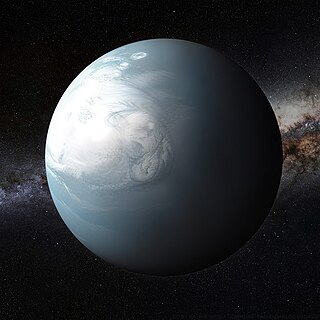
A hycean planet is a particular type of exoplanet that features a liquid water ocean under a hydrogen-rich atmosphere.
TOI-1227 b is one of the youngest transiting exoplanets discovered, alongside K2-33b and HIP 67522 b. The exoplanet TOI-1227 b is about 11±2 Myrs old and currently 9.5 R🜨 large. It will become a 3-5 R🜨 planet in about 1 billion years, because the planet is still contracting. TOI-1227 b orbits a very low-mass star every 27.36 days.
TOI-813 is a bright subgiant G-type star located 858 light-years away from planet Earth. It is too faint to be seen with the naked eye. TOI-813 has a mass of 1.32 solar masses, a radius of 1.95 solar radii and a luminosity of 4.3 times the solar luminosity.
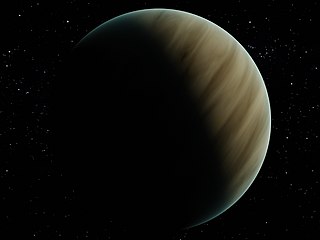
TOI-813 b is a Saturn sized exoplanet orbiting the star TOI-813, a evolved and bright subgiant G-type star located 858 light years away from Earth. The exoplanet is a Neptune like gas giant type planet with 42 earth masses and 6.7 earth radii. In approximately 780 million years, the planet will be engulfed and destroyed by its parent star.
References
- ↑ "★ TOI 1853". Stellar Catalog. Retrieved 2023-09-23.
- ↑ Choi, Charles Q (2023-08-30). "Scorching Neptune-size world is way too massive for astronomers to explain". Space.com . Retrieved 2023-09-23.
- ↑ Naponiello, Luca; Mancini, Luigi; Sozzetti, Alessandro; Bonomo, Aldo S.; Morbidelli, Alessandro; Dou, Jingyao; Zeng, Li; Leinhardt, Zoe M.; Biazzo, Katia; Cubillos, Patricio E.; Pinamonti, Matteo; Locci, Daniele; Maggio, Antonio; Damasso, Mario; Lanza, Antonino F. (2023-08-30). "A super-massive Neptune-sized planet". Nature : 1–6. arXiv: 2309.01464 . doi:10.1038/s41586-023-06499-2. ISSN 1476-4687.
 | This extrasolar-planet-related article is a stub. You can help Wikipedia by expanding it. |