
Mahendra Bir Bikram Shah Dev, was the ninth King of Nepal from 13 March 1955 until his death in 1972, which was due to heart attack as told in an interview by his personal physician Dr. Mrigendra Raj Pandey. Following the 1960 coup d'état, he established the partyless Panchayat system which governed the country for 28 years until the introduction of multiparty democracy in 1990. During his reign, Nepal experienced a period of industrial, political and economic change which opened it to the rest of the world for the first time after the 104-year-long reign of the Rana rulers, who kept the country under an isolationist policy, came to an end in 1951.
Music of Nepal refers to the various musical genres played and listened to in Nepal. With more than fifty ethnic groups in Nepal, the country's music is highly diverse. Genres like Tamang Selo, Chyabrung, Dohori, Adhunik Geet, Bhajan, Filmi music, Ghazal, Classical music, songs and Ratna music are widely played and popular, but many other less common genres are yet to be cataloged. Western musical genres like Rock, Metal, Hip-Hop, Rap, R&B also regularly feature on the Nepalese music charts. Most of the country's musical bands are based in the Kathmandu valley. Musical genres from Tibet and India have greatly influenced Nepalese music.

Newar or Newari, known officially in Nepal as Nepal Bhasa, is a Sino-Tibetan language spoken by the Newar people, the indigenous inhabitants of Nepal Mandala, which consists of the Kathmandu Valley and surrounding regions in Nepal.

A dhunge dhara or hiti is a traditional stone drinking fountain found in Nepal. It is an intricately carved stone waterway through which water flows uninterrupted from underground sources. Dhunge dharas are part of a comprehensive drinking water supply system, commissioned by various rulers of Ancient and Medieval Nepal. The system is supported by numerous ponds and canals that form an elaborate network of water bodies, created as a water resource during the dry season and to help alleviate the water pressure caused by the monsoon rains. After the introduction of modern, piped water systems, starting in the late 19th century, this old system has fallen into disrepair and some parts of it are lost forever. Nevertheless, many people of Nepal still rely on the old dhunge dharas on a daily basis.
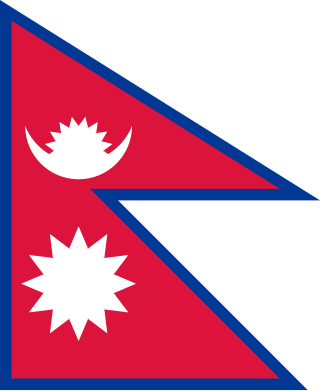
The following outline is provided as an overview of and topical guide to Nepal:

Savdhaan India – India Fights Back is an Indian Hindi-language crime show aired by Star Bharat. The series was created by Ajit Thakur. It is hosted by Ashutosh Rana, Tisca Chopra, Sushant Singh, Gaurav Chopra, Mohnish Behl, Pooja Gaur, Saurabh Raj Jain, Shivani Tomar, Pratyusha Banerjee, Hiten Tejwani, Divya Dutta, Sidharth Shukla and Mohit Malik. It provides dramatised versions of real-life crimes in India and the story of struggle of the victims to get justice for their sufferings.
The National Film Awards is the most prominent and prestigious award of Nepali cinema. The first National Film Award was held in 2005, in the presence of His Majesty's King Gyanendra Bir Bikram Shah. The event is held at the residence of the president of Nepal and the president gives the awards to the winners in various categories. It is yearly organised by Film Development Board, Nepal.
Lars Johanson is a Swedish Turcologist and linguist, an emeritus professor at the University of Mainz, and docent at the Department of Linguistics and Philology, University of Uppsala, Sweden.

Nepal Literature Festival is an annual international literary festival which takes place in Pokhara, Nepal. It was founded in 2011 by Bookworm Foundation, a not-for-profit organization.

Nepal Idol is a Nepali reality television singing competition that is part of the Idols franchise created and owned by FremantleMedia. Nepal Idol 2017 is the first season of Idol Franchise in Nepal which aired on AP1 TV.
"Melancholy" is an environmentally-themed song sung by 365 Nepali artists. This song was intended to promote an environmental message by breaking the Guinness World Records for "Most Vocal Solos in a Song Recording", which it successfully did. It was written, music composed and directed by environmentalist Nipesh Dhaka. The song was recorded as a single on 19 May 2016. The recording sessions were inaugurated by Prime Minister Khadga Prasad Oli at 8 am and continued until 6 pm. The song was released on 2 September 2017 by President Bidya Devi Bhandari at Army Officer's Club, Kathmandu.

Nischal Basnet is a Nepalese film director and actor who primarily appears in Nepali language films. He made his directorial debut in 2012 with the crime-thriller Loot and wrote screenplay for the film. The film focuses on Hakku Kale, who masterminds a bank robbery. The film received mixed reviews from the critics, some of whom criticized the script for not being original. According to The Kathmandu Post, the film "changed the discourse of the Nepali film industry". Loot earned 25.5 million Nepalese rupees, making it Nepal's highest-grossing film of 2012. Basnet went on to win the Dcine Award for Best Debut Director. In 2014, Basnet acted in and produced Ram Babu Gurung's romantic drama Kabaddi. In the film, Basnet plays Bibek, who tries to abduct a gangster's daughter. The same year, Basnet directed the dark comedy Talakjung vs Tulke. The film is set during the Nepalese Civil War, which lasted from 1996 to 2006. Basnet won the Film Critics Society of Nepal Award for Best Director and the National Film Award for Best Director. Talakjung vs Tulke was selected as the Nepalese entry for the Best Foreign Language Film at the 88th Academy Awards, but it was not nominated.

General elections were held in Nepal on 20 November 2022 to elect the 275 members of the House of Representatives. There were two ballots in the election; one to elect 165 members from single-member constituencies via FPTP, and the other to elect the remaining 110 members from a single nation-wide constituency via party-list proportional representation.
Events in the year 2023 in Nepal.
