On 20 September 1941 Major Szostak, Commander of the Polish Armoured Forces in the Soviet Union submitted a wide-ranging training plan for the Polish Units by proposing to create a training centre of tank and transport troops to be attached to the Soviet Tank Training School in Saratov. The plan was approved by Gen Anders and submitted to the Soviet authorities in Moscow. Their agreement was never received. Then Major Szostak, on his own initiative, approached Col Rogonin commanding officer of the Saratov Tank School with a plan to train Polish units which were being formed, on the School equipment. Col Rogonin favoured the plan but its approval was never received from the Ulianovsk Military District. At the beginning of January 1942 Gen Anders ordered further enlargement of the Polish Forces in the Soviet Union. At the same time the army command started making plans to adopt British army structure and Major Szostak, on 15 Jan 1942 ordered the formation of the following units:
- Organisation Centre of Tank Units - c.o. Capt Bronislaw Rafalski
- Tank Training Centre - c.o. Major Felsztynski (Order 150/tjn. Br. Panc.)
Core of the Tank Training Centre was to consist of the 5th and the 6th Tank Battalions. At the beginning the Centre was located in the region of Carabalty in the vicinity of Frunze. The training started on 15 Feb. 1942. Towards the end of March troops were evacuated to Iran.

Lieutenant General Stanisław Maczek was a Polish tank commander of World War II, whose division was instrumental in the Allied liberation of France, closing the Falaise pocket, resulting in the destruction of 14 German Wehrmacht and SS divisions. A veteran of World War I, the Polish–Ukrainian and Polish–Soviet Wars, Maczek was the commander of Poland's only major armoured formation during the September 1939 campaign, and later commanded a Polish armoured formation in France in 1940. He was the commander of the famous 1st Polish Armoured Division, and later of the I Polish Army Corps under Allied Command in 1942–45.

The Polish 1st Armoured Division was an armoured division of the Polish Armed Forces in the West during World War II. Created in February 1942 at Duns in Scotland, it was commanded by Major General Stanisław Maczek and at its peak numbered approximately 18,000 soldiers. The division served in the final phases of the Battle of Normandy in August 1944 during Operation Totalize and the Battle of Chambois and then continued to fight throughout the campaign in Northern Europe, mainly as part of the First Canadian Army.

Władysław Albert Anders was a general in the Polish Army and later in life a politician and prominent member of the Polish government-in-exile in London.
The Polish II Corps, 1943–1947, was a major tactical and operational unit of the Polish Armed Forces in the West during World War II. It was commanded by Lieutenant General Władysław Anders and fought with distinction in the Italian Campaign, in particular at the Battle of Monte Cassino. By the end of 1945, the corps had grown to well over 100,000 soldiers.
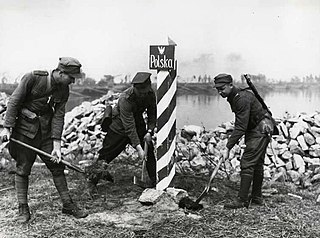
The Polish First Army was an army unit of the Polish Armed Forces in the East. It was formed in the Soviet Union in 1944, from the previously existing Polish I Corps in the Soviet Union, as part of the People's Army of Poland (LWP). The First Army fought westward, subordinated to the Soviet 1st Belorussian Front, during the offensive against Nazi Germany that led to the capture of Warsaw in January 1945, and the capture of Berlin in May 1945.

The 1st (Polish) Independent Parachute Brigade was a parachute infantry brigade of the Polish Armed Forces in the West under the command of Major General Stanisław Sosabowski, created in September 1941 during the Second World War and based in Scotland.

The 1st Guards Tank Army is a tank army of the Russian Ground Forces.

The Polish 10th Armoured Cavalry Brigade was an armoured formation of the Polish Armed Forces in the West. It was organized in France during World War II as part of the Polish Army in France, mostly by veterans of the 10th Motorized Cavalry Brigade who managed to escape from German and Soviet occupied Poland. Led by General Stanisław Maczek, it took part in the Battle of France in May 1940. It was later reformed in Great Britain as a part of the 1st Armoured Division.

Kaminski Brigade, also known as Waffen-Sturm-Brigade der SS RONA, was a collaborationist formation composed of Russian nationals from the territory of the Lokot Autonomy in Axis-occupied areas of the RSFSR in the Soviet Union during the German–Soviet War of 1941−45.
The 8th Infantry Division was a tactical unit of the Polish Army. It was active in the Polish-Bolshevik War, as well as during the Invasion of Poland in 1939. During World War II, the division was reformed twice as part of two distinct armed forces: once as part of the Home Army during the Warsaw Uprising and again as part of the Polish Army in the East.
The 16th Pomeranian Infantry Division is a military unit of the Polish Army. It was first raised on 16 August 1919 during the Polish uprising, before going on to serve during the subsequent war with the Bolsheviks. At the start of World War II the division fought briefly against the advancing German Army before being destroyed on 19 September 1939 after being surrounded in the Kampinos Forest. The division was raised once more in 1945 following the Soviet takeover of Poland; however, it did not see further action during the war. Afterwards it continued to serve, undergoing a number of changes in name and role. Today, it exists as the 16th Mechanised Division.
The Polish Armed Forces in the East, also called Polish Army in the USSR, were the Polish military forces established in the Soviet Union during World War II.

15th Poznań Uhlan Regiment – unit of Polish cavalry, part of Greater Polands Army, Polish Army of Second Republic and Polish Armed Forces in the West during World War II.
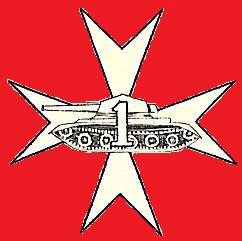
The 1st Armoured Regiment was an armoured regiment of the Polish Armed Forces in the West during World War II, part of the 1st Armoured Division.

Stanisław Szostak was a colonel of the Polish Armoured Corps.

Armoured Forces Training Centre - Armoured Forces Training Centre of the Polish Forces in the West.

32nd Armoured Reconnaissance Group(pl: 32 Dywizjon Pancerny) - Polish reconnaissance unit in the Polish September Campaign.
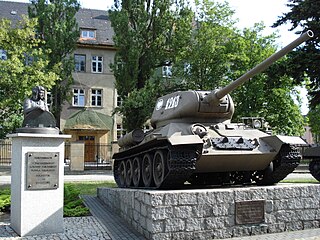
The 1st Armoured Corps was an armoured formation of the Polish People's Army during 1944 - 1945. The corps saw combat in Germany in 1945. Later that year, the subordinate units of the corps were dispersed to garrisons in Poland and the corps itself was inactivated in October 1945.

Muzeum Broni Pancernej Centrum Szkolenia Wojsk Lądowych im. Hetmana Polnego Koronnego Stefana Czarnieckiego w Poznaniu, abbreviated Muzeum Broni Pancernej CSWL is a large collection of military vehicles, formerly located within Land Forces Training Center in Poznań, Poland.

This article deals with the history and development of tanks of the Polish army from their first use after World War I, into the interwar period, during World War II, the Cold War and modern era.

