
The term "Terre Matildiche" is used to refer to the group of territories that was ruled by the countess Matilda of Tuscany.
The term "Terre Matildiche" is used to refer to the group of territories that was ruled by the countess Matilda of Tuscany.

Matilda of Tuscany, also referred to as la Gran Contessa, was a member of the House of Canossa in the second half of the eleventh century. Matilda was one of the most important governing figures of the Italian Middle Ages. She reigned in a period of constant battles, political intrigues and Roman-Catholic excommunications, and was able to demonstrate an innate and skilled strategic leadership capacity in both military and diplomatic matters.

Reggio nell'Emilia, usually referred to as Reggio Emilia, or simply Reggio by its inhabitants, and known until 1861 as Reggio di Lombardia, is a city in northern Italy, in the Emilia-Romagna region. It has about 171,944 inhabitants and is the main comune (municipality) of the Province of Reggio Emilia.

The Province of Reggio Emilia is one of the nine provinces of the Italian Region of Emilia-Romagna. The capital city, which is the most densely populated comune in the province, is Reggio Emilia.

Boniface III, son of Tedald of Canossa and the father of Matilda of Tuscany, was the most powerful north Italian prince of his age. By inheritance he was count of Brescia, Canossa, Ferrara, Florence, Lucca, Mantua, Modena, Pisa, Pistoia, Parma, Reggio, and Verona from 1007 and, by appointment, margrave of Tuscany from 1027 until his assassination in 1052.

Sassuolo is an Italian town, comune, and industrial centre of the Province of Modena in Emilia-Romagna.

Bibbiano is a comune (municipality) in the Province of Reggio Emilia in the Italian region of Emilia-Romagna, located about 70 kilometres (43 mi) northwest of Bologna and about 14 kilometres (9 mi) southwest of Reggio Emilia.

Cadelbosco di Sopra is a town and comune in the province of Reggio Emilia in Emilia-Romagna, Italy.
Casina is a comune (municipality) in the Province of Reggio Emilia, in the Italian region Emilia-Romagna, located about 70 kilometres west of Bologna and about 25 km (16 mi) southwest of Reggio Emilia.
Vetto is a comune (municipality) in the Province of Reggio Emilia in the Italian region Emilia-Romagna, located about 80 kilometres (50 mi) west of Bologna and about 35 kilometres (22 mi) southwest of Reggio Emilia.

Vezzano sul Crostolo is a comune (municipality) in the Province of Reggio Emilia in the Italian region Emilia-Romagna, located about 60 kilometres (37 mi) west of Bologna and about 13 kilometres (8 mi) southwest of Reggio Emilia.
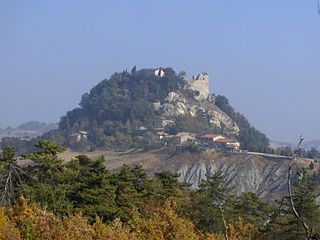
Canossa is a comune and castle town in the Province of Reggio Emilia, Emilia-Romagna, northern Italy. It is where Holy Roman Emperor Henry IV did penance in 1077 and stood three days bare-headed in the snow to reverse his excommunication by Pope Gregory VII. The Walk to Canossa is sometimes used as a symbol of the changing relationship between the medieval Church and State.
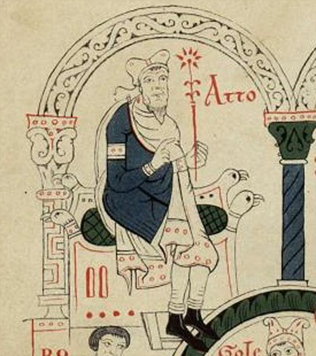
Adalbert Atto was the first Count of Canossa and founder of that noble house which eventually was to play a determinant role in the political settling of Regnum Italicum and the Investiture Controversy in the eleventh and twelfth centuries.

The House of Canossa was an Italian noble family from Lucca holding the castle of Canossa, from the early tenth to the early twelfth century.

The March of Tuscany was a march of the Kingdom of Italy and the Holy Roman Empire during the Middle Ages. Located in northwestern central Italy, it bordered the Papal States to the south, the Ligurian Sea to the west and Lombardy to the north. It comprised a collection of counties, largely in the valley of the Arno River, originally centered on Lucca.
Richelida or Richilda was a member of the dynasty known to historians as the Giselbertiners. Her second husband was Boniface III of Tuscany.

The Castle of Canossa is a castle in Canossa, province of Reggio Emilia, northern Italy.

The Abbey of Frassinoro was one of the many Benedictine monasteries throughout Europe associated with the noblewoman Matilda of Tuscany, who reigned over the Badia lands near Frassinoro. This abbey was located in Frassinoro, in the Apennines in the province of Modena, on the border with Reggio Emilia.
Corteo Storico Matildico is a reminiscent event of historical nature, which takes place annually in Quattro Castella, in the province of Reggio Emilia, since 1955.
The Oratory of the Madonna della Battaglia is a Roman Catholic chapel-church located on the Strada Provinciale numero 78, in the frazione of Bergonzano, outside of the town of Quattro Castella, province of Reggio Emilia, region of Emilia Romagna, Italy.

The Sant'Antonino Martire is a Roman Catholic church located in the town center of Quattro Castella, province of Reggio Emilia, region of Emilia Romagna, Italy.