Gothic fiction, which is largely known by the subgenre of Gothic horror, is a genre or mode of literature and film that combines fiction and horror, death, and at times romance. Its origin is attributed to English author Horace Walpole, with his 1764 novel The Castle of Otranto, subtitled "A Gothic Story". The effect of Gothic fiction feeds on a pleasing sort of terror, an extension of Romantic literary pleasures that were relatively new at the time of Walpole's novel. It originated in England in the second half of the 18th century where, following Walpole, it was further developed by Clara Reeve, Ann Radcliffe, William Thomas Beckford and Matthew Lewis. The genre had much success in the 19th century, as witnessed in prose by Mary Shelley's Frankenstein and the works of Edgar Allan Poe as well as Charles Dickens with his novella, A Christmas Carol, and in poetry in the work of Samuel Taylor Coleridge, and Lord Byron. Another well known novel in this genre, dating from the late Victorian era, is Bram Stoker's Dracula. The name Gothic, which originally referred to the Goths, and then came to mean "German", refers to the medieval Gothic architecture, in which many of these stories take place. This extreme form of Romanticism was very popular throughout Europe, especially among English- and German-language writers and artists. The English Gothic novel also led to new novel types such as the German Schauerroman and the French Roman Noir.
Historical fiction is a literary genre in which the plot takes place in a setting located in the past. Although the term is commonly used as a synonym for the historical novel, it can also be applied to other types of narrative, including theatre, opera, cinema and television, as well as video games and graphic novels.
The picaresque novel is a genre of prose fiction that depicts the adventures of a roguish, but "appealing hero", of low social class, who lives by his wits in a corrupt society. Picaresque novels typically adopt a realistic style, with elements of comedy and satire. This style of novel originated in Spain in 1554 and flourished throughout Europe for more than 200 years, though the term "picaresque novel" was only coined in 1810. It continues to influence modern literature. The term is also sometimes used to describe works, like Cervantes' Don Quixote and Charles Dickens' Pickwick Papers, which only contain some of the genre's elements.

The English novel is an important part of English literature. This article mainly concerns novels, written in English, by novelists who were born or have spent a significant part of their lives in England, or Scotland, or Wales, or Northern Ireland. However, given the nature of the subject, this guideline has been applied with common sense, and reference is made to novels in other languages or novelists who are not primarily British where appropriate.

An antihero or antiheroine is a main character in a story who lacks conventional heroic qualities and attributes such as idealism, courage and morality. Although antiheroes may sometimes perform actions that are morally correct, it is not always for the right reasons, often acting primarily out of self-interest or in ways that defy conventional ethical codes.
This article presents lists of the literary events and publications in 1753.
This article presents lists of the literary events and publications in 1760.
The idiom tongue-in-cheek refers to a humorous or sarcastic statement expressed in a mock serious manner.

The Adventures of Peregrine Pickle is a picaresque novel by the Scottish author Tobias Smollett (1721–1771), first published in 1751 and revised and published again in 1758. It tells the story of an egotistical man who experiences luck and misfortunes in the height of 18th-century European society.
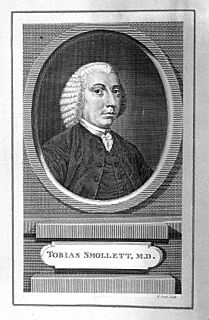
The Life and Adventures of Sir Launcelot Greaves, a novel by Tobias Smollett, was published in 1760 in the monthly paper The British Magazine. Its first number, published in January, 1760, contained the first installment of Smollett’s fourth novel. The novel, Smollett's shortest, differs stylistically from his previous works.

The History of Sir Charles Grandison, commonly called Sir Charles Grandison, is an epistolary novel by English writer Samuel Richardson first published in February 1753. The book was a response to Henry Fielding's The History of Tom Jones, a Foundling, which parodied the morals presented in Richardson's previous novels. The novel follows the story of Harriet Byron who is pursued by Sir Hargrave Pollexfen. After she rejects Pollexfen, he kidnaps her, and she is only freed when Sir Charles Grandison comes to her rescue. After his appearance, the novel focuses on his history and life, and he becomes its central figure.

Adventure fiction is fiction that usually presents danger, or gives the reader a sense of excitement.
The sentimental novel or the novel of sensibility is an 18th-century literary genre which celebrates the emotional and intellectual concepts of sentiment, sentimentalism, and sensibility. Sentimentalism, which is to be distinguished from sensibility, was a fashion in both poetry and prose fiction beginning in the eighteenth century in reaction to the rationalism of the Augustan Age.
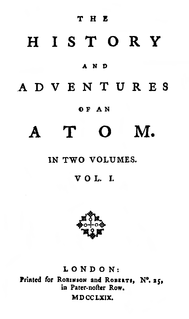
The History and Adventures of an Atom, by Tobias Smollett, is a novel that savagely satirises English politics during the Seven Years' War.
The Romantic hero is a literary archetype referring to a character that rejects established norms and conventions, has been rejected by society, and has himself as the center of his or her own existence. The Romantic hero is often the protagonist in a literary work, and the primary focus is on the character's thoughts rather than his or her actions.

The novel in Scotland includes all long prose fiction published in Scotland and by Scottish authors since the development of the literary format in the eighteenth century. The novel was soon a major element of Scottish literary and critical life. Tobias Smollett's picaresque novels, such as The Adventures of Roderick Random and The Adventures of Peregrine Pickle mean that he is often seen as Scotland's first novelist. Other Scots who contributed to the development of the novel in the eighteenth century include Henry Mackenzie and John Moore.

Scottish literature in the eighteenth century is literature written in Scotland or by Scottish writers in the eighteenth century. It includes literature written in English, Scottish Gaelic and Scots, in forms including poetry, drama and novels. After the Union in 1707 Scottish literature developed a distinct national identity. Allan Ramsay led a "vernacular revival", the trend for pastoral poetry and developed the Habbie stanza. He was part of a community of poets working in Scots and English who included William Hamilton of Gilbertfield, Robert Crawford, Alexander Ross, William Hamilton of Bangour, Alison Rutherford Cockburn, and James Thompson. The eighteenth century was also a period of innovation in Gaelic vernacular poetry. Major figures included Rob Donn Mackay, Donnchadh Bàn Mac an t-Saoir, Uillean Ross and Alasdair mac Mhaighstir Alasdair, who helped inspire a new form of nature poetry. James Macpherson was the first Scottish poet to gain an international reputation, claiming to have found poetry written by Ossian. Robert Burns is widely regarded as the national poet.

The novel of circulation, otherwise known as the it-narrative, or object narrative, is a genre of novel common at one time in British literature, and follows the fortunes of an object, for example a coin, that is passed around between different owners. Sometimes, instead, it involves a pet or other domestic animal, as for example in Francis Coventry's The History of Pompey the Little (1751). This and other such works blended satire with the interest for contemporary readers of a roman à clef. They also use objects such as hackney-carriages and bank-notes to interrogate what it meant to live in an increasingly mobile society, and to consider the effect of circulation on human relations.