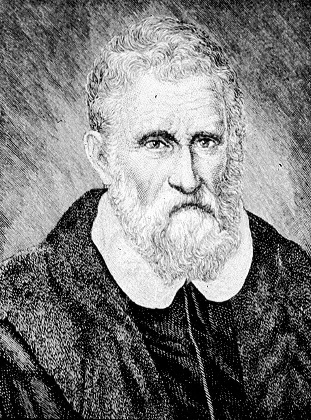
Marco Polo was a Venetian merchant, explorer and writer who travelled through Asia along the Silk Road between 1271 and 1295. His travels are recorded in The Travels of Marco Polo, a book that described the then-mysterious culture and inner workings of the Eastern world, including the wealth and great size of the Mongol Empire and China under the Yuan dynasty, giving Europeans their first comprehensive look into China, Persia, India, Japan, and other Asian societies.
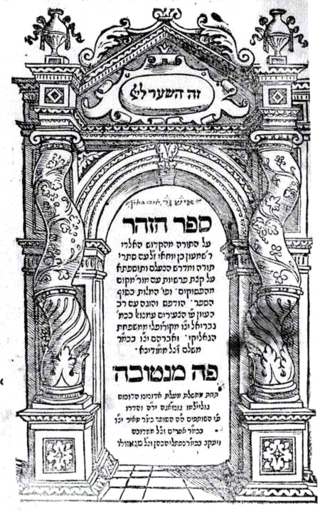
The Zohar is a foundational work of Kabbalistic literature. It is a group of books including commentary on the mystical aspects of the Torah and scriptural interpretations as well as material on mysticism, mythical cosmogony, and mystical psychology. The Zohar contains discussions of the nature of God, the origin and structure of the universe, the nature of souls, redemption, the relationship of ego to darkness and "true self" to "the light of God".

Sefer haYashar is a medieval Hebrew midrash, also known as the Toledot Adam and Divrei haYamim heArukh. The Hebrew title "Sefer haYashar" might be translated as the "Book of Righteousness" but it is known in English translation mostly as The Book of Jasher following English tradition. Its author is unknown.
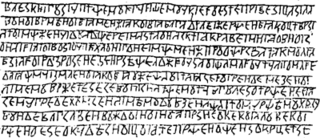
The Book of Veles is a literary forgery purporting to be a text of ancient Slavic religion and history supposedly written on wooden planks.
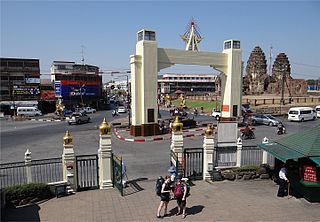
Lopburi is the capital city of Lopburi Province in Thailand. It is about 150 kilometres (93 mi) northeast of Bangkok. It has a population of 58,000. The town covers the whole tambon Tha Hin and parts of Thale Chup Son of Mueang Lopburi District, a total area of 6.85 km2.
Jews and Judaism in China are predominantly composed of Sephardi Jews and their descendants. Other Jewish ethnic divisions are also represented, including Ashkenazi Jews, Mizrahi Jews and a number of converts.

Pseudepigrapha are falsely attributed works, texts whose claimed author is not the true author, or a work whose real author attributed it to a figure of the past. The name of the author to whom the work is falsely attributed is often prefixed with the particle "pseudo-", such as for example "pseudo-Aristotle" or "pseudo-Dionysius": these terms refer to the anonymous authors of works falsely attributed to Aristotle and Dionysius the Areopagite, respectively.

Book of the Marvels of the World, in English commonly called The Travels of Marco Polo, is a 13th-century travelogue written down by Rustichello da Pisa from stories told by Italian explorer Marco Polo. It describes Polo's travels through Asia between 1271 and 1295, and his experiences at the court of Kublai Khan.
Cultural exchanges between western peoples, particularly Arabs and Chinese, have been occurring for centuries. The earliest records go back to 635, with the discovery of the Nestorian Stone, and are then followed by Marco Polo and Ibn Batutta several centuries later.
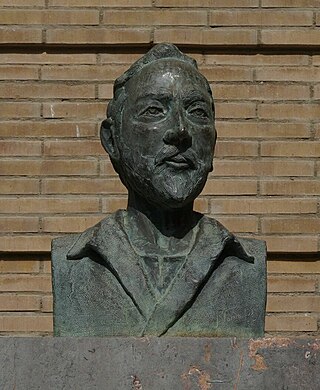
Benjamin of Tudela, also known as Benjamin ben Jonah, was a medieval Jewish traveler who visited Europe, Asia, and Africa in the twelfth century. His vivid descriptions of western Asia preceded those of Marco Polo by a hundred years. With his broad education and vast knowledge of languages, Benjamin of Tudela is a major figure in medieval geography and Jewish history.
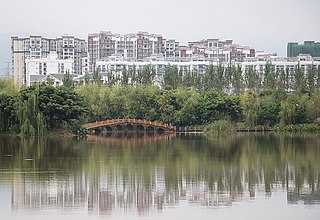
Xichang is a city in and the seat of the Liangshan Yi Autonomous Prefecture, in the south of Sichuan, China.
Antisemitism in Japan has developed over the years despite the presence of a relatively small and obscure Jewish population. Japan had no traditional antisemitism until nationalist ideology and propaganda began to spread on the eve of World War II. Before and during the war, Nazi Germany, an ally to the Japanese, encouraged Japan to adopt antisemitic policies. In the post-war period, extremist groups and ideologues have promoted conspiracy theories.
David Selbourne is a British political philosopher, social commentator and historian of ideas. He was educated at Manchester Grammar School, and Balliol College, Oxford, where he studied Jurisprudence, held the Winter Williams Law Scholarship, and was awarded a Paton Studentship and the Jenkins Law Prize. He was thereafter a British Commonwealth Fellow at the University of Chicago Law School, and in 1960 was called to the bar of the Inner Temple where he was student scholar, but did not practise law. He is the father of Raphael Selbourne, winner of the 2009 Costa First Book Award.
The Franklin Prophecy, sometimes called the Franklin Forgery, is an antisemitic speech falsely attributed to Benjamin Franklin, warning of the supposed dangers of admitting Jews to the nascent United States. The speech was purportedly transcribed by Charles Cotesworth Pinckney during the Constitutional Convention of 1787, but was unknown before its appearance in 1934 in the pages of William Dudley Pelley's Silver Legion pro-Nazi magazine Liberation. No evidence exists for the document's authenticity, and some of Pelley's claims have actively been disproven.

Four major military campaigns were launched by the Mongol Empire, and later the Yuan dynasty, against the kingdom of Đại Việt ruled by the Trần dynasty and the kingdom of Champa in 1258, 1282–1284, 1285, and 1287–88. The campaigns are treated by a number of scholars as a success due to the establishment of tributary relations with Đại Việt despite the Mongols suffering major military defeats. In contrast, modern Vietnamese historiography regards the war as a major victory against the foreign invaders.

The Protocols of the Elders of Zion is a fabricated text purporting to detail a Jewish plot for global domination. Largely plagiarized from several earlier sources, it was first published in Imperial Russia in 1903, translated into multiple languages, and disseminated internationally in the early part of the 20th century. It played a key part in popularizing belief in an international Jewish conspiracy.
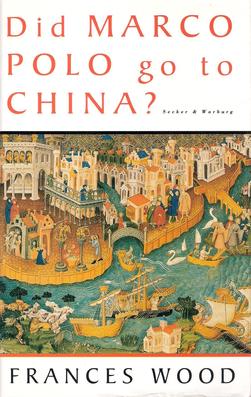
Did Marco Polo Go to China? is a 1995 book, by Frances Wood, arguing that Italian explorer Marco Polo never visited China but travelled no further than Persia and that he based his description of China on accounts from Persian travelers.
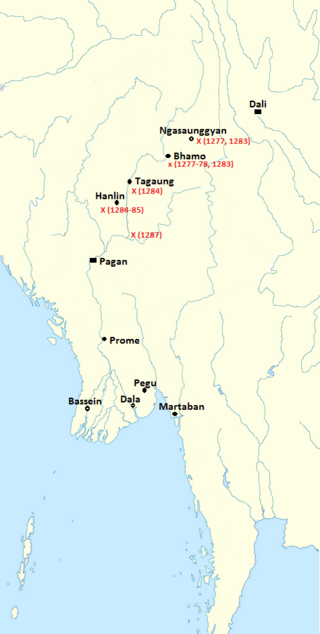
The first Mongol invasions of Burma were a series of military conflicts between Kublai Khan's Yuan dynasty, a division of the Mongol Empire, and the Pagan Empire that took place between 1277 and 1287. The invasions toppled the 250-year-old Pagan Empire, and the Mongol army seized Pagan territories in present-day Dehong, Yunnan and northern Burma to Tagaung. The invasions ushered in 250 years of political fragmentation in Burma and the rise of ethnic Tai-Shan states throughout mainland Southeast Asia.
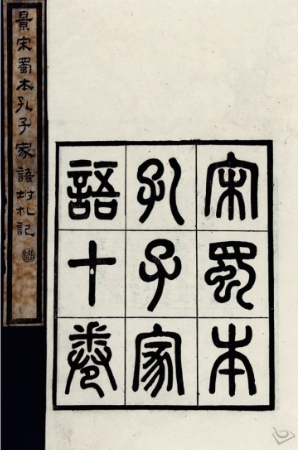
The Kongzi Jiayu, translated as The School Sayings of Confucius or Family Sayings of Confucius, is a collection of sayings of Confucius (Kongzi), written as a supplement to the Analects (Lunyu).
Stephen G. Haw is a botanical taxonomist and historian, specializing in subjects relating to China. He is the author of several published books and a large number of periodical articles. His most important work relates to the taxonomy of Tree Peonies and to the history of the Mongol period in East Asia. He has made a major contribution to studies of Marco Polo's account of East Asia: according to Peter Jackson, an authority on the history of the Mongol conquests, his book about Marco Polo "must surely now have settled the controversy surrounding the historicity of Polo's visit to China."

