 | This article needs additional citations for verification .(September 2014) |
The Closed Circle: An interpretation of the Arabs is a 1989 book by author David Pryce-Jones that was published by Harper & Row. [1]
| | This article needs additional citations for verification .(September 2014) |
The Closed Circle: An interpretation of the Arabs is a 1989 book by author David Pryce-Jones that was published by Harper & Row. [1]
This book discusses the tribal roots of Arab society which form the basis of its cultural traditions. The author documents the cultural forces which drive the violence and mayhem that, in his view, is characteristic of Arab societies in their dealings with each other and with the West.
The author argues that the Arab world is stuck in an age-old tribalism and behavior from which it is unable to evolve. In tribal society, loyalty is extended to close kin and other members of the tribe. In the Arab world those who seek power achieve it by plotting secretly and ruthlessly eliminating their rivals.

The Arabs, also known as the Arab people, are an ethnic group mainly inhabiting the Arab world in West Asia and North Africa. A significant Arab diaspora is present in various parts of the world.

Cultural imperialism comprises the cultural dimensions of imperialism. The word "imperialism" describes practices in which a country engages culture to create and maintain unequal social and economic relationships among social groups. Cultural imperialism often uses wealth, media power and violence to implement the system of cultural hegemony that legitimizes imperialism.
Dominator culture refers to a model of society where fear and force maintain rigid understandings of power and superiority within a hierarchical structure. Futurist and writer Riane Eisler first popularized this term in her book The Chalice and the Blade. In it, Eisler positions the dominator model in contrast to the partnership model, a more egalitarian structure of society founded on mutual respect among its inhabitants. In dominator culture, men rule over women, whereas partnership culture values men and women equally.

Fatema Mernissi was a Moroccan feminist writer and sociologist.
Liberalism and progressivism within Islam involve professed Muslims who have created a considerable body of progressive thought about Islamic understanding and practice. Their work is sometimes characterized as "progressive Islam". Some scholars, such as Omid Safi, differentiate between "Progressive Muslims" versus "Liberal advocates of Islam".
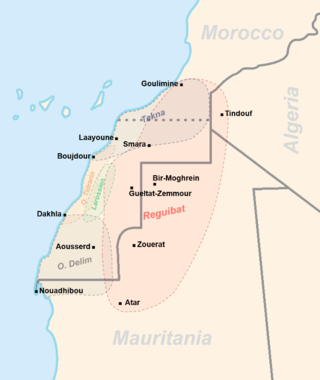
The Sahrawis, or Sahrawi people, are an ethnic group native to the western part of the Sahara desert, which includes the Western Sahara, southern Morocco, much of Mauritania, and along the southwestern border of Algeria. They are of mixed Hassani Arab and Sanhaji Berber descent, as well as West African and other indigenous populations.

William Robertson Smith was a Scottish orientalist, Old Testament scholar, professor of divinity, and minister of the Free Church of Scotland. He was an editor of the Encyclopædia Britannica and contributor to the Encyclopaedia Biblica. He is also known for his book Religion of the Semites, which is considered a foundational text in the comparative study of religion.
Gisèle Littman, better known by her pen name Bat Ye'or, is an Egyptian-born British-French author, who argues in her writings that Islam, anti-Americanism and antisemitism hold sway over European culture and politics.
David Eugene Henry Pryce-Jones is a British conservative author and commentator.
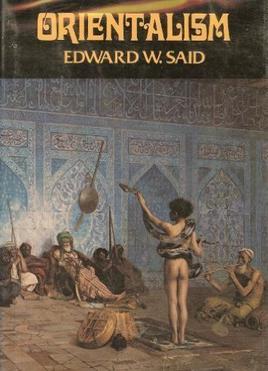
Orientalism is a 1978 book by Edward W. Said, in which the author establishes the term "Orientalism" as a critical concept to describe the West's commonly contemptuous depiction and portrayal of The East, i.e. the Orient. Societies and peoples of the Orient are those who inhabit the places of Asia, North Africa, and the Middle East. Said argues that Orientalism, in the sense of the Western scholarship about the Eastern World, is inextricably tied to the imperialist societies who produced it, which makes much Orientalist work inherently political and servile to power.

Arab culture is the culture of the Arabs, from the Atlantic Ocean in the west to the Arabian Sea in the east, in a region of the Middle East and North Africa known as the Arab world. The various religions the Arabs have adopted throughout their history and the various empires and kingdoms that have ruled and took lead of the civilization have contributed to the ethnogenesis and formation of modern Arab culture. Language, literature, gastronomy, art, architecture, music, spirituality, philosophy and mysticism are all part of the cultural heritage of the Arabs.
The Closed Circle may refer to:
Culture and Conflict in the Middle East is a 2008 book by Philip Carl Salzman, an emeritus professor of Anthropology at McGill University and senior fellow of the Frontier Centre for Public Policy, a Canadian thinktank associated with free-market, conservative political thought.
Postcolonialism is the critical academic study of the cultural, political and economic legacy of colonialism and imperialism, focusing on the impact of human control and exploitation of colonized people and their lands. The field started to emerge in the 1960s, as scholars from previously colonized countries began publishing on the lingering effects of colonialism, developing a critical theory analysis of the history, culture, literature, and discourse of imperial power.

Icon of Evil: Hitler's Mufti and the Rise of Radical Islam is a 2008 book by David G. Dalin and John F. Rothmann initially published by Random House; the 2009 version of the book by Transaction Publishers has an introduction by Alan Dershowitz. It is a biography of Haj Amin al-Husseini (1895–1974), who was the Grand Mufti of Jerusalem during the British Mandate period. Some reviewers were critical of its "overtly propagandistic" style, citing numerous factual errors and criticizing its thesis that a direct line can be drawn from the Mufti to modern-day Islamic leaders as unconvincing and lacking evidence. Other reviewers praised the book, one describing it as "the first serious biography of the mufti to appear in 14 years".

David S. Reynolds is an American literary critic, biographer, and historian who has written about American literature and culture. He is the author or editor of fifteen books, on the Civil War era—including figures such as Walt Whitman, Abraham Lincoln, Herman Melville, Nathaniel Hawthorne, Edgar Allan Poe, Ralph Waldo Emerson, Henry David Thoreau, Emily Dickinson, Harriet Beecher Stowe, George Lippard, and John Brown. Reynolds has been awarded the Bancroft Prize, the Lincoln Prize, the Christian Gauss Award, the Ambassador Book Award, the Gustavus Myers Book Award, the John Hope Franklin Prize, and was a finalist for the National Book Critics Circle Award. He is a regular reviewer for The New York Review of Books..
Mohammed Jaber Al-Ansari, is a prominent Bahraini philosopher and political thinker, and an influential proponent of rational thinking in the 20th-century Arab World. He played a pivotal role in establishing the previously peripheral Persian Gulf region as an integral contributor to modern Arabic thought, on equal footing with other parts of the Arab World. His early work as a literary historian, and critic, instigated wide literary activity in his native Bahrain and in its surrounding Persian Gulf region. Al-Ansari was one of the early Arab intellectuals to delve into studying the East Asian experiences and draw comparisons with the Arab World.
Bryan v. Itasca County, 426 U.S. 373 (1976), was a case in which the Supreme Court of the United States held that a state did not have the right to assess a tax on the property of a Native American (Indian) living on tribal land absent a specific Congressional grant of authority to do so.

The Ethnic Cleansing of Palestine is a book authored by New Historian Ilan Pappé and published in 2006 by Oneworld Publications. The book is about the 1948 Palestinian expulsion and flight, which Pappe argues was the result of ethnic cleansing.

Petro-Islam is a neologism used to refer to the international propagation of the extremist and fundamentalist interpretations of Sunni Islam derived from the doctrines of Muhammad ibn Abd al-Wahhab, a Sunni Muslim preacher, scholar, reformer and theologian from Uyaynah in the Najd region of the Arabian Peninsula, eponym of the Islamic revivalist movement known as Wahhabism. This movement has been favored by the Kingdom of Saudi Arabia and the other Arab states of the Persian Gulf.
 | This article about a book on ethnicity or ethnology is a stub. You can help Wikipedia by expanding it. |
 | This article about cultural studies is a stub. You can help Wikipedia by expanding it. |