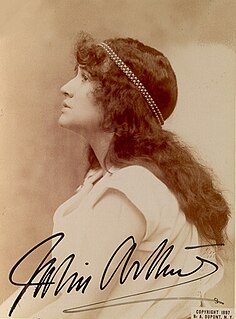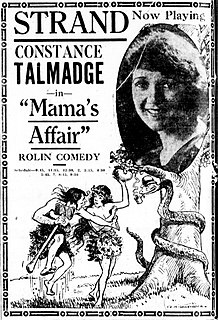
Mama's Affair is a 1921 American silent romantic comedy film directed by Victor Fleming and based on the play of the same title by Rachel Barton Butler. Cast members Effie Shannon, George Le Guere and Katherine Kaelred reprise their roles from the Broadway play.

Madame X is a 1920 American silent drama film directed by Frank Lloyd and starring Pauline Frederick. The film is based on the 1908 play Madame X, by French playwright Alexandre Bisson, and was adapted for the screen by J.E. Nash and Frank Lloyd. A copy of this film survives in the George Eastman House Motion Picture Collection.

We Can't Have Everything was a 1918 American silent drama film directed and written by Cecil B. DeMille based upon a novel by Rupert Hughes.

The Great Love is a 1918 American silent war drama film directed and written by D. W. Griffith who, along with scenario writer Stanner E.V. Taylor, is credited as "Captain Victor Marier". The film stars George Fawcett and Lillian Gish. Set during World War I, exterior scenes were shot on location in England. The Great Love is now considered to be a lost film.
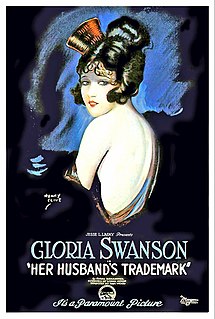
Her Husband's Trademark is a 1922 American silent drama film directed by Sam Wood and starring Gloria Swanson and Richard Wayne. Produced by Famous Players-Lasky and distributed by Paramount Pictures, the film was shot on location in El Paso, Texas.
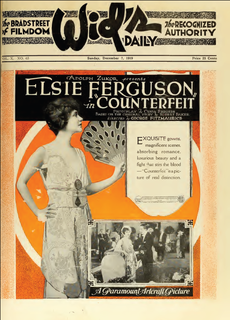
Counterfeit is a 1919 American silent detective drama film directed by George Fitzmaurice and starring Elsie Ferguson. The assistant director was C. Van Arsdale.

The Glorious Adventure is a lost 1918 American silent drama film directed by Hobart Henley.

A Doll's House is a 1918 American silent drama film produced by Famous Players-Lasky and distributed by Artcraft Pictures, an affiliate of Paramount Pictures. It is the third American motion picture filming of Henrik Ibsen's play A Doll's House. Maurice Tourneur directed and Elsie Ferguson starred. This film is lost.

Treasure Island is a 1918 American silent adventure film based on the novel of the same name by Robert Louis Stevenson. This is one of many silent versions of the story and is noteworthy because it is almost entirely acted by child or teenage actors. The film was co-directed by brothers Sidney and Chester Franklin. The film is one of Fox's Sunset Kiddies productions following in the wake of previous Kiddie productions like Aladdin and his Wonderful Lamp. This is a lost film.
The Love That Lives is a 1917 American silent drama film produced by Famous Players Film Company and distributed through Paramount Pictures. The film stars Pauline Frederick and was directed by Robert G. Vignola. The film is based on the story "Flames of Sacrifice", by Scudder Middleton.

My Lady's Garter is a lost 1920 American silent mystery film directed by Maurice Tourneur and starring Wyndham Standing, Sylvia Breamer and Holmes Herbert. It was based on the 1912 novel of the same name by Jacques Futrelle, a writer who perished with the sinking of the Titanic in 1912.

Arms and the Girl is a 1917 American silent drama film produced by Famous Players-Lasky and distributed by Paramount Pictures. It was directed by Joseph Kaufman and stars Billie Burke. The film is one of the few of director Kaufman's to survive and the earliest known Billie Burke silent to survive.

Girls is a 1919 American silent romantic comedy directed by Walter Edwards and starring Marguerite Clark. It is based on the 1909 Broadway play of the same name by Clyde Fitch starring Florence Reed in the part Clark plays in this film.

Scratch my Back is a 1920 American silent comedy film produced by Eminent Authors Pictures and distributed by Goldwyn Pictures. Adapted by Rupert Hughes from one of his story, the film was directed by Sidney Olcott with T. Roy Barnes and Helene Chadwick in the leading roles. It is not known whether the film currently survives.
The Judgement House is a 1917 American drama silent film directed by J. Stuart Blackton and written by J. Stuart Blackton based upon the novel by Gilbert Parker. The film stars Violet Heming, Wilfred Lucas, Conway Tearle, Paul Doucet, Florence Deshon, and Lucille Hammill. The film was released on November 19, 1917, by Paramount Pictures.
Missing is a 1918 American silent drama film directed by James Young and written by Mary Augusta Ward, J. Stuart Blackton, and James Young. The film stars Thomas Meighan, Sylvia Breamer, Robert Gordon, Winter Hall, Ola Humphrey and Mollie McConnell. The film was released on June 16, 1918, by Paramount Pictures.

Wealth is a 1921 American silent drama film directed by William Desmond Taylor, written by Cosmo Hamilton and Julia Crawford Ivers, and starring Ethel Clayton, Herbert Rawlinson, J.M. Dumont, Larry Steers, George Periolat, and Claire McDowell. It was released on August 21, 1921, by Paramount Pictures. It is not known whether the film currently survives, and it may be a lost film.

Between Friends is a 1924 American silent melodrama film based on the eponymous novel by Robert W. Chambers. The film was directed by J. Stuart Blackton and produced by Albert E. Smith. It stars Lou Tellegen, Anna Q. Nilsson, and Norman Kerry. The feature was distributed by Vitagraph Studios, which was founded by Blackton and Smith in 1897 in Brooklyn, New York. The film is lost.

The Scarlet Car is a lost 1923 American silent drama film directed by Stuart Paton and starring Herbert Rawlinson, Claire Adams and Edward Cecil. It is based on a novel by Richard Harding Davis which had previously been turned into a 1917 film of the same title.