Related Research Articles
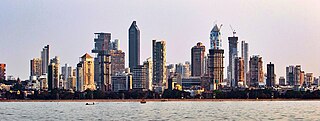
Mumbai, formerly known as Bombay, is the capital city of the Indian state of Maharashtra. Mumbai is the financial capital and the most populous city proper of India with an estimated population of 12.5 million (1.25 crore). Mumbai is the centre of the Mumbai Metropolitan Region, the sixth-most populous metropolitan area in the world with a population of over 23 million. Mumbai lies on the Konkan coast on the west coast of India and has a deep natural harbour. In 2008, Mumbai was named an alpha world city. Mumbai has the highest number of billionaires out of any city in Asia.

Shortwave radio is radio transmission using radio frequencies in the shortwave bands (SW). There is no official definition of the band range, but it always includes all of the high frequency band (HF), which extends from 3 to 30 MHz ; above the medium frequency band (MF), to the bottom of the VHF band.

Broadcasting is the distribution of audio or video content to a dispersed audience via any electronic mass communications medium, but typically one using the electromagnetic spectrum, in a one-to-many model. Broadcasting began with AM radio, which came into popular use around 1920 with the spread of vacuum tube radio transmitters and receivers. Before this, most implementations of electronic communication were one-to-one, with the message intended for a single recipient. The term broadcasting evolved from its use as the agricultural method of sowing seeds in a field by casting them broadly about. It was later adopted for describing the widespread distribution of information by printed materials or by telegraph. Examples applying it to "one-to-many" radio transmissions of an individual station to multiple listeners appeared as early as 1898.

Mulk Raj Anand was an Indian writer in English, recognised for his depiction of the lives of the poorer class in the traditional Indian society. One of the pioneers of Indo-Anglian fiction, he, together with R. K. Narayan, Ahmad Ali and Raja Rao, was one of the first India-based writers in English to gain an International readership. Anand is admired for his novels and short stories, which have acquired the status of classics of modern Indian English literature; they are noted for their perceptive insight into the lives of the oppressed and for their analysis of impoverishment, exploitation and misfortune. He became known for his protest novel Untouchable (1935), which was followed by other works on the Indian poor such as Coolie (1936) and Two Leaves and a Bud (1937). He is also noted for being among the first writers to incorporate Punjabi and Hindustani idioms into English, and was a recipient of the civilian honour of the Padma Bhushan, the third-highest civilian award in the Republic of India.

It is generally recognized that the first radio transmission was made from a temporary station set up by Guglielmo Marconi in 1895 on the Isle of Wight. This followed on from pioneering work in the field by a number of people including Alessandro Volta, André-Marie Ampère, Georg Ohm, James Clerk Maxwell and Heinrich Rudolf Hertz.
All India Radio (AIR), also known as Akashvani, is an Indian state-owned public radio broadcaster founded by the Government of India, owned by the Ministry of Information and Broadcasting and one of Prasar Bharati's two divisions. It was established in 1936. It is the sister service of Prasar Bharati's Doordarshan, an Indian television broadcaster. Headquartered in the Akashvani Bhavan building in New Delhi, it houses the Drama Section, the FM Section, and the National Service, and is also home to the Indian television station Doordarshan Kendra, (Delhi).
Radio Ceylon is a radio station based in Sri Lanka and the first radio station in Asia. Broadcasting was started on an experimental basis by the colonial Telegraph Department in 1923, just four years after the inauguration of broadcasting in Europe.
WCAO is a commercial radio station in Baltimore, Maryland. It broadcasts an urban gospel radio format and is owned by iHeartMedia, Inc. It also airs some Christian talk and teaching programs. The studios and offices are located at The Rotunda shopping center in Baltimore.

Polskie Radio Program I, known also as PR1 or radiowa Jedynka is a radio channel broadcast by the Polish public broadcaster, Polskie Radio. It is dedicated to information and easy listening music. Some of its broadcasts have decades-old traditions and are quite famous, such as Matysiakowie and W Jezioranach.
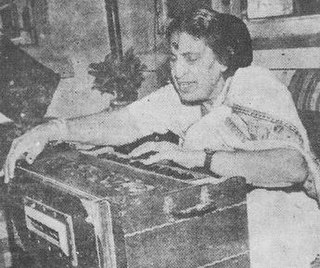
Saraswati Devi, born Khorshed Minocher-Homji, was an Indian director of music and score composer who worked in Hindi cinema in the 1930s and 1940s. She is most noted for her score, Mein Ban ki Chiriyra Banke Bun Bun Bolun Re in Bombay Talkies's Achut Kanya (1936). She along with Nargis' mother & Sanjay Dutt's grandmother Jaddanbai is considered to be one of the first female music composers in Indian cinema.

National Public Radio is an American public broadcasting organization headquartered in Washington, D.C., with its NPR West headquarters in Culver City, California. It serves as a national syndicator to a network of more than 1,000 public radio stations in the United States. It differs from other non-profit membership media organizations, such as the Associated Press, in that it was established by an act of Congress.
National Communications Network (NCN) is a national, state-owned television and radio broadcasting corporation in Guyana. It was formed in 2004 through the merger of the government radio service, Guyana Broadcasting Corporation (GBC), and the government-run television service, GTV. NCN's studios are situated on Homestretch Avenue in Georgetown.
Radio broadcasting started in Bahrain in 1940 by the British as a war-measure. Regular radio broadcasting, in Arabic, first started in 1955. By 1980, the radio service broadcast up to 14 hours a day. The country's first English language radio station started in 1977, as a result of an increase in English speakers in Bahrain and the Persian Gulf region. The radio's programs were primarily religious and educational, with occasional news announcements.

Balakrishna Vishwanath Keskar was an Indian politician and Union Minister for Information and Broadcasting between 1952 and 1962. Remembered for creating the Vrinda Vadya and promoting classical music through All India Radio, Keskar, who was India's longest serving Minister for Information and Broadcasting, was also responsible for banning Hindi film music, cricket commentaries and the harmonium on All India Radio.
Broadcasting in the city of Chennai began in 1924 by the Madras Presidency Radio Club. The service was operational till the government-run All India Radio started broadcasting in the city in 1938.
Peshawar Radio Station also known as Radio Pakistan Station, Peshawar is the oldest radio station in Pakistan, opening in 1935. When Abdul Qayyum Khan, a political leader of North-West Frontier Province Pakistan, went to London during the Round Table Conference of 1930-1932 he met Marconi, who had invented the wireless telegraph, and requested him to donate a radio transmitter for the N.W.F.P. Soon after the gift from Marconi arrived. The transmitter, personally engineered by Marconi, was installed in Peshawar and inaugurated by Sir Ralph Edwin Hotchkin Griffith, the Governor of North-West Frontier Province in 1935. After 14 August 1947 the station was property of Radio Pakistan.

Ira Nagrath, known as Ira Roshan, was an Indian singer and composer, wife of music director Roshan, mother of actor and film director Rakesh Roshan and music director Rajesh Roshan, and paternal grandmother of Hrithik Roshan.
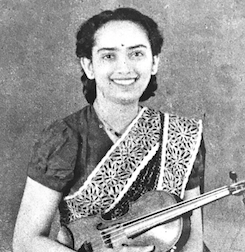
Philomena Rukmavathy Thumboochetty was an Indian violinist. She was the first Indian musician admitted to the Conservatoire de Paris.

Venu Dattatreye Chitale, also known as Leela Ganesh Khare, was an Indian writer, BBC Radio broadcaster, and secretary to George Orwell during the early years of the Second World War.

The Women’s Royal Indian Naval Service (WRINS) was the naval section of the Women's Auxiliary Corps (India). It was established during the Second World War as a branch of the Royal Indian Navy.
References
- ↑ Kapoor, Vinod (2021). Radio Cavalcade: Indian Broadcasting ...A Look Back. Notion Press. ISBN 978-1-63781-669-1.
- ↑ Luthra, H. R. Indian Broadcasting. Publications Division Ministry of Information & Broadcasting. ISBN 978-81-230-2286-4.
- ↑ "Indian program guide from 1936". www.worldradiohistory.com. Indian State Broadcasting Service. Retrieved 21 September 2024.
- ↑ Service,Bombay, The Indian State Broadcasting (22 December 1935). "The Indian Listener: Vol. I. No. 1. (22nd December 1935)". The Indian Listener. 1 (1). Bombay: The Indian State Broadcasting Service.
 | This magazine-related article is a stub. You can help Wikipedia by expanding it. See tips for writing articles about magazines. Further suggestions might be found on the article's talk page. |