
Frederick Lonsdale was a British playwright known for his librettos to several successful musicals early in the 20th century, including King of Cadonia (1908), The Balkan Princess (1910), Betty (1915), The Maid of the Mountains (1917), Monsieur Beaucaire (1919) and Madame Pompadour (1923). He also wrote comedy plays, including The Last of Mrs. Cheyney (1925) and On Approval (1927) and the murder melodrama But for the Grace of God (1946). Some of his plays and musicals were made into films, and he also wrote a few screenplays.

Lewis Edward Lawes was a prison warden and a proponent of prison reform. During his 21-year tenure at Sing Sing Correctional Facility, he supervised the executions of 303 prisoners.

Coral Edith Browne was an Australian-American stage and screen actress. Her extensive theatre credits included Broadway productions of Macbeth (1956), The Rehearsal (1963) and The Right Honourable Gentleman (1965). She won the 1984 BAFTA TV Award for Best Actress for the BBC TV film An Englishman Abroad (1983). Her film appearances included Auntie Mame (1958), The Killing of Sister George (1968), The Ruling Class (1972) and Dreamchild (1985). She was actor Vincent Price's third wife.

William H. Daniels ASC was a film cinematographer who was Greta Garbo's personal lensman, serving as the cinematographer for such Garbo-starring films as Torrent (1926), The Mysterious Lady (1928), The Kiss (1929), Anna Christie, Romance, Grand Hotel (1932), Anna Karenina (1935), and Camille (1936). Early in his career he worked regularly with director Erich von Stroheim, providing cinematography for such films as The Devil's Pass Key (1920) and Greed (1924). Daniels went on to win an Academy Award for Best Cinematography for his work on The Naked City (1948).
George Joseph Folsey, A.S.C., was an American cinematographer who worked on 162 films from 1919 to his retirement in 1976.

George Fitzmaurice was a French-born film director and producer.

Sidney Arnold Franklin was an American film director and producer. Franklin, like William C. deMille, specialized in adapting literary works or Broadway stage plays.

The Last of Mrs. Cheyney is a 1925 play by British playwright Frederick Lonsdale. A popular success in London, it was adapted four times as a film, three times in the United States from 1929 to 1951, and the last, in 1961, as a German production.

Judy Campbell was an English film, television and stage actress, widely known to be Noël Coward's muse. Her daughter was the actress and singer Jane Birkin, her son the screenwriter and director Andrew Birkin, and among her grandchildren are the actresses Charlotte Gainsbourg and Lou Doillon, the late poet Anno Birkin, the artist David Birkin and the late photographer Kate Barry.
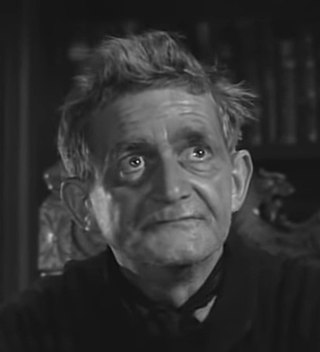
Terence Arthur De Marney was a British film, stage, radio and television actor, as well as theatre director and writer.
Günther Anders was a German cameraman and cinematographer.

Benita Hume was an English theatre and film actress. She appeared in more than 40 films from 1925 to 1955.

Jameson Thomas was an English film actor. He appeared in more than 80 films between 1923 and 1939.
Hanns Kräly, credited in the United States as Hans Kraly, was a German actor and screenwriter. His main collaborations were with director Ernst Lubitsch, and they worked together on 30 films between 1915 and 1929. In 1930, their longstanding partnership and with that much of Kräly's reputable career as a screenwriter came to an end due to an affair he was having with Lubitsch's then-wife Helene Krauss. Kräly is also notable for his comedy play Kohlhiesel's Daughters which has been turned into films on a number of occasions.

The Last of Mrs. Cheyney is a 1937 American comedy drama film adapted from the 1925 Frederick Lonsdale play The Last of Mrs. Cheyney. The film tells the story of a chic jewel thief in England, who falls in love with one of her marks.

Lillian Gertrude Michael, sometimes nicknamed Beck Michael, was an American film, stage and television actress.
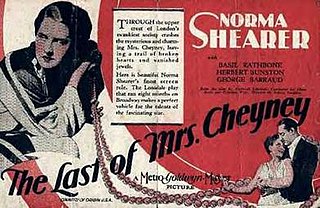
The Last of Mrs. Cheyney is a 1929 American Pre-Code comedy-drama film directed by Sidney Franklin. The screenplay by Hanns Kräly is based on the 1925 play of the same name by Frederick Lonsdale which ran on Broadway for 385 performances. The film was remade twice, with the same title in 1937 and as The Law and the Lady in 1951.

Conrad Albinus Nervig was an American film editor with 81 film credits.

The Law and the Lady is a 1951 American comedy film directed by Edwin H. Knopf and starring Greer Garson, Michael Wilding and Fernando Lamas. It is not related to the Wilkie Collins novel The Law and the Lady. Very loosely based on the 1925 play The Last of Mrs. Cheyney by Frederick Lonsdale, the action is transferred to the turn of the century, the names are all changed, and the first half of the film shows the history of the two thieves. Previous film versions of the story, made in 1929, starring Norma Shearer, and 1937, starring Joan Crawford, retained the play's contemporary setting, included a crew of confederates, and opened with Mrs. Cheyney as an established figure in society. This film also ends differently from the play, with the partners in crime ending as romantic partners but going back to England to face the music for their very first swindle. In the play and in the two other films, Charles leaves and Mrs. Cheyney accepts Lord Dilling, who kisses her and declares: “That's the Last of Mrs. Cheyney!”

The Last of Mrs. Cheyney is a 1961 comedy film directed by Franz Josef Wild and starring Lilli Palmer, Carlos Thompson and Martin Held. The film was made as a co-production between France, Switzerland and West Germany. It is based on the 1925 play of the same title by the British writer Frederick Lonsdale which has been adapted into films on several occasions.
