Related Research Articles
The foreign exchange market is a global decentralized or over-the-counter (OTC) market for the trading of currencies. This market determines foreign exchange rates for every currency. It includes all aspects of buying, selling and exchanging currencies at current or determined prices. In terms of trading volume, it is by far the largest market in the world, followed by the credit market.

The Bordeaux Wine Official Classification of 1855 resulted from the 1855 Exposition Universelle de Paris, when Emperor Napoleon III requested a classification system for France's best Bordeaux wines that were to be on display for visitors from around the world. Brokers from the wine industry ranked the wines according to a château's reputation and trading price, which at that time was directly related to quality.

A winemaker or vintner is a person engaged in winemaking. They are generally employed by wineries or wine companies, where their work includes:
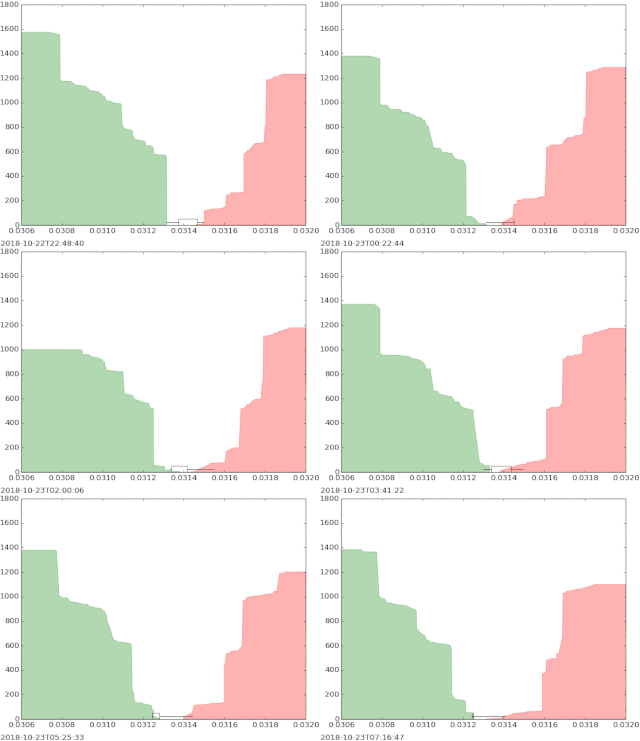
The bid–ask spread is the difference between the prices quoted for an immediate sale (offer) and an immediate purchase (bid) for stocks, futures contracts, options, or currency pairs. The size of the bid–ask spread in a security is one measure of the liquidity of the market and of the size of the transaction cost. If the spread is 0 then it is a frictionless asset.

Château Lafite Rothschild is a wine estate in France, owned by members of the Rothschild family since the 19th century. The name Lafite comes from the surname of the La Fite family.
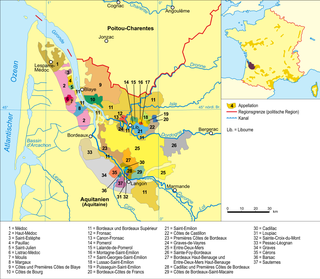
Bordeaux wine is produced in the Bordeaux region of southwest France, around the city of Bordeaux, on the Garonne River. To the north of the city the Dordogne River joins the Garonne forming the broad estuary called the Gironde; the Gironde department, with a total vineyard area of over 120,000 hectares, is the largest wine growing area in France.

French wine is produced all throughout France, in quantities between 50 and 60 million hectolitres per year, or 7–8 billion bottles. France is one of the largest wine producers in the world, along with Italian, Spanish, and American wine-producing regions. French wine traces its history to the 6th century BC, with many of France's regions dating their wine-making history to Roman times. The wines produced range from expensive wines sold internationally to modest wines usually only seen within France such as the Margnat wines were during the post war period.
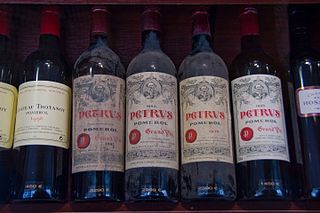
Wine fraud relates to the commercial aspects of wine. The most prevalent type of fraud is one where wines are adulterated, usually with the addition of cheaper products and sometimes with harmful chemicals and sweeteners.
California wine has a long and continuing history, and in the late twentieth century became recognized as producing some of the world's finest wine. While wine is made in all fifty U.S. states, up to 90% of American wine is produced in the state. California would be the fourth largest producer of wine in the world if it were an independent nation.
Cult wines are those for which dedicated groups of committed enthusiasts will pay large sums of money. Such wines include, for example, Screaming Eagle from the United States and Penfolds Grange from Australia, among many others.

Château Durfort-Vivens is a winery in the Margaux appellation of the Bordeaux region of France. It is also the name of the red wine produced by this property. The wine produced here was classified as one of fifteen Deuxièmes Crus in the original Bordeaux Wine Official Classification of 1855.
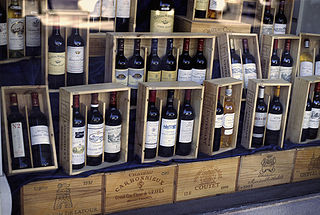
En primeur or "wine futures", is a method of purchasing wines early while the wine is still in the barrel. This offers the customer the opportunity to invest before the wine is bottled. Payment is made at an early stage, a year or 18 months prior to the official release of a vintage. A possible advantage of buying wines en primeur is that the wines may be considerably cheaper during the en primeur period than they will be once bottled and released to the market. However, that is not guaranteed and some wines may lose value over time. Wine experts, like Tom Stevenson, recommend buying en primeur for wines with very limited quantities and will most likely not be available when they are released. The wines most commonly offered en primeur are from Bordeaux, Burgundy, the Rhône Valley and Port, although other regions are adopting the practice.

In finance, a dark pool is a private forum for trading securities, derivatives, and other financial instruments. Liquidity on these markets is called dark pool liquidity. The bulk of dark pool trades represent large trades by financial institutions that are offered away from public exchanges like the New York Stock Exchange and the NASDAQ, so that such trades remain confidential and outside the purview of the general investing public. The fragmentation of electronic trading platforms has allowed dark pools to be created, and they are normally accessed through crossing networks or directly among market participants via private contractual arrangements. Generally dark pools are not available to the public, but in some cases they may be accessed indirectly by retail investors and traders via retail brokers.
In considering the Bordeaux Wine Official Classification of 1855, Alexis Lichine held the opinion that the list, some hundred years after the selection was made, no longer expressed the whole truth concerning the ranking of Bordeaux wine. Working for a reevaluation and change of structure of the classification of Bordeaux estates, he ended up spending much of his professional life on a campaign that lasted more than thirty years to accomplish a revision. Having published his Classification des Grands Crus Rouges de Bordeaux in 1962, with several revisions over the following years, Lichine came to be viewed as "the doyen of unofficial classification compilers".

The history of French wine, spans a period of at least 2600 years dating to the founding of Massalia in the 6th century BC by Phocaeans with the possibility that viticulture existed much earlier. The Romans did much to spread viticulture across the land they knew as Gaul, encouraging the planting of vines in areas that would become the well known wine regions of Bordeaux, Burgundy, Alsace, Champagne, Languedoc, Loire Valley and the Rhone.
Liv-ex is a global marketplace for wine trading. It has over 530 members from start-ups to established merchants. Liv-ex supplies them with data, trading and logistics services.
Langton's Classification of Australian Wine is a listing of fine Australian wines compiled by wine-specialist auction house and online merchant Langton's. The Classification is a ranking of the best-performing Australian wines based on secondary market support over a minimum of 10 vintages. It was first published in 1991. The Classification is divided into three categories - Exceptional, Outstanding and Excellent - and new editions have appeared at intervals of approximately five years. The seventh edition was published in August 2018 and includes 136 of Australia's finest wines. Editions of the classification are identified by Roman numerals.

A wine auction is an auction devoted to wine, sometimes in combination with other alcoholic beverages. There are two basic types of wine auctions: first hand wine auctions, where wineries sell their own wines, and second hand wine auctions, arranged by auction houses or other auctioneers to make it possible for any owners of wine to trade it. In most cases, the wines traded at wine auctions are collectible wine, so-called "fine wine". These are wines which are typically suitable for extended cellaring, and where some of the buyers are looking for mature wines which are no longer available through first-hand retail channels.
Investment wine, like gold bullion, rare coins, fine art, and tulip bulbs, is seen by some as an alternative investment other than the more traditional investment holdings of stocks, bonds, cash, or real estate. While most wine is purchased with the intent of consuming it, some wines are purchased with the intention to resell them at a higher price in the future. A wine's value often goes up as time passes and consumption increases as the market becomes tighter and access to good wine is more elusive.
Collectors market index is a tool used by collectors and investors to track values of collectibles against collectors market from a specific date, calculated in form of Index. It measures the value of a section of the collectors market and computed from the prices of selected collectibles, typically a weighted average.
References
- ↑ "Liv-ex - The global marketplace for the wine trade. Price, source & sell wine". Liv-ex. Retrieved 31 July 2019.
- ↑ "Bordeaux Wine Official Classification of 1855", Wikipedia, 13 June 2019, retrieved 31 July 2019
- ↑ Liv-ex (31 July 2019). "The Liv-ex Classification 2019". Liv-ex. Retrieved 31 July 2019.