
Stephen Edwin King is an American author. Widely known for his horror novels, he has been crowned the "King of Horror". He has also explored other genres, among them suspense, crime, science-fiction, fantasy and mystery. Though known primarily for his novels, he has written approximately 200 short stories, most of which have been published in collections.

Saul Bellow was an American writer. For his literary work, Bellow was awarded the Pulitzer Prize, the 1976 Nobel Prize in Literature, and the National Medal of Arts. He is the only writer to win the National Book Award for Fiction three times, and he received the National Book Foundation's lifetime Medal for Distinguished Contribution to American Letters in 1990.

Hubert "Cubby" Selby Jr. was an American writer. Two of his novels, Last Exit to Brooklyn (1964) and Requiem for a Dream (1978), explore worlds in the New York area and were adapted as films, both of which he appeared in.
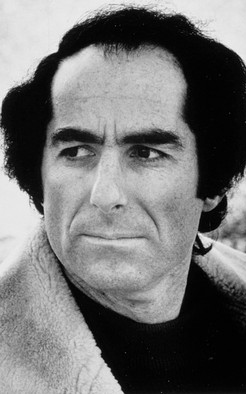
Philip Milton Roth was an American novelist and short-story writer. Roth's fiction—often set in his birthplace of Newark, New Jersey—is known for its intensely autobiographical character, for philosophically and formally blurring the distinction between reality and fiction, for its "sensual, ingenious style" and for its provocative explorations of American identity. He first gained attention with the 1959 short story collection Goodbye, Columbus, which won the U.S. National Book Award for Fiction. Ten years later, he published the bestseller Portnoy's Complaint. Nathan Zuckerman, Roth's literary alter ego, narrates several of his books. A fictionalized Philip Roth narrates some of his others, such as the alternate history The Plot Against America.

Truman Garcia Capote was an American novelist, screenwriter, playwright, and actor. Several of his short stories, novels, and plays have been praised as literary classics, including the novella Breakfast at Tiffany's (1958) and the true crime novel In Cold Blood (1966). His works have been adapted into more than 20 films and television productions.
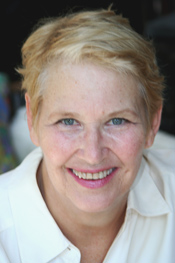
Annie Dillard is an American author, best known for her narrative prose in both fiction and non-fiction. She has published works of poetry, essays, prose, and literary criticism, as well as two novels and one memoir. Her 1974 book Pilgrim at Tinker Creek won the 1975 Pulitzer Prize for General Nonfiction. From 1980, Dillard taught for 21 years in the English department of Wesleyan University, in Middletown, Connecticut.

A Moveable Feast is a memoir by Ernest Hemingway about his years as a struggling expatriate journalist and writer in Paris during the 1920s. It was published posthumously in 1964. The book chronicles Hemingway's first marriage to Hadley Richardson and his relationships with other cultural figures of the Lost Generation in interwar France.
Richard Thomas Condon was an American political novelist. Though his works were satire, they were generally transformed into thrillers or semi-thrillers in other media, such as cinema. All 26 books were written in distinctive Condon style, which combined a fast pace, outrage, and frequent humor while focusing almost obsessively on monetary greed and political corruption. Condon himself once said: "Every book I've ever written has been about abuse of power. I feel very strongly about that. I'd like people to know how deeply their politicians wrong them." Condon's books were occasionally bestsellers, and a number of his books were made into films; he is primarily remembered for his 1959 The Manchurian Candidate and, many years later, a series of four novels about a family of New York gangsters named Prizzi.

Tropic of Cancer is an autobiographical novel by Henry Miller that is best known as "notorious for its candid sexuality", with the resulting social controversy considered responsible for the "free speech that we now take for granted in literature." It was first published in 1934 by the Obelisk Press in Paris, France, but this edition was banned in the United States. Its publication in 1961 in the United States by Grove Press led to obscenity trials that tested American laws on pornography in the early 1960s. In 1964, the U.S. Supreme Court declared the book non-obscene. It is regarded as an important work of 20th-century literature.

Monique Wittig was a French author, philosopher and feminist theorist who wrote about abolition of the sex-class system and coined the phrase "heterosexual contract". Her groundbreaking work is titled The Straight Mind and Other Essays. She published her first novel, L'Opoponax, in 1964. Her second novel, Les Guérillères (1969), was a landmark in lesbian feminism.

Across the River and Into the Trees is a novel by American writer Ernest Hemingway, published by Charles Scribner's Sons in 1950, after first being serialized in Cosmopolitan magazine earlier that year. The title is derived from the last words of Confederate States Army General Thomas J. "Stonewall" Jackson, who was mortally wounded by friendly fire during the American Civil War: “Let us cross over the river and rest under the shade of the trees.” In the 19th century, this was understood to refer to the Jordan River and the passage to death and afterlife in Christianity.

Last Exit to Brooklyn is a 1964 novel by American author Hubert Selby Jr. The novel takes a harsh, uncompromising look at lower class Brooklyn in the 1950s written in spare, stripped-down prose.
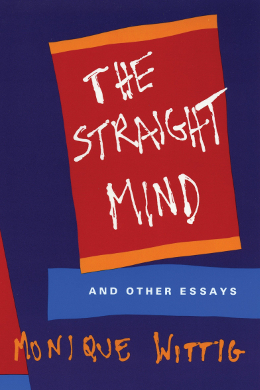
The Straight Mind and Other Essays is a 1992 collection of essays by Monique Wittig.

Molloy is a novel by Samuel Beckett first written in French and published by Paris-based Les Éditions de Minuit in 1951. The English translation, published in 1955, is by Beckett and Patrick Bowles.

Les Guérillères is a 1969 novel by Monique Wittig. It was translated to English in 1971.

The Lesbian Body is a 1973 novel by Monique Wittig. It was translated into English in 1975.
Helen Weaver was an American writer and translator. She translated over fifty books from French. Antonin Artaud: Selected Writings was a Finalist for the National Book Award in translation in 1977.

Opopanax is the commercial name of bisabol or bissabol, the fragrant oleo-gum-resin of Commiphora guidottii. It has been a major export article from Somalia since ancient times, and is called hebbakhade, habaghadi or habak hadi in Somali. It is an important ingredient in perfumery and therefore known as scented myrrh, sweet myrrh, perfumed myrrh or perfumed bdellium.

Bitter in the Mouth is a 2010 novel by Vietnamese-American author Monique Truong. The novel is written in a stream of consciousness narrative structure and follows the character of Linda Hammerick as she comes of age. Linda remembers her childhood in Boiling Springs, North Carolina, in the 1970s and her relationships that follow, through college and beyond. Her present mingles with her past as she learns of her heritage and deals with death, sexual abuse, cancer, adoption, unwanted pregnancies, and family issues. Throughout all of these experiences, Linda lives with a secret extra sense, the ability to taste words, which she later discovers is a form of synesthesia.


