
Romania is a country located at the crossroads of Central, Eastern, and Southeast Europe. It borders Ukraine to the north and east, Hungary to the west, Serbia to the southwest, Bulgaria to the south, Moldova to the east, and the Black Sea to the southeast. It has a mainly continental climate, and an area of 238,397 km2 (92,046 sq mi) with a population of 19 million people (2023). Romania is the twelfth-largest country in Europe and the sixth-most populous member state of the European Union. Europe's second-longest river, the Danube, empties into the Danube Delta in the southeast of the country. The Carpathian Mountains cross Romania from the north to the southwest and include Moldoveanu Peak, at an altitude of 2,544 m (8,346 ft). Romania's capital and largest city is Bucharest. Other major urban centers include Cluj-Napoca, Timișoara, Iași, Constanța and Brașov.

Oltenița is a city in Călărași County, Muntenia, Romania, on the left bank of the river Argeș, where its waters flow into the Danube.

The Department of State Security, commonly known as the Securitate, was the secret police agency of the Socialist Republic of Romania. It was founded on 30 August 1948 from the Siguranța with help and direction from the Soviet MGB.

Gheorghe "Gică" Popescu is a Romanian former professional football player who played as a defender.

The Temple of Bacchus is part of the Baalbek archaeological site, in Beqaa Valley region of Lebanon. The temple complex is considered an outstanding archaeological and artistic site of Imperial Roman Architecture and was inscribed as a UNESCO World Heritage Site in 1984. This monument to Bacchus is one of the best preserved and grandest Roman temple ruins; its age is unknown, but its fine ornamentation can be dated to the second century CE.

The Romanian anti-communist resistance movement was active from the late 1940s to the mid-1950s, with isolated individual fighters remaining at large until the early 1960s. Armed resistance was the first and most structured form of resistance against the Romanian People's Republic, which in turn regarded the fighters as "bandits". It was not until the overthrow of Nicolae Ceaușescu in late 1989 that details about what was called "anti-communist armed resistance" were made public. It was only then that the public learned about the several small armed groups, which sometimes termed themselves "hajduks", that had taken refuge in the Carpathian Mountains, where some hid for ten years from authorities. The last fighter was eliminated in the mountains of Banat in 1962. The Romanian resistance was one of the longest lasting armed movements in the former Eastern Bloc.

Dem Rădulescu was a Romanian theatre, film and television actor, and academic. He was also a professor at the Caragiale National University of Theatre and Film in Bucharest.
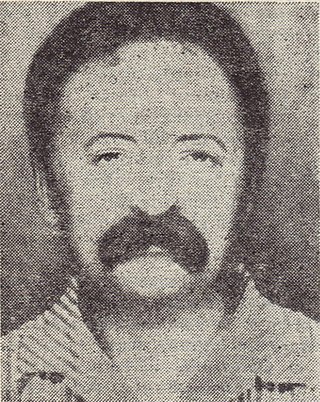
Leonid Dimov was a Romanian postmodernist poet and translator. He was one of the main representatives of onirism in Romanian poetry, explorer of the dream as an absolute, objective reality.
Gheorghe Ștefănescu was a Romanian businessman at the centre of one of the largest corruption scandals during the Communist period, in the wine industry.
Emil Hossu was a Romanian actor.

Geo Saizescu was a Romanian film director, screenwriter, and actor. He appeared in 22 films between 1963 and 2009 and directed 16 films between 1956 and 2012.

Themistocles Popa was a Romanian composer, musician, and film actor.

Mircea Diaconu is a Romanian actor, writer, and politician. First appearing on stage in 1970, and on screen two years later, Diaconu pursued a lengthy career in both formats, working with a series of prominent directors. He acted in some sixty films through the 2000s, and continued to act in theatre during the ensuing decade. He took part in the Romanian Revolution of 1989. In 2008, he entered electoral politics, becoming a senator, and subsequently serving a term as a Member of the European Parliament. In 2019, he ran for president, placing fourth.

Banatul Timișoara was a former football club in Timișoara, Romania. The team is named after the region Banat. The team was founded in 1923 and played in the County Championship in Timiș County. The best season for them is 1928–1929. In 1927, former players at Sparta-Unirea CFR joined the team and created a stronger team winning the regional championship to qualify in 1928–29 Divizia A, the Romanian first division. The best performance of Banatul is to reach the semi-final in this season and be eliminated by Victoria Cluj. After World War II, they played in the Third League of Romania without notable performances. Banatul Timișoara disbanded in 1950.
Cercul Atletic București was a team from Bucharest, Romania. They played in the Romanian league before World War I.

Stăruinţa Oradea was a Romanian football club from Oradea. They reached the final round of the Romanian football championship five times in the 1920s.
Vasile Chitaru was a Romanian footballer who played as a forward.
Events from the year 1998 in Romania.
Events from the year 1993 in Romania.
Bachus may be a variant of Bacchus, the Latin name for Dionysus.

