
The Troubles were an ethno-nationalist conflict in Northern Ireland during the late 20th century. Also known internationally as the Northern Ireland conflict, it is sometimes described as an "irregular war" or "low-level war". The conflict began in the late 1960s and is usually deemed to have ended with the Good Friday Agreement of 1998. Although the Troubles primarily took place in Northern Ireland, at times the violence spilled over into parts of the Republic of Ireland, England, and mainland Europe.

The East Tyrone Brigade of the Provisional Irish Republican Army (IRA), also known as the Tyrone/Monaghan Brigade was one of the most active republican paramilitary groups in Northern Ireland during "the Troubles". It is believed to have drawn its membership from across the eastern side of County Tyrone as well as north County Monaghan and south County Londonderry.

The Remembrance Day bombing took place on 8 November 1987 in Enniskillen, County Fermanagh, Northern Ireland. A Provisional Irish Republican Army (IRA) bomb exploded near the town's war memorial (cenotaph) during a Remembrance Sunday ceremony, which was being held to commemorate British military war dead. Eleven people were killed, many of them elderly, and 63 were injured. The IRA said it had made a mistake and that its target had been the British soldiers parading to the memorial.
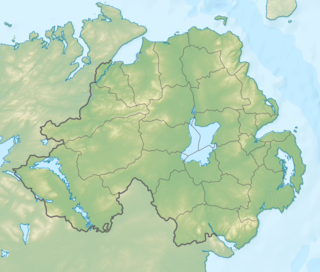
The Kingsmill massacre was a mass shooting that took place on 5 January 1976 near the village of Whitecross in south County Armagh, Northern Ireland. Gunmen stopped a minibus carrying eleven Protestant workmen, lined them up alongside it and shot them. Only one victim survived, despite having been shot 18 times. A Catholic man on the minibus was allowed to go free. A group calling itself the South Armagh Republican Action Force claimed responsibility. It said the shooting was retaliation for a string of attacks on Catholic civilians in the area by Loyalists, particularly the killing of six Catholics the night before. The Kingsmill massacre was the climax of a string of tit-for-tat killings in the area during the mid-1970s, and was one of the deadliest mass shootings of the Troubles.
This is a chronology of activities by the Provisional Irish Republican Army (IRA) from 1970 to 1979. For actions after this period see Chronology of Provisional Irish Republican Army actions.

The Shankill Road bombing was carried out by the Provisional Irish Republican Army (IRA) on 23 October 1993 and is one of the most notorious incidents of the Troubles in Northern Ireland. The IRA aimed to assassinate the leadership of the loyalist Ulster Defence Association (UDA), attending a meeting above Frizzell's fish shop on the Shankill Road, Belfast. Two IRA members disguised as deliverymen entered the shop carrying a bomb, which detonated prematurely. Ten people were killed: one of the IRA bombers, a UDA member and eight Protestant civilians, two of whom were children. More than fifty people were wounded. Unknown to the IRA, the meeting had ended early.
The proxy bomb, also known as a human bomb, was a tactic used mainly by the Provisional Irish Republican Army (IRA) in Northern Ireland during the conflict known as "the Troubles". It involved forcing people to drive car bombs to British military targets after placing them or their families under some kind of threat. The Ulster Volunteer Force replicated IRA actions with a series of bombings in the Republic of Ireland in 1974. The tactic was later adopted by the FARC in Colombia and by rebels in the Syrian Civil War.

This article recounts the violence and other effects related to The Troubles in Portadown, County Armagh, Northern Ireland. Much of it has been related to the Drumcree parade dispute.
The Northern Irish Troubles resulted in 11 deaths in or near the mainly Protestant County Antrim town of Ballymena. Eight people were killed by various loyalist groups, and three by the Irish Republican Army (IRA). Two of the IRA victims were members of the Royal Ulster Constabulary; all other victims were civilians. Of the eleven victims, six were Protestants and five were Catholics. Some of those killings are described below:
The Troubles in Cookstown recounts incidents during, and the effects of, The Troubles in Cookstown, County Tyrone, Northern Ireland.
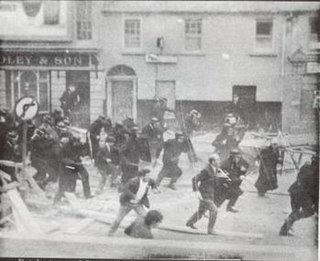
During 12–16 August 1969, there was an outbreak of political and sectarian violence in Northern Ireland, which is often seen as the beginning of the thirty-year conflict known as the Troubles. There had been sporadic violence throughout the year arising out of the civil rights campaign, which demanded an end to discrimination against Catholics and Irish nationalists. Civil rights marches had been repeatedly attacked by Ulster Protestant loyalists and also came into frequent conflict with the Royal Ulster Constabulary (RUC), the overwhelmingly Protestant police force.
The Reavey and O'Dowd killings were two co-ordinated gun attacks on 4 January 1976 in County Armagh, Northern Ireland. Six Irish Catholic civilians died after members of the Ulster Volunteer Force (UVF), an Ulster loyalist paramilitary group, broke into their homes and shot them. Three members of the Reavey family were shot at their home in Whitecross and four members of the O'Dowd family were shot at their home in Ballydougan. Two of the Reaveys and three of the O'Dowds were killed outright, with the third Reavey victim dying of brain hemorrhage almost a month later.
This is a chronology of activities by the Provisional Irish Republican Army (IRA) from 1980 to 1989. For actions before and after this period see Chronology of Provisional Irish Republican Army actions.
This is a chronology of activities by the Provisional Irish Republican Army (IRA), from 1990 to 1999. For actions before and after this period see Chronology of Provisional Irish Republican Army actions.

The Tullyvallen massacre took place on 1 September 1975, when Irish republican gunmen attacked an Orange Order meeting hall at Tullyvallen, near Newtownhamilton in County Armagh, Northern Ireland. The Orange Order is an Ulster Protestant and unionist brotherhood. Five Orangemen were killed and seven wounded in the shooting. The "South Armagh Republican Action Force" claimed responsibility, saying it was retaliation for a string of attacks on Catholic civilians by Loyalists. It is believed members of the Provisional IRA carried out the attack, despite the organisation being on ceasefire.

From 6 to 11 July 1997 there were mass protests, fierce riots and gun battles in Irish nationalist districts of Northern Ireland. Irish nationalists/republicans, in some cases supported by the Provisional Irish Republican Army (IRA), attacked the police and British Army. The protests and violence were sparked by the decision to allow the Orange Order to march through a Catholic/nationalist neighbourhood of Portadown. Irish nationalists were outraged by the decision and by the RUC's aggressive treatment of those protesting against the march. There had been a bitter dispute over the march for many years.
The Teebane bombing took place on 17 January 1992 at a rural crossroads between Omagh and Cookstown in County Tyrone, Northern Ireland. A roadside bomb destroyed a van carrying 14 construction workers who had been repairing a British Army base in Omagh. Eight of the men were killed and the rest were wounded. The Provisional Irish Republican Army (IRA) claimed responsibility, saying that the workers were killed because they were "collaborating" with the "forces of occupation".
The Ballygawley land mine attack was a bomb attack carried out by the Provisional Irish Republican Army (IRA) on the 13 July 1983. The IRA exploded a landmine under an Ulster Defense Regiment's (UDR) mobile patrol at Ballygawley Road, near Dungannon in County Tyrone, Northern Ireland. Four UDR soldiers were killed in the incident.
The Bessbrook bombing took place on the 17 April 1979 when four Royal Ulster Constabulary (RUC) officers were killed when the Provisional IRA exploded an estimated 1,000 pound roadside van bomb at Bessbrook, County Armagh, believed to be the largest bomb used by the IRA up to that point.
