Related Research Articles
Deism is the philosophical position and rationalistic theology that generally rejects revelation as a source of divine knowledge, and asserts that empirical reason and observation of the natural world are exclusively logical, reliable, and sufficient to determine the existence of a Supreme Being as the creator of the universe. More simply stated, Deism is the belief in the existence of God, specifically in a creator who does not intervene in the universe after creating it, solely based on rational thought without any reliance on revealed religions or religious authority. Deism emphasizes the concept of natural theology.
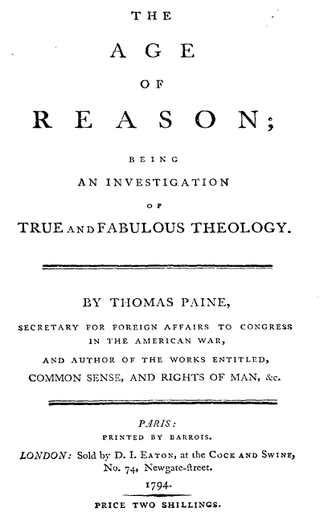
The Age of Reason; Being an Investigation of True and Fabulous Theology is a work by English and American political activist Thomas Paine, arguing for the philosophical position of deism. It follows in the tradition of 18th-century British deism, and challenges institutionalized religion and the legitimacy of the Bible. It was published in three parts in 1794, 1795, and 1807.
Matthew Tindal was an eminent English deist author. His works, highly influential at the dawn of the Enlightenment, caused great controversy and challenged the Christian consensus of his time.

Thomas Sherlock was a British divine who served as a Church of England bishop for 33 years. He is also noted in church history as an important contributor to Christian apologetics.

Walter Charleton was a natural philosopher and English writer.

Samuel Chandler was an English Nonconformist minister and pamphleteer. He has been called the "uncrowned patriarch of Dissent" in the latter part of George II's reign.
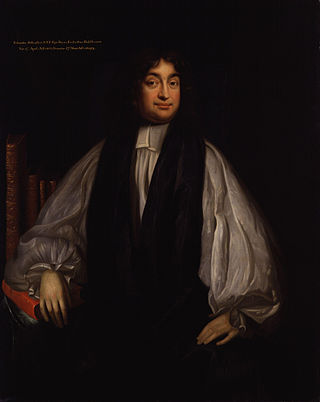
Edward Stillingfleet was a British Christian theologian and scholar. Considered an outstanding preacher as well as a strong polemical writer defending Anglicanism, Stillingfleet was known as "the beauty of holiness" for his good looks in the pulpit, and was called by John Hough "the ablest man of his time".

Archibald Pitcairne or Pitcairn was a Scottish physician. He was a physician and poet who first studied law at Edinburgh and Paris graduating with an M.A. from Edinburgh in 1671. He turned his attention to medicine, and commenced to practise in Edinburgh, around 1681. He was appointed professor of physic at Leyden, in 1692, resigning his chair. On returning to Edinburgh, however, around 1693, he was suspected of being at heart an atheist, chiefly on account of his mockery of the puritanical strictness of the Presbyterian church. He was the reputed author of two satirical works, 'The Assembly, or Scotch Reformation : a Comedy,' 1692, and Habel, a Satirical Poem,' 1692. He wrote also a number of Latin verses. He was one of the most celebrated physicians of his time.
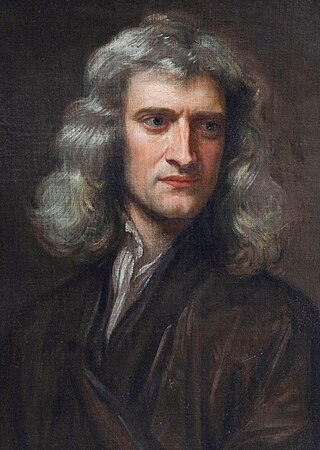
Isaac Newton was considered an insightful and erudite theologian by his Protestant contemporaries. He wrote many works that would now be classified as occult studies, and he wrote religious tracts that dealt with the literal interpretation of the Bible. He kept his heretical beliefs private.
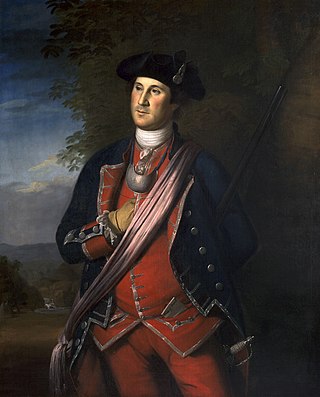
The religious views of George Washington have long been debated. While some of the other Founding Fathers of the United States, such as Thomas Jefferson, Benjamin Franklin, and Patrick Henry, were noted for writing about religion, Washington rarely discussed his religious and philosophical views.
John Sergeant was an English Roman Catholic priest, controversialist and theologian.
Thomas Morgan was an English deist.
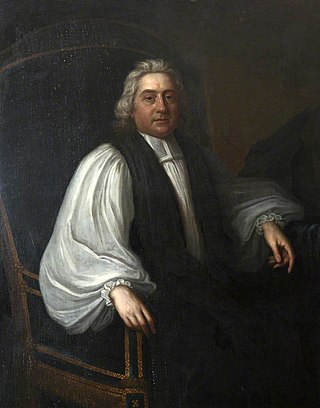
Ofspring Blackall, Bishop of Exeter and religious controversialist, was born in London.
The religious views of Thomas Jefferson diverged widely from the traditional Christianity of his era. Throughout his life, Jefferson was intensely interested in theology, religious studies, and morality. Jefferson was most comfortable with Deism, rational religion, theistic rationalism, and Unitarianism. He was sympathetic to and in general agreement with the moral precepts of Christianity. He considered the teachings of Jesus as having "the most sublime and benevolent code of morals which has ever been offered to man," yet he held that the pure teachings of Jesus appeared to have been appropriated by some of Jesus' early followers, resulting in a Bible that contained both "diamonds" of wisdom and the "dung" of ancient political agendas.

Christian deism is a standpoint in the philosophy of religion stemming from Christianity and Deism. It refers to Deists who believe in the moral teachings—but not the divinity—of Jesus. Corbett and Corbett (1999) cite John Adams and Thomas Jefferson as exemplars.
Thomas Pierce or Peirse (1622–1691) was an English churchman and controversialist, a high-handed President of Magdalen College, Oxford, and Dean of Salisbury.
Deism, the religious attitude typical of the Enlightenment, especially in France and England, holds that the only way the existence of God can be proven is to combine the application of reason with observation of the world. A Deist is defined as "One who believes in the existence of a God or Supreme Being but denies revealed religion, basing his belief on the light of nature and reason." Deism was often synonymous with so-called natural religion because its principles are drawn from nature and human reasoning. In contrast to Deism there are many cultural religions or revealed religions, such as Judaism, Trinitarian Christianity, Islam, Buddhism, and others, which believe in supernatural intervention of God in the world; while Deism denies any supernatural intervention and emphasizes that the world is operated by natural laws of the Supreme Being.
Richard Frewin, M.D. (1681?–1761), was an English physician and professor of history.
Sir John Colbatch was an English apothecary and physician. Beginning as an apprentice, rising through freeman to master apothecary in the Worcester Mercer's Company, he went to London in the early 1690s.

Theophilus Lobb (1678–1763) was an English physician, known as a medical and as a religious writer.
References
 This article incorporates text from a publication now in the public domain : "Emes, Thomas". Dictionary of National Biography . London: Smith, Elder & Co. 1885–1900.
| International | |
|---|---|
| National | |
