Related Research Articles

Agostino Carracci was an Italian painter, printmaker, tapestry designer, and art teacher. He was, together with his brother, Annibale Carracci, and cousin, Ludovico Carracci, one of the founders of the Accademia degli Incamminati in Bologna. Intended to devise alternatives to the Mannerist style favored in the preceding decades, this teaching academy helped propel painters of the School of Bologna to prominence.

Giacomo Francesco Zuccarelli was an Italian artist of the late Baroque or Rococo period. He is considered to be the most important landscape painter to have emerged from his adopted city of Venice during the mid-eighteenth century, and his Arcadian views became popular throughout Europe and especially in England where he resided for two extended periods. His patronage extended to the nobility, and he often collaborated with other artists such as Antonio Visentini and Bernardo Bellotto. In 1768, Zuccarelli became a founding member of the Royal Academy of Arts, and upon his final return to Italy, he was elected president of the Venetian Academy. In addition to his rural landscapes which frequently incorporated religious and classical themes, Zuccarelli created devotional pieces and on occasion did portraiture. Besides paintings, his varied output included etchings, drawings, and designs for tapestries as well as a set of Old Testament playing cards.

Hans Memling was a German-Flemish painter who worked in the tradition of Early Netherlandish painting. Born in the Middle Rhine region, he probably spent his childhood in Mainz. During his apprenticeship as a painter he moved to the Netherlands and spent time in the Brussels workshop of Rogier van der Weyden. In 1465 he was made a citizen of Bruges, where he became one of the leading artists and the master of a large workshop. A tax document from 1480 lists him among the wealthiest citizens. Memling's religious works often incorporated donor portraits of the clergymen, aristocrats, and burghers who were his patrons. These portraits built upon the styles which Memling learned in his youth.

Jean-Antoine Watteau was a French painter and draughtsman whose brief career spurred the revival of interest in colour and movement, as seen in the tradition of Correggio and Rubens. He revitalized the waning Baroque style, shifting it to the less severe, more naturalistic, less formally classical, Rococo. Watteau is credited with inventing the genre of fêtes galantes, scenes of bucolic and idyllic charm, suffused with a theatrical air. Some of his best known subjects were drawn from the world of Italian comedy and ballet.

Sir Anthony van Dyck was a Flemish Baroque artist who became the leading court painter in England after success in the Spanish Netherlands and Italy.

Lorenzo Lotto was an Italian Renaissance painter, draughtsman, and illustrator, traditionally placed in the Venetian school, though much of his career was spent in other north Italian cities. He painted mainly altarpieces, religious subjects and portraits. He was active during the High Renaissance and the first half of the Mannerist period, but his work maintained a generally similar High Renaissance style throughout his career, although his nervous and eccentric posings and distortions represented a transitional stage to the Florentine and Roman Mannerists.

Claude-Joseph Vernet was a French painter. His son, Antoine Charles Horace Vernet, was also a painter.

Paris Bordone was an Italian painter of the Venetian Renaissance who, despite training with Titian, maintained a strand of Mannerist complexity and provincial vigor.
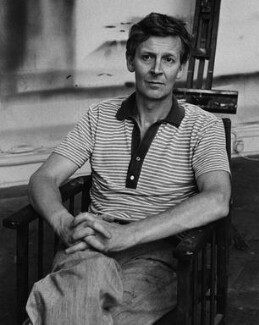
Michael James Andrews was a British painter.

The Thyssen-Bornemisza National Museum, or simply the Thyssen, is an art museum in Madrid, Spain, located near the Prado Museum on one of the city's main boulevards. It is known as part of the "Golden Triangle of Art", which also includes the Prado and the Reina Sofía national galleries. The Thyssen-Bornemisza fills the historical gaps in its counterparts' collections: in the Prado's case this includes Italian primitives and works from the English, Dutch and German schools, while in the case of the Reina Sofía it concerns Impressionists, Expressionists, and European and American paintings from the 20th century.
Sir Michael Vincent Levey, LVO, FBA, FRSL was a British art historian and was the director of the National Gallery from 1973 to 1986.

Giovanni Battista Piazzetta was an Italian Rococo painter of religious subjects and genre scenes.

Ercole de' Roberti, also known as Ercole Ferrarese or Ercole da Ferrara, was an Italian artist of the Early Renaissance and the School of Ferrara. He was profiled in Vasari's Le Vite delle più eccellenti pittori, scultori, ed architettori. The son of the doorkeeper at the Este castle, Ercole later held the position of court artist for the Este family in Ferrara. According to Vasari:
Ercole had an extraordinary love of wine, and his frequent drunkenness did much to shorten his life, which he had enjoyed without any accident up to the age of forty, when he was smitten one day by apoplexy, which made an end of him in a short time.

Carlos Sebastián Pedro Hubert de Haes was a Spanish painter from Belgium. He was noted for the Realism in his landscapes, and was considered to be the "first contemporary Spanish artist able to capture something of a particularly Spanish 'essence' in his work". He was cited along with Jenaro Perez Villaamil and Aureliano de Beruete as one of the three Spanish grand masters of landscape painting, the latter of which was his pupil.
George Kinnaird, 7th Lord Kinnaird (1754–1805) was a Scottish aristocrat, virtuoso, and banker. He was a Scottish representative peer in 1787.

Madonna of the Dry Tree or Our Lady of the Barren Tree is a small oil-on-oak panel painting dated c. 1462–1465, attributed to the Early Netherlandish painter Petrus Christus. Its dramatic imagery shows the Virgin Mary holding the Christ Child within a tree, surrounded by black, withered branches forming a crown of thorns.

Robert Fullarton Udny or Udney (1725–1802) was a Scottish merchant, art collector and Fellow of the Royal Society. His collection, highly reputed in its time, was broken up at a sale in 1804.

Francis Augustus Silva was an American Luminist painter of the Hudson River School. His specialty was marine scenes, particularly of the Atlantic coast, a genre in which he masterfully captured the subtle gradations of light in the coastal atmosphere. He focused on romantic scenes, avoiding depictions of seaside recreation, even when painting scenes at Coney Island, which was then already a popular recreational area.

Landscape with Venus and Adonis is an oil-on-canvas painting by Flemish painter Tobias Verhaecht. The work was probably painted in the 1600s, and is now in the Thyssen-Bornemisza Museum in Madrid.
William Morland (1739–1815) was an English banker and politician, Member of Parliament for Taunton from 1796 to 1806.
References
- Michael Levey, An English Commission to Guardi, The Burlington Magazine Vol. 102, No. 689 (Aug., 1960), pp. 363–366, Published by: The Burlington Magazine Publications Ltd. Stable URL: http://www.jstor.org/stable/873044

