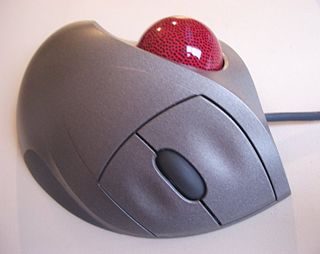
A trackball mouse is a pointing device consisting of a ball held by a socket containing sensors to detect a rotation of the ball about two axes—like an upside-down ball mouse with an exposed protruding ball. Users roll the ball to position the on-screen pointer, using their thumb, fingers, or the palm of the hand, while using the fingertips to press the buttons.

Slapping and popping are ways to produce percussive sounds on a stringed instrument. It is primarily used on the double bass or bass guitar. Slapping on bass guitar involves using the edge of one's knuckle, where it is particularly bony, to quickly strike the string against the fretboard. On bass guitars, this is commonly done with the thumb, while on double bass, the edge of the hand or index finger may be used. Popping refers to pulling the string away from the fretboard and quickly releasing it so it snaps back against the fretboard. On bass guitar, the two techniques are commonly used together in alternation, though either may be used separately.
Touch typing is a style of typing. Although the phrase refers to typing without using the sense of sight to find the keys—specifically, a touch typist will know their location on the keyboard through muscle memory—the term is often used to refer to a specific form of touch typing that involves placing the eight fingers in a horizontal row along the middle of the keyboard and having them reach for specific other keys. Both two-handed touch typing and one-handed touch typing are possible.
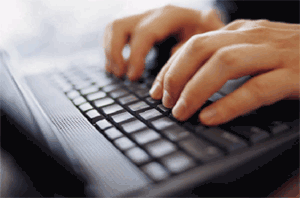
Typing is the process of writing or inputting text by pressing keys on a typewriter, computer keyboard, mobile phone or calculator. It can be distinguished from other means of text input, such as handwriting and speech recognition. Text can be in the form of letters, numbers and other symbols. The world's first typist was Lillian Sholes from Wisconsin in the US, the daughter of Christopher Sholes, who invented the first practical typewriter.
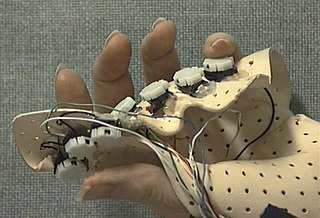
A keyer is a device for signaling by hand, by way of pressing one or more switches. Modern keyers typically have a large number of switches but not as many as a full-size keyboard; typically between four and fifty. A keyer differs from a keyboard in the sense that it lacks a traditional "board"; the keys are arranged in a cluster which is often held in the hand. An example of a very simple keyer is a single telegraph key which used for keying Morse code. In such a use, the term "to key" typically means to turn on and off a carrier wave. For example, it is said that one "keys the transmitter" by interrupting some stage of the amplification of a transmitter with a telegraph key.
Several manual alphabets in use around the world employ two hands to represent some or all of the letters of an alphabet, usually as a part of a deaf sign language. Two-handed alphabets are less widespread than one-handed manual alphabets. They may be used to represent the Latin alphabet or the Cyrillic alphabet.

The shaka sign, sometimes known as "hang loose" or "right on", is a gesture with friendly intent often associated with Hawaii and surf culture. It consists of extending the thumb and smallest finger while holding the three middle fingers curled, and gesturing in salutation while presenting the front or back of the hand; the wrist may be rotated back and forth for emphasis. The shaka sign is similar to the letter Y in the American manual alphabet in American Sign Language. The shaka sign should not be confused with the sign of the horns, where the index and pinky finger is extended and the thumb holds down the middle two fingers.

Arrow keys or cursor movement keys are keys on a computer keyboard that are either programmed or designated to move the cursor in a specified direction.
Stevens grip is a technique for playing keyboard percussion instruments with four mallets developed by Leigh Howard Stevens. While marimba performance with two, four, and even six mallets had been done for more than a century, Stevens developed this grip based on the Musser grip, looking to expanded musical possibilities. Stevens codified his grip and his approach to performance techniques developed during his studies at the Eastman School of Music in his 1979 book, Method of Movement for Marimba. In this book, Stevens explains that his grip is an evolution of the Musser grip, and it is sometimes called the Musser-Stevens grip.
PCD Maltron Ltd, trading as Maltron, is a manufacturer of ergonomic special-needs keyboards. It was founded by South African-born inventor Lillian Malt and manufacturer Stephen Hobday. Maltron specialises in making keyboards for the prevention and etiological treatment of repetitive strain injury.
In music, fingering, or on stringed instruments sometimes also called stopping, is the choice of which fingers and hand positions to use when playing certain musical instruments. Fingering typically changes throughout a piece; the challenge of choosing good fingering for a piece is to make the hand movements as comfortable as possible without changing hand position too often. A fingering can be the result of the working process of the composer, who puts it into the manuscript, an editor, who adds it into the printed score, or the performer, who puts his or her own fingering in the score or in performance.
Fingering...also stopping...(1) A system of symbols for the fingers of the hand used to associate specific notes with specific fingers....(2)Control of finger movements and position to achieve physiological efficiency, acoustical accuracy [frequency and amplitude] and musical articulation.

The Microwriter is a hand-held portable word-processor with a chording keyboard. First demonstrated in 1978, it was invented by UK-based, US-born film director Cy Endfield and his partner Chris Rainey and was marketed in the early 1980s by Microwriter Ltd, of Mitcham, Surrey, UK. By using a mnemonic alphabet, it was claimed to allow note-taking of up to 8,000 characters at an input rate averaging 1.5 times that of handwriting.

A thumb signal, usually described as a thumbs-up or thumbs-down, is a common hand gesture achieved by a closed fist held with the thumb extended upward or downward in approval or disapproval, respectively. These gestures have become metaphors in English: "The audience gave the movie the thumbs-up" means that the audience approved of the movie, regardless of whether the gesture was made.

The Nissan Diesel Big Thumb is a heavy-duty commercial vehicle that was produced by the Japanese manufacturer Nissan Diesel and sold between 1990 and 2008. Unlike the successor to the Nissan Diesel C-series, the Big Thumb's size range was primarily available in other big-size trucks.

A computer keyboard is a peripheral input device modeled after the typewriter keyboard which uses an arrangement of buttons or keys to act as mechanical levers or electronic switches. Replacing early punched cards and paper tape technology, interaction via teleprinter-style keyboards have been the main input method for computers since the 1970s, supplemented by the computer mouse since the 1980s.

Finger substitution is a playing technique used on many different instruments, ranging from stringed instruments such as the violin and cello to keyboard instruments such as the piano and pipe organ. It involves replacing one finger which is depressing a string or key with another finger to facilitate the performance of a passage or create a desired tone or sound. The simplest type of finger substitution is when a finger replaces another finger during a rest; the more difficult type is to replace one finger with another while a note is being played.
In computing, an input device is a piece of equipment used to provide data and control signals to an information processing system, such as a computer or information appliance. Examples of input devices include keyboards, mouse, scanners, cameras, joysticks, and microphones.

The thumb-shift keyboard is a keyboard design for inputting Japanese sentences on word processors and computers. It was invented by Fujitsu in the late 1970s and released in 1980 as a feature of the line of Japanese word processors the company sold, named OASYS, to make Japanese input easier, faster and more natural. It is popular among people who input large quantities of Japanese sentences, such as writers, playwrights, lawyers and so on, because of its ease of use and speed. The rights regarding the use of this design were transferred to Nihongo Nyuuryoku Consortium, a technology sharing cooperative of interested companies, in 1989. It is referred to as an example of keyboard layout in Japanese Industrial Standards.
The KALQ keyboard,, is a keyboard layout that has been developed by researchers at the Montana Tech, University of St Andrews and the Max Planck Institute for Informatics as a split-screen keyboard for thumb-typing, which is claimed to allow a 34% increase in speed of typing for the people who use touchscreen. KALQ was released as a free app, albeit a beta, for Android-based smartphones. Although the KALQ project received some buzz in tech media, as of early 2017, the latest public version is dated October 2013, and still labelled a beta.

