
Thyme is the herb of some members of the genus Thymus of aromatic perennial evergreen herbs in the mint family Lamiaceae. Thymes are relatives of the oregano genus Origanum, with both plants being mostly indigenous to the Mediterranean region. Thymes have culinary, medicinal, and ornamental uses, and the species most commonly cultivated and used for culinary purposes is Thymus vulgaris.

The thymus is a specialized primary lymphoid organ of the immune system. Within the thymus, thymus cell lymphocytes or T cells mature. T cells are critical to the adaptive immune system, where the body adapts specifically to foreign invaders. The thymus is located in the upper front part of the chest, in the anterior superior mediastinum, behind the sternum, and in front of the heart. It is made up of two lobes, each consisting of a central medulla and an outer cortex, surrounded by a capsule.
Faggot, faggots, or faggoting may refer to:

Herbes de Provence is a mixture of dried herbs considered typical of the Provence region of southeastern France. Formerly simply a descriptive term, commercial blends started to be sold under this name in the 1970s. These blends often contain savory, marjoram, rosemary, thyme, and oregano. Lavender leaves are also included in products in the North American market. The herb mixture is typically used with grilled foods and stews.

Elephantiasis is the enlargement and hardening of limbs or body parts due to tissue swelling. It is characterised by edema, hypertrophy, and fibrosis of skin and subcutaneous tissues, due to obstruction of lymphatic vessels. It may affect the genitalia. The term elephantiasis is often used in reference to parasitic worm infections, but may refer to a variety of diseases where parts of a person's body swell to massive proportions.
In pharmacology, an adjuvant is a drug or other substance, or a combination of substances, that is used to increase the efficacy or potency of certain drugs. Specifically, the term can refer to:

The genus Thymus contains about 350 species of aromatic perennial herbaceous plants and subshrubs to 40 cm tall in the family Lamiaceae, native to temperate regions in Europe, North Africa and Asia.
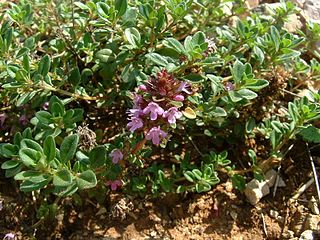
Thymus serpyllum, known by the common names of Breckland thyme, Breckland wild thyme, wild thyme, creeping thyme, or elfin thyme, is a species of flowering plant in the mint family Lamiaceae, native to most of Europe and North Africa. It is a low, usually prostrate subshrub growing to 2 cm (1 in) tall with creeping stems up to 10 cm (4 in) long. The oval evergreen leaves are 3–8 mm long. The strongly scented flowers are either lilac, pink-purple, magenta, or a rare white, all 4–6 mm long and produced in clusters. The hardy plant tolerates some pedestrian traffic and produces odors ranging from heavily herbal to lightly lemon, depending on the variety.
Clive Exton was a British television and film screenwriter who wrote scripts for the series Poirot,Jeeves and Wooster, and Rosemary & Thyme.
Rosemary is a name for several plants of the Genus Salvia and Ceratiola.

T-cell-prolymphocytic leukemia (T-PLL) is a mature T-cell leukemia with aggressive behavior and predilection for blood, bone marrow, lymph nodes, liver, spleen, and skin involvement. T-PLL is a very rare leukemia, primarily affecting adults over the age of 30. It represents 2% of all small lymphocytic leukemias in adults. Other names include T-cell chronic lymphocytic leukemia, "knobby" type of T-cell leukemia, and T-prolymphocytic leukemia/T-cell lymphocytic leukemia.

Thymic carcinoma is a rare type of thymus gland cancer. It usually spreads, has a high risk of recurrence, and has a poor survival rate. Thymic carcinoma is divided into subtypes, depending on the types of cells in which the cancer began. Also called type C thymoma.
"The Sprig of Thyme", "The Seeds of Love", "Maiden’s Lament", "Garners Gay", "Let No Man Steal Your Thyme" or "Rue" is a traditional British and Irish folk ballad that uses botanical and other symbolism to warn young people of the dangers in taking false lovers. The song was first documented in 1689 and the many variants go by a large number of titles.

Ductal carcinoma is a type of tumor that primarily presents in the ducts of a gland.
Thymic involution is the shrinking (involution) of the thymus with age, resulting in changes in the architecture of the thymus and a decrease in tissue mass. Thymus involution is one of the major characteristics of vertebrate immunology, and occurs in almost all vertebrates, from birds, teleosts, amphibians to reptiles, though the thymi of a few species of sharks are known not to involute. This process is genetically regulated, with the nucleic material responsible being an example of a conserved sequence — one maintained through natural selection since it arose in a common ancestor of all species now exhibiting it, via a phenomenon known to bioinformaticists as an orthologic sequence homology.
Thyme is any member of the genus Thymus of aromatic herbs with culinary, medicinal, and ornamental uses.
Hyperthermic intrathoracic chemotherapy (HITOC) is part of a surgical strategy employed in the treatment of various pleural malignancies. The pleura in this situation could be considered to include the surface linings of the chest wall, lungs, mediastinum, and diaphragm. HITOC is the chest counterpart of HIPEC. Traditionally used in the treatment of malignant mesothelioma, a primary malignancy of the pleura, this modality has recently been evaluated in the treatment of secondary pleural malignancies.

Joy Ann Williams was an American immunologist at the National Cancer Institute where she researched the biology of thymic development.

Flybe, styled as flybe, is a British airline based in Birmingham, England.
