
Agrippina "the Elder" was a prominent member of the Julio-Claudian dynasty. She was the daughter of Marcus Vipsanius Agrippa and Augustus' daughter, Julia the Elder. Her brothers Lucius and Gaius Caesar were the adoptive sons of Augustus, and were his heirs until their deaths in AD 2 and 4, respectively. Following their deaths, her second cousin Germanicus was made the adoptive son of Tiberius, Augustus' stepson, as part of Augustus' succession scheme in the adoptions of AD 4. As a result of the adoption, Agrippina was wed to Germanicus in order to bring him closer to the Julian family.

Gaius Julius Caesar Augustus Germanicus, better known by his nickname Caligula, was the third Roman emperor, ruling from 37 until his assassination in 41. He was the son of the popular Roman general Germanicus and Augustus' granddaughter Agrippina the Elder. Caligula was born into the first ruling family of the Roman Empire, conventionally known as the Julio-Claudian dynasty.
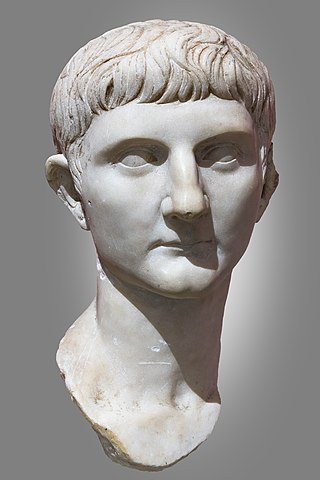
Germanicus Julius Caesar was an ancient Roman general, known for his campaigns in Germania. The son of Nero Claudius Drusus and Antonia the Younger, Germanicus was born into an influential branch of the patrician gens Claudia. The agnomen Germanicus was added to his full name in 9 BC when it was posthumously awarded to his father in honour of his victories in Germania. In AD 4, he was adopted by his paternal uncle Tiberius, who succeeded Augustus as Roman emperor a decade later. As a result, Germanicus became an official member of the gens Julia, another prominent family, to which he was related on his mother's side. His connection to the Julii was further consolidated through a marriage between himself and Agrippina the Elder, a granddaughter of Augustus. He was also the father of Caligula, the maternal grandfather of Nero, and the older brother of Claudius.
The Gracchi brothers were two Roman brothers, sons of Tiberius Sempronius Gracchus who was consul in 177 BC. Tiberius, the elder brother, was tribune of the plebs in 133 BC and Gaius, the younger brother, was tribune a decade later in 123–122 BC.
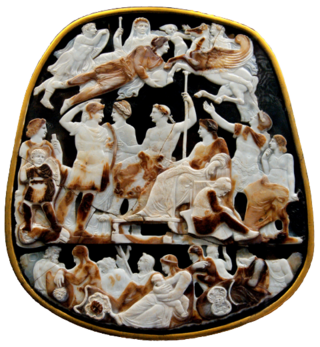
The Julio-Claudian dynasty comprised the first five Roman emperors: Augustus, Tiberius, Caligula, Claudius, and Nero.

Tiberius Julius Caesar Augustus was the second Roman emperor. He reigned from AD 14 until 37, succeeding his stepfather, the first Roman emperor Augustus. Tiberius was born in Rome in 42 BC. His father was the politician Tiberius Claudius Nero and his mother was Livia Drusilla, who would eventually divorce his father, and marry the future-emperor Augustus in 38 BC. Following the untimely deaths of Augustus' two grandsons and adopted heirs, Gaius and Lucius Caesar, Tiberius was designated Augustus' successor. Prior to this, Tiberius had proved himself an able diplomat, and one of the most successful Roman generals: his conquests of Pannonia, Dalmatia, Raetia, and (temporarily) parts of Germania laid the foundations for the empire's northern frontier.

Livia Drusilla was a Roman empress from 27 BC to AD 14 as the wife of Emperor Augustus Caesar. She was known as Julia Augusta after her formal adoption into the Julian family in AD 14.
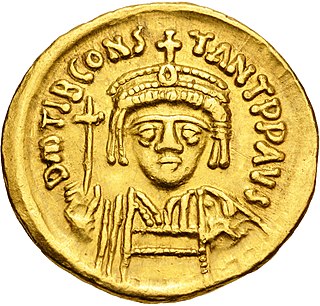
Tiberius II Constantine was Eastern Roman emperor from 574 to 582. Tiberius rose to power in 574 when Justin II, prior to a mental breakdown, proclaimed him caesar and adopted him as his own son. In 578, the dying Justin II gave him the title of augustus, thus becoming co-emperor alongside him. Tiberius became sole ruler less than two weeks later, assuming the regnal name of "Constantine" under which he reigned until his death.

Tiberius III, born Apsimar, was Byzantine emperor from 698 to 705 AD. Little is known about his early life, other than that he was droungarios, a mid-level commander, of the Cibyrrhaeots, and that his birth name was Apsimar. In 696, Tiberius was part of an army led by John the Patrician sent by Byzantine Emperor Leontius to retake the city of Carthage in the Exarchate of Africa, which had been captured by the Arab Umayyads. After seizing the city, this army was pushed back by Umayyad reinforcements and retreated to the island of Crete; some of the officers, fearing the wrath of Leontius, killed John and declared Tiberius emperor. Tiberius swiftly gathered a fleet, sailed for Constantinople, and deposed Leontius. Tiberius did not attempt to retake Byzantine Africa from the Umayyads, but campaigned against them along the eastern border with some success. In 705 former Emperor Justinian II, who had been deposed by Leontius, led an army of Slavs and Bulgars to Constantinople, and after entering the city secretly, deposed Tiberius. Tiberius fled to Bithynia, but was captured several months later and beheaded between August 705 and February 706. His body was initially thrown into the sea, but was later recovered and buried in a church on the island of Prote.
Tiberius Sempronius Gracchus may refer to:
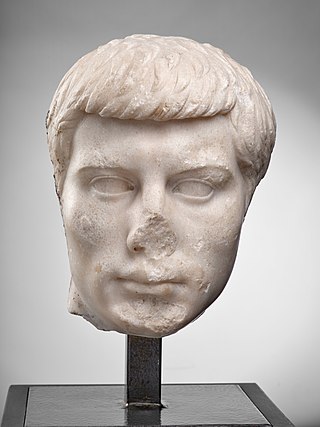
Tiberius Julius Caesar Nero Gemellus, known as Tiberius Gemellus was the son of Drusus and Livilla, the grandson of the Emperor Tiberius, and the cousin of the Emperor Caligula. Gemellus is a nickname meaning "the twin". His twin brother, Tiberius Claudius Caesar Germanicus II Gemellus, died as a young child in 23. His father and older cousins died, and are suspected by contemporary sources as having been systematically eliminated by the powerful praetorian prefect Sejanus. Their removal allowed Gemellus and Caligula to be named joint-heirs by Tiberius in 35, a decision that ultimately resulted in Caligula assuming power and having Gemellus killed in late 37 or early 38.

Drusus Julius Caesar, was the son of Emperor Tiberius, and heir to the Roman Empire following the death of his adoptive brother Germanicus in AD 19.
Tiberius Claudius Nero may refer to:
Tiberius was the second Roman emperor. The term may also refer to:
Tiberius Sempronius Longus may refer to:
Tiberius Claudius may refer to:
Rhescuporis may refer to:
