Contents

TIT, Tit, Tits, or tit may refer to:
TIT, Tit, Tits, or tit may refer to:


The penduline tits constitute the family Remizidae, of small passerine birds related to the true tits. All but the verdin make elaborate bag nests hanging from trees, usually over water.
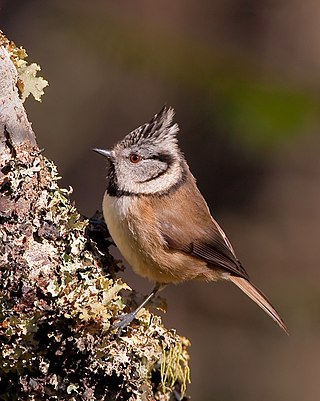
The tits, chickadees, and titmice constitute the Paridae, a large family of small passerine birds which occur mainly in the Northern Hemisphere and Africa. Most were formerly classified in the genus Parus.

The ground tit, Tibetan ground-tit or Hume's ground-tit is a bird of the Tibetan plateau north of the Himalayas. The peculiar appearance confused ornithologists in the past who called it as Hume's groundpecker and still later as Hume's ground jay or Tibetan ground jay assuming that it belonged to the family Corvidae that includes the crows and jays. Although morphologically confusing, the species has since been identified using molecular sequence comparisons as being a member of the tit family (Paridae) and is the only species in the genus Pseudopodoces. It is found in the Tibetan Plateau of China, India, Nepal & Bhutan.
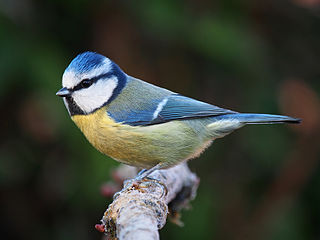
The Eurasian blue tit is a small passerine bird in the tit family, Paridae. It is easily recognisable by its blue and yellow plumage and small size.

The crested tit or European crested tit, is a passerine bird in the tit family Paridae. It is a widespread and common resident breeder in coniferous forests throughout central and northern Europe and in deciduous woodland in France and the Iberian Peninsula. In Great Britain, it is chiefly restricted to the ancient pinewoods of Inverness and Strathspey in Scotland, and seldom strays far from its haunts. A few vagrant crested tits have been seen in England. It is resident, and most individuals do not migrate.

The grey-headed chickadee or Siberian tit, formerly Parus cinctus, is a passerine bird in the tit family Paridae. It is a widespread resident breeder throughout subarctic Scandinavia and the northern Palearctic, and also into North America in Alaska and the far northwest of Canada. It is a conifer specialist. It is resident, and most birds do not migrate. Curiously, the bird has no grey on its head, which is black, white, and brown.

The Himalayan black-lored tit, also known as simply black-lored tit, is a passerine bird in the tit family Paridae. The yellow-cheeked tit is probably its closest relative, and it may also be related to the yellow tit. These three tits almost certainly form a distinct lineage, as indicated by morphology, and mtDNA cytochrome b sequence analysis.
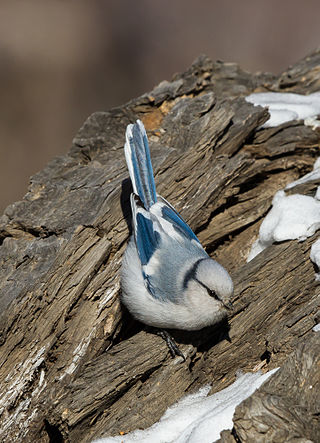
The azure tit is a passerine bird in the tit family Paridae. It is a widespread and common resident breeder throughout Russia, Central Asia, northwest China, Manchuria, and Pakistan.

The Mexican chickadee is a small songbird, a passerine bird in the tit family Paridae. It is still often placed in the genus Parus with most other tits, but mtDNA cytochrome b sequence data and morphology suggest that separating Poecile more adequately expresses these birds' relationships. The American Ornithologists' Union had been treating Poecile as distinct genus for some time already.

The white-winged black tit is a passerine bird in the tit family Paridae. It is also known as the white-winged tit, dark-eyed black tit or northern black tit. The species was first described by Eduard Rüppell in 1840.

The tomtit is a small passerine bird in the family Petroicidae, the Australasian robins. It is endemic to the islands of New Zealand, ranging across the main islands as well as several of the outlying islands. In the Māori language, the North Island tomtit is known as miromiro and the South Island tomtit is known as ngirungiru. This bird has several other Māori and English names as well. There are several subspecies showing considerable variation in plumage and size. The species is not threatened and has adapted to the changes made to New Zealand's biodiversity.

Baeolophus is a genus of birds in the family Paridae, commonly called tits. Its members are known as titmouses or titmice. All the species are native to North America. In the past, most authorities retained Baeolophus as a subgenus within the genus Parus, but treatment as a distinct genus, initiated by the American Ornithological Society, is now widely accepted.

The pygmy bushtit is a species of bird in the bushtit family Aegithalidae. The species was once placed, along with the rest of its family, with the true tits, Paridae.

Poecile is a genus of birds in the tit family Paridae. It contains 15 species, which are scattered across North America, Europe and Asia; the North American species are the chickadees. In the past, most authorities retained Poecile as a subgenus within the genus Parus, but treatment as a distinct genus, initiated by the American Ornithologists Union, is now widely accepted. This is supported by mtDNA cytochrome b sequence analysis.
Cyanistes is a genus of birds in the tit family Paridae. The genus was at one time considered as a subgenus of Parus. In 2005 an article describing a molecular phylogenetic study that had examined mitochondrial DNA sequences from members of the tit family, proposed that a number of subgenera including Cyanistes be elevated to genus status. This proposal was accepted by the International Ornithologists' Union and the British Ornithologists' Union.
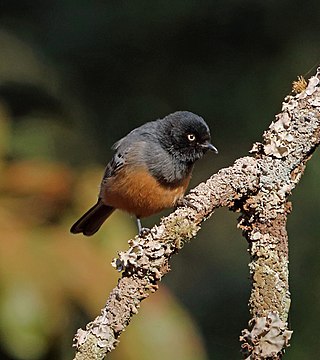
Melaniparus is a genus of birds in the tit family. The species were formerly placed in the speciose genus Parus but were moved to Melaniparus based on a molecular phylogenetic analysis published in 2013 that showed that the members formed a distinct clade. The genus Melaniparus had originally been introduced by the French naturalist Charles Lucien Bonaparte in 1850. The type species was subsequently designated as the southern black tit. The name of the genus combines the Ancient Greek melas, melanos "black" and the genus Parus introduced by Carl Linnaeus in 1758.

The white-shouldered black tit, also known as the pale-eyed black tit, is a passerine bird in the tit family. It breeds in a belt across Africa from Senegal in the west to Kenya and Ethiopia in the east. It is sometimes considered conspecific with the more southerly white-winged black tit Melaniparus leucomelas and, like that species, it is mainly black with a white wing patch, but differs in that it has a pale eye.

The Caspian tit is a passerine bird in the tit family. It breeds in the deciduous mountain forests of northern Iran, just extending into Azerbaijan.

The Indian black-lored tit, Indian tit, or Indian yellow tit is a passerine bird in the tit family Paridae. The yellow-cheeked tit is probably its closest relative, and both may be related to the yellow tit. These three tits almost certainly form a distinct lineage as evidenced by morphology, and mtDNA cytochrome b sequence analysis. The subgenus name Macholophus may apply for them.
A tomtit is a species of passerine bird in the family Petroicidae found in New Zealand.