Toothache tree may refer to one of several American trees:
Aralia spinosa, commonly known as devil's walking stick, is a woody species of plant in the genus Aralia, family Araliaceae, native to eastern North America. The various names refer to the viciously sharp, spiny stems, petioles, and even leaf midribs. It has also been known as Angelica-tree.
Zanthoxylum clava-herculis is a spiny tree or shrub native to the southeastern United States. It grows to 10–17 m tall and has distinctive spined thick, corky lumps 2–3 cm long on the bark. The leaves are glabrous and leathery, pinnately compound, 20–30 cm long with 7-19 leaflets, each leaflet 4–5 cm long. The flowers are dioecious, in panicles up to 20 cm long, each flower small, 6–8 mm diameter, with 3-5 white petals. The fruit is a two-valved capsule 6 mm diameter with a rough surface, and containing several small black seeds. The tree has also been called Z. macrophyllum. The genus name is sometimes spelled Xanthoxylum.
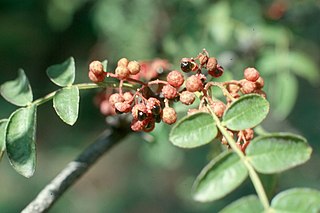
Zanthoxylum americanum, the common prickly-ash, common pricklyash, common prickly ash or northern prickly-ash, is an aromatic shrub or small tree native to central and eastern portions of the United States and Canada. It is the northernmost New World species in the citrus family, Rutaceae, and is the type species in its genus, which includes sichuan pepper. It can grow to 10 meters (33 ft) tall with a diameter at breast height (DBH) of 15 cm (5.9 in). It produces membranous leaflets and axillary flower clusters. The wood is not commercially valuable, but oil extracts from the bark have been used in traditional and alternative medicine, and have been studied for antifungal and cytotoxic properties. The genus name is sometimes spelled Xanthoxylum.
Aralia elata, commonly called Chinese angelica-tree, Japanese angelica-tree, and Korean angelica-tree, is a woody plant belonging to the family Araliaceae. It is known as tara-no-ki in Japanese, and dureup-namu (두릅나무) in Korean.
Hercules' Club may refer to:
Prickly ash may refer to:
Zanthoxylum simulans, is a flowering plant in the family Rutaceae, native to eastern China and Taiwan. It is one of several species of Zanthoxylum from which Sichuan pepper is produced.

The term Uziza refers to the dried fruit of the West African deciduous shrub Zanthoxylum tessmannii, syn. Fagara tessmannii, a member of the 'prickly ash' Zanthoxylum family. The name of the spice is derived from Igbo, a language in Nigeria, where the spice is grown and harvested on a commercial basis. Zanthoxylum tessmannii is a close relative of the Sichuan pepper, and Uziza has a similar taste profile to the Asian spice. However, unlike Sichuan pepper where only the pericarp of the fruit is used, uziza is used whole. This may explain why uziza has a spicier flavour and greater pungency than sichuan pepper.
Zanthoxylum oahuense, commonly known as aʻe or Oʻahu prickly-ash, is a species of flowering plant in the citrus family, Rutaceae, that is endemic to the island of Oʻahu in Hawaii. It is a small tree, reaching a height of 5 m (16 ft). Aʻe inhabits mixed mesic and wet forests at elevations of 580–800 m (1,900–2,620 ft). It is threatened by habitat loss.
Zanthoxylum ailanthoides, also called ailanthus-like prickly ash, is an Asiatic plant of the prickly-ash genus Zanthoxylum, natively occurring in forest-covered parts of southeastern China, Taiwan, Southeast Asia, and Japan from Honshu southward. The piquant fruit serves as a local "substitute for the ordinary red-pepper" in China. In Taiwan, the young leaves are used in cuisines.
Zanthoxylum fagara or wild lime, is a species of flowering plant that—despite its name—is not part of the genus Citrus with real limes and other fruit, but is a close cousin in the larger citrus family, Rutaceae. It is native to southern Florida and Texas in the United States, Mexico, Central America, the Caribbean, and South America as far south as Paraguay. Common names include: lime prickly-ash, wild lime, colima, uña de gato, and corriosa.
Zanthoxylum armatum, also called winged prickly ash, is a species of plant in the family Rutaceae. It is an aromatic, deciduous, spiny shrub growing to 3.5 meters in height, endemic to Nepal, China, Japan, Korea and Pakistan.
Zanthoxylum coriaceum is a species of flowering plant in the citrus family known by the common name Biscayne prickly-ash. It is native to the West Caribbean, including South Florida and the Florida Keys, Cuba, Bahamas, Cayman Islands, and Hispaniola.
Zanthoxylum rhoifolium is a species of tree in the citrus family known by the common names mamica de cadela, tambataru, and prickly ash. It is native to South America. It is a common tree on the Cerrado.
Zanthoxylum nitidum is a species of flowering plant in the citrus family. Common names include shiny-leaf prickly-ash. In Assamese it is known as tez-mui and tejamool. It is also called liang mian zhen.
Zanthoxylum schinifolium, also called mastic-leaf prickly ash, is a species of flowering plant in the Rutaceae, the citrus family, which, along with Z. simulans and Z. bungeanum is known as Sichuan pepper and used as a spice.
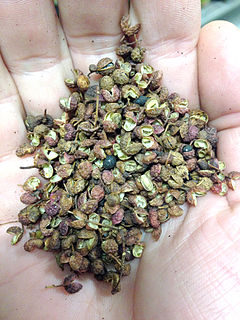
Sichuan pepper is a spice in Chinese cuisine that originates from the Sichuan cuisine of China's southwestern Sichuan Province. It has a unique aroma and flavor that is neither hot like chili peppers nor pungent like black pepper. Instead, it has slight lemony overtones and creates a tingly numbness in the mouth due to hydroxy-α-sanshool. It is commonly used in Sichuanese dishes such as mapo doufu and Chongqing hot pot, and is often added together with chili peppers to create a flavor known in Mandarin as málà.
| This page is an index of articles on plant species (or higher taxonomic groups) with the same common name (vernacular name). If an internal link led you here, you may wish to edit the linking article so that it links directly to the intended article. |