Related Research Articles

Andrzej Witold Wajda was a Polish film and theatre director. Recipient of an Honorary Oscar, the Palme d'Or, as well as Honorary Golden Lion and Honorary Golden Bear Awards, he was a prominent member of the "Polish Film School". He was known especially for his trilogy of war films consisting of A Generation (1955), Kanał (1957) and Ashes and Diamonds (1958).

Michael Sendivogius was a Polish alchemist, philosopher, and medical doctor. A pioneer of chemistry, he developed ways of purification and creation of various acids, metals and other chemical compounds. He discovered that air is not a single substance and contains a life-giving substance—later called oxygen—170 years before Scheele's discovery of the element. He correctly identified this 'food of life' with the gas given off by heating nitre (saltpetre). This substance, the 'central nitre', had a central position in Sendivogius' schema of the universe.
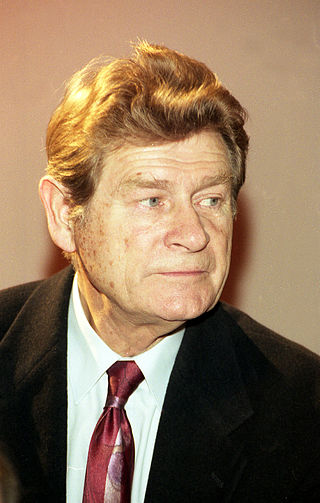
Stanisław Mikulski was a Polish theatre, television and film actor, and host of Koło Fortuny.

"La Tortura" is a song by Colombian singer-songwriter Shakira, featuring Spanish singer Alejandro Sanz, from Shakira's sixth studio album Fijación Oral, Vol. 1 (2005). It was released on 13 April 2005 by Epic Records as the lead single from the album. The song was written and produced by Shakira, with additional musical composition and production from longtime collaborators Luis Fernando Ochoa and Lester Mendez respectively. "La Tortura" is a song with prominent influences of reggaeton, and lyrically tells the story of a woman who has been emotionally "tortured" because her boyfriend cheated and eventually left her for another, and has now returned begging forgiveness. A Spanglish version of the song titled "La Tortura " is featured on the reissue of Shakira's seventh studio album Oral Fixation, Vol. 2.
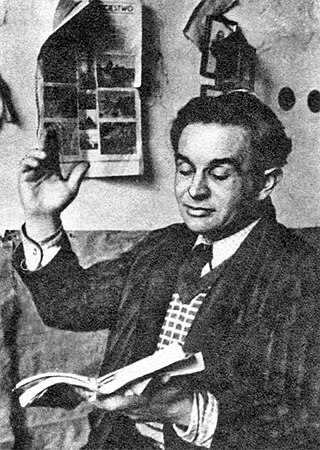
Konstanty Ildefons Gałczyński, alias Karakuliambro, was a Polish poet. He is well known for the "paradramatic" absurd humorous sketches of the Green Goose Theatre.

Moskwa is a Polish punk-rock band, created in 1983 by Paweł "Guma" Gumola, Piotr "Rogoza" Rogoziński and Tomek "Pałker" Gron (drums) in Łódz city.

Stanisław "Cat" Mackiewicz was a conservative Polish writer, journalist and monarchist.
Bohdan Urbankowski is a Polish writer, poet and philosopher.

Leon Stanisław Niemczyk was a Polish actor.

Witold Zalewski is a Polish writer, publicist and prosaist. During the Occupation of Poland he was a soldier of Armia Krajowa and participated in Warsaw Uprising. Zalewski was associated with conspiratory magazine Dźwigary, editorial board member of weekly magazine Pokolenie (1946–1947), publicist of Przegląd Kulturalny (1952–1963), publicist of Kultura (1963–1970).

Agnieszka Arnold is a Polish documentary filmmaker born 1947. She compiled two documentaries on the Jedwabne pogrom of Jewish villagers, during World War II, by their Polish neighbors.
Antoni Niemczak is a retired long-distance runner from Poland, who won the inaugural 1984 edition of the Vienna Marathon, clocking 2:12:17 on March 25, 1984. He finished in eighth place at the 1986 European Championships in Stuttgart, West Germany. His best marathon time is 2:09:41, which he ran on October 28, 1990, in the Chicago Marathon. He finished in second place with a margin of less than one second between him and Martin Pitayo. Antoni was ranked seventh in the world for the marathon in 1990, the same year he won the San Francisco Marathon.
Edward Stanisław Długajczyk is a Polish historian. He is specializing in history of Upper Silesia in the 20th century.

Alicja Majewska is a Polish singer. From 1971 to 1974, she was a member of the band Partita as vocalist. In 1975, she received the main award at the National Festival of Polish Song in Opole. She was awarded a Grand Prix at the 1980 festival in Rostock, and was honored in Havana (1985). She received the "Gloria Artis" medal.

Polskie Radio Program III, known also as Radiowa Trójka or shortly Trójka is a radio channel broadcast by the Polish public broadcaster, Polskie Radio. It is a music station playing a wide variety of music from rock, alternative, jazz and others. It is broadcast on FM, via satellite and online. The studios are located at Myśliwiecka Street 3/5/7 in Warsaw.
The Republic of Ostrów was a short-lived autonomous republic in the Polish area of Ostrów Wielkopolski. The republic, declared on 10 November 1918, intended to liberate Poles from Prussia and the German Empire. It was formed about a month before the Greater Poland Uprising.

Republic of Hope is a 1988 Polish historical film created by Zbigniew Kuźmiński and written by Kuźmiński and Kazimierz Radowicz. Film is based on the miniseries The Republic of Ostrów which premiered on TVP on June 4, 1986.
Ewa Petelska was a Polish film director and screenwriter. She directed 26 films between 1951 and 1985. Her 1963 film Black Wings was entered into the 3rd Moscow International Film Festival where it won a Silver Prize. Her 1973 film Copernicus (Kopernik) was entered into the 8th Moscow International Film Festival where it won the Silver Prize.
Zbigniew Kuźmiński was a Polish film director and screenwriter. He was nominated for Polish Golden Lions and has received Gdynia Film Festival's Golden Talar Award in 1987, as well as many other accolades.
Trail of Hope: The Anders Army, An Odyssey across Three Continents is a history book about the World War II-era Polish Anders Army, written by the English historian Norman Davies. It was published by Osprey Publishing in 2015. The book was published in English and Polish same year.
References
- ↑ Tortura nadziei at the Filmpolski.pl (in Polish)
